
“Foldit” is a software program exploring protein folding—or perhaps more accurately, a “game.” Whether it’s entertaining depends entirely on personal taste. The following slogan is Foldit’s official tagline, expressing its core design premise clearly and succinctly: to “play” with science.
Foldit is a revolutionary new computer game enabling you to contribute to important scientific research.
My earliest encounter with distributed computing research dates back to around 1997. At the time, I was fascinated by hacker culture and happened to be developing campus BBS bulletin boards. Having administrative access to several computer labs and classrooms allowed me to experiment with distributed computing architectures. That said, my programming skills never developed remarkably, so I didn’t pursue that specific research angle much further.
My first experience with truly impactful distributed computing came in late 1999 when I discovered “SETI@home.” Back then, I secretly installed the client on virtually every machine I could get my hands on—campus labs, classrooms, computers I repaired or built for friends, and even public terminals encountered while out shopping. As a result, computation credits accumulated rapidly. Unfortunately, I took a long hiatus, and when I tried to log back in two years ago, I had forgotten my login credentials (crying). Part of the reason was that SETI@home migrated to the BOINC platform, and since my original registration email was tied to an old university address that expired after graduation, retrieving a password reset became impossible.
Today, nearly all mainstream scientific distributed computing initiatives operate via the BOINC platform. BOINC stands for the Berkeley Open Infrastructure for Network Computing. Originally developed specifically for SETI@home, its exceptional algorithmic efficiency soon led to adoption across mathematics, medicine, astronomy, meteorology, and more. According to statistics, as of April 30, 2010, BOINC boasted approximately 577,000 active hosts worldwide, delivering an average computing capacity of roughly 5,173 TeraFLOPS (TFLOPS).
What I am introducing today, however, is an entirely different take on distributed computation: Foldit—literally “fold it” (smiles). Before diving into Foldit itself, we should briefly understand what protein folding actually is.
A protein is a complex organic compound formed by linear chains of amino acid residues linked by peptide bonds between carboxyl and amino groups. The amino acid sequence of a protein is encoded by its corresponding gene. In addition to the 20 “standard” amino acids encoded by genetic code, certain residues in a protein can undergo post-translational modifications that alter chemical structures, thereby activating or regulating the protein. Multiple proteins often assemble into stable protein complexes to carry out specialized biological functions, participating in virtually every cellular process—such as enzymes. (Source: Wikipedia)
A protein’s primary structure refers to its amino acid sequence. Due to characteristics such as hydrophilicity, hydrophobicity, positive and negative charges of the amino acid residues, interactions among these residues fold the chain into a three-dimensional tertiary structure.
As illustrated in the diagram below, according to the research of Christian B. Anfinsen (recipient of the 1972 Nobel Prize in Chemistry), proteins can be denatured by heat or specific chemical environments, causing their tertiary structure to unravel. When conditions return to physiological baseline, the protein refolds into its native 3D conformation in under a second. No matter how many times the experiment is repeated, the protein adopts only that single native structure. Anfinsen thus formulated his thermodynamic hypothesis: “the primary structure of a protein completely determines its tertiary structure.”
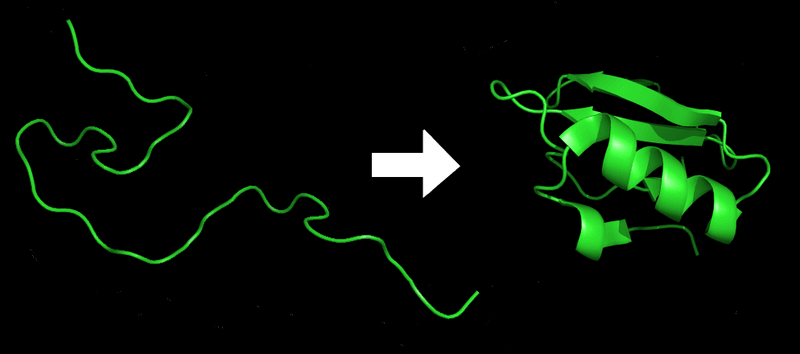
Anfinsen’s findings are profoundly significant: a protein’s biological function is governed strictly by its 3D spatial conformation. Today, known gene sequences allow us to transcribe and translate corresponding amino acid sequences—the primary structure. If the 3D conformation could be predicted directly from the primary sequence, researchers could deduce biological functions straight from raw genetic code. Yet while nature folds a protein in milliseconds, computational biologists cannot easily calculate 3D structures from linear amino acid sequences in reasonable timeframes, let alone obtain exact atomic coordinates. Consequently, unraveling the protein folding mechanism has become known as cracking the second genetic code: the “folding code.”
Currently, in vitro protein refolding protocols typically denature proteins using guanidine or urea, then gradually dial down the denaturant concentration, reducing interference with the protein’s innate folding propensity so it returns naturally to its minimum free-energy state. However, this process cannot effectively suppress misfolding interactions within and between peptide chains. Thus, despite general conformational rules being understood, ab initio protein structure prediction continues to demand immense computational power.
The Protein Folding Game
So where does Foldit fit into the picture?
Strictly speaking, Foldit is not a conventional passive distributed computing client. Its creator, the Baker Laboratory at the University of Washington, is also the team behind “Rosetta@home,” a major protein structure prediction project running on BOINC. Foldit provides a structured tutorial sequence that lets players manipulate simplified protein-like models, periodically pushing new puzzles based on real-world unresolved or benchmark protein structures. Using interactive toolsets, players solve puzzles and construct realistic molecular configurations. Whenever a structure is manipulated, a “score” reflects conformational optimization based on thermodynamic stability.
Foldit harnesses the human brain’s natural aptitude for spatial 3D pattern recognition. While early puzzles are based on proteins with known crystallographic structures, analyzing the intuitive heuristics players use to solve these spatial challenges enables researchers to refine the search algorithms used in automated prediction pipelines.
How to Play Foldit
First, head to the official website to download the client (available for PC and Mac). Run through the standard installation process, and launch the program.
Initially, the game presents several tutorial puzzles. As you advance through levels, more tools unlock, gradually populating a toolbar in the lower-left area of the screen comprising three primary tool palettes:
- Actions: includes Shake Side-chains, Wiggle All, Freeze Protein, Remove Bands, Disable Bands, and Reset Puzzle.
- Undo: includes Undo, Redo, Clear, Restore Very Best, Restore Crdt Best, Restore Rcnt Best, Set Rcnt Best, and Graph Properties.
- Menu: includes Puzzle Menu, General Options, Save Solution, Open/Share Solutions, Save Screenshot, and Save and Exit.
Among these, Shake Side-chains under Actions automatically optimizes the rotamer orientations of amino acid side chains to minimize energy, while Wiggle All automatically refines backbone conformations to lower steric strain. The full suite of tools unlocks during active gameplay puzzles. In addition, an in-game global chat window is located in the lower-right corner, letting players connect and exchange strategies across the globe.
As seen from the toolset, Foldit provides an array of automated helper algorithms. The goal is to blend automated computation with human intuition and spatial imagination to bolster algorithmic efficiency, so novices need not worry about getting hopelessly stuck.
Yet seasoned players set impressive benchmarks. In my first actual puzzle attempt, using automated scripts brought me to a respectable score of 9,309, placing me only at rank 336—the global leader stood at 11,488 points (lol), and this was merely a beginner-tier puzzle. However, after making some bold, counter-intuitive manual adjustments, my score surged to 9,385, climbing to rank 285. Perhaps that captures the developers’ original vision: tapping into spontaneous human ingenuity to discover shortcuts algorithms might never find on their own.
Download the client: Foldit Download.
Support Independent Perspectives & In-Depth Insights
Every thoughtful analysis and candid critique comes from our dedication to truth and quality. We choose not to follow sensational algorithms or clickbait headlines.
Sustaining independent research requires reader support. Make a one-time or monthly contribution, securely processed by Google.
Payments secured by Google · Manage or cancel anytime in your Google Account



Comments