
Beginning this May, whenever the Central Weather Bureau of the Republic of China (ROC) detects an earthquake with a magnitude of 5.0 or greater and an estimated seismic intensity of Level 5 or higher, it will immediately utilize the Public Warning Cell Broadcast Service (PWS) to send real-time earthquake early warnings and earthquake reports to smartphones in heavily affected areas. This gives the public crucial seconds to react and evacuate, minimizing potential loss of life and property damage caused by natural disasters.
The Executive Yuan noted that due to abnormal global climate trends in recent years, the frequency and destructive power of natural disasters have surged dramatically. Situated along the seismic rim of the western Pacific, the nation faces frequent earthquakes and typhoons, making early warning systems vital. To safeguard the lives and property of citizens, the Executive Yuan instructed the Office of Disaster Management on February 21, 2013, to build a public warning system, deploying disaster alert messaging across Taiwan Island, the Penghu Islands, the Kinmen Islands, and the Matsu Islands.
According to the Executive Yuan, the PWS Public Warning Cell Broadcast Service, overseen by the National Communications Commission (NCC), has integrated earthquake data from the Central Weather Bureau. Starting immediately, eligible smartphones will receive free broadcasts of two alert categories: “Earthquake Early Warning” and “Earthquake Report,” enabling citizens to take protective measures at the earliest possible moment.
However, due to technical hardware constraints in legacy infrastructure, the earthquake emergency alert SMS can only be received free of charge by 4G smartphones. While 2G and 3G mobile networks support emergency SMS messages, their transmission capacity is capped at 2,000 messages per minute—far too slow for high-volume, time-critical public alerts.
Currently, owners of compliant 4G smartphones (such as Apple’s iPhone SE and iPhone 6s) can receive official Presidential Alerts and Emergency Alerts natively without installing extra apps or adjusting system settings.
The Executive Yuan advised that when an alert is delivered, the phone will sound a distinctive tone accompanied by intense vibration. Citizens should remain calm and immediately take appropriate shelter. Additional alert feeds—including debris flow warnings and emergency road/bridge closure notices—are scheduled to roll out progressively before July.
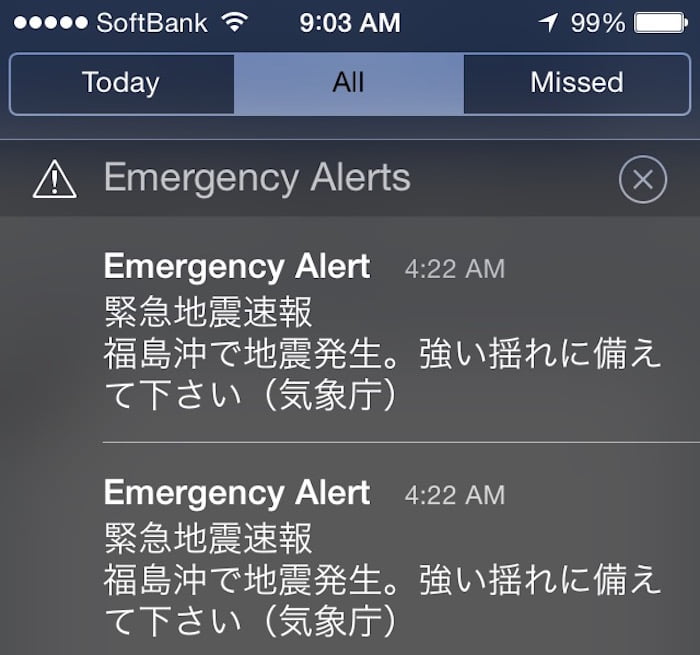 Disaster warning SMS alert service in Japan.
What Is the Public Warning System (PWS)?
The Public Warning System utilizes the Cell Broadcast Service (CBS) capability of 4G mobile networks. It enables disaster management agencies to broadcast emergency notifications simultaneously to all 4G smartphones located within a specific geographical cell tower footprint within seconds, providing timely updates for prompt evacuation and disaster mitigation.
Which Smartphone Models Support Full Presidential Alerts?
In addition to 4G handsets (or 3G handsets equipped with 4G SIM cards), 21 smartphone models have completed the required firmware updates. Alongside Apple’s full supported lineup (iPhone 5c, 5s, 6 Plus, 6s, 6s Plus, SE), supported models include HTC’s Desire 530, Desire 825, and Desire 628; Samsung’s Note 4 and Note 4 Edge; LG’s G5, Stylus 2, and K8; OPPO’s F1, R7 Plus, and R7s; Acer Liquid Jade 2; Xiaomi’s Redmi 3; and the Nextbit Robin.
Furthermore, an additional 43 models of 4G phones can receive alerts once their manufacturers release software and firmware updates. Consumers can verify whether their device is compatible on the NCC Certification Query page by entering the handset’s certification number, brand, or model name and checking the notes column.
Why Can’t Emergency Alerts Use Standard SMS?
Mobile carriers currently offer three text transmission methods: Short Message Service (SMS), Multimedia Message Service (MMS), and Cell Broadcast Service (CBS).
While standard SMS and MMS are familiar to most mobile users, they operate on a point-to-point (one-to-one) transmission architecture. During a major disaster, millions of concurrent SMS messages would overwhelm cellular networks, resulting in massive bottlenecks and unacceptable delivery delays. Consequently, modern international emergency management systems universally employ Cell Broadcast Service for mass public alerts.
Why Might a Phone Miss an Emergency Alert?
While the system is constantly being optimized, the Executive Yuan noted circumstances under which a 4G device might fail to receive an alert broadcast:
- Active voice call: The user was on a voice call when the alert went out (unless using 4G VoLTE); legacy 3G voice calls block incoming broadcast alerts.
- Active 3G data connection: The device was transmitting data over a 3G network, including background app sync. (Connecting to Wi-Fi at home or the office, or turning on mobile power-saving features to sleep background 3G connections, can help avoid this limitation. Note that this restriction does not apply to active 4G data).
- Flight mode or missing SIM: The handset was in Airplane Mode or had no active SIM card installed.
- Alert settings toggled off: The user manually disabled “Alert Notifications,” “Emergency Alerts,” or “Test Messages” in system settings (all are enabled by default).
- Pending firmware update: The phone lacks the necessary firmware patch to decode all disaster warning broadcast channels (primarily affecting phones certified before March 1, 2016).
Can a 3G Phone with a 4G SIM Card Receive Alerts?
The disaster alert broadcast is a statutory free service provided by 4G mobile carriers. Because many voice calls still rely on Circuit Switched Fallback (CSFB) to 3G WCDMA networks, the NCC required 4G carriers to support CBS alerts on 3G WCDMA networks as well.
Consequently, a 3G phone using a 4G SIM card can still receive emergency disaster alerts while in standby mode, provided the device hardware supports CBS reception.
The Unique Ringtone and Sound Pattern of Public Alerts
Emergency alert notifications feature a dedicated, unalterable sound and vibration profile distinctly different from regular text messages:
- Audio frequencies: Dual-tone alerts mix fundamental frequencies of 853 Hz and 960 Hz simultaneously; devices supporting single tones output a 960 Hz pure tone.
- Cadence: The alert pattern consists of two sound sequences separated by a 0.5-second pause. Each sequence includes one 2-second blast followed by two 1-second tones, with 0.5-second intervals between them, repeated twice.
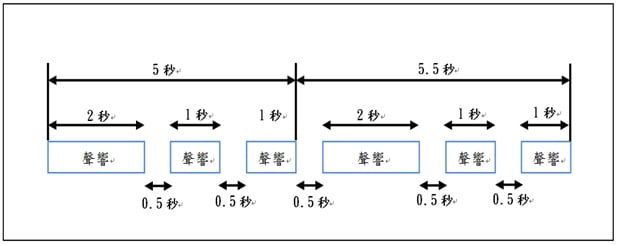 Frequency and time-domain acoustic profile of the disaster emergency warning tone.
References
- Central Weather Bureau: Earthquake Information.
- NCC Equipment Certification Database.
- NCC Public Warning Cell Broadcast Service Portal.
Support Independent Perspectives & In-Depth Insights
Every thoughtful analysis and candid critique comes from our dedication to truth and quality. We choose not to follow sensational algorithms or clickbait headlines.
Sustaining independent research requires reader support. Make a one-time or monthly contribution, securely processed by Google.
Payments secured by Google · Manage or cancel anytime in your Google Account


Comments