

Recent smartphone scams have mostly clustered around messaging platforms such as Facebook, Skype, and Line. Line in particular had notoriously lax security, and lately one could constantly see friends on Facebook sharing news of being hacked[1].
To test this, I specifically disguised myself as a scam ring member and sent scam messages to my friends on Line, aiming to train their everyday security awareness.
For example, my latest message read: “Dear valued customer, your digital certificate has expired. For your online security, please visit https://example.com/update immediately to renew your certificate. Thank you.”
This message actually drew a wide variety of responses—I can only describe them as hilarious (table-flip: one silly fellow actually asked me to perform a seductive dance for him).
Two Common Types of Mobile Phone Scams
Type 1: Hijacking and Impersonation
In the first approach, fraudsters breach a Line account to gain control, and then use that hijacked account to ask the owner’s “real friends” to buy GASH gaming point cards or receive telecom small-amount carrier billing confirmation SMS codes on their behalf.
If it is a point card scam, success depends on whether the real friend actually runs to the store to buy the card, scratches off the code, and takes a picture or texts the verification code back to the hijacker.
If it is a carrier-billing SMS verification scam, success relies on whether the real friend relays the received SMS verification code to the fraudster.
Because ordinary spammers do not know your phone number in advance, they will repeatedly ask for your mobile number in chat[2], using excuses like their phone being broken or an emergency. Everyone should stay vigilant against this.
Because these two scam types risk being discovered quickly when the genuine user recovers their password, the scams usually display an urgent tone and readily switch targets when resistance is met, making them relatively easy to spot[3].
Type 2: Indiscriminate Spam Message Attacks
In this approach, scammers don’t even need to hijack existing accounts. They simply create a new account and blast spam messages indiscriminately.
For example, my friend received a message that read: “Your civil damages lawsuit notice. [Taipei District Court] https://example.com/notice”
When you tap the shortened URL in the SMS, it links to a Dropbox folder containing an APK file (Android Application Package File) disguised as “Notice”, sized at 260 KB.
 Online Scam: Notice.apk
Another friend received a similar SMS reading: “You are applying for online payment of the electricity bill totaling NT$9,800. If this was not authorized by you, please view the digital certificate to cancel: https://example.com/cancel”
Clicking that shortened URL led to something similar—an APK file on Dropbox named “Certificate”, sized at 108.01 KB.
This is precisely why I repeatedly tell friends never to carelessly root (or jailbreak / flash custom ROMs onto) phones and tablets for family and friends.
You might understand how the operating system works and know how to secure it, but your friends and family might not. They represent the high-risk demographic most vulnerable to malicious traps set by cybercriminals.
Similarly, I advise against rooting smartphones and tablets accessible to young children. Many casual games secretly recommend other mini-games during gameplay, and the devil is in the details: most recommended games are hosted on private servers rather than vetted through the Google Play review process, meaning malicious apps can easily be downloaded and run covertly on your phone[4].
For this kind of scam, success is defined by a user opening the link on a rooted phone or tablet, downloading the APK, and executing it[5].
However, this doesn’t mean non-rooted phones are completely immune, especially nowadays when some manufacturers enable root permissions out-of-the-box simply as a marketing gimmick.
After inspecting the aforementioned APK files, I discovered their command-and-control server was located in the Russian Federation.
If the Government of the Republic of China (ROC) wished to trace and investigate, it would encounter tremendous difficulties.
The known risk is that the infected phone will continuously upload the user’s phone contents and personal privacy data to the hacker’s servers, resulting in confidential data leaks and potential exploitation.
Suggestions for Scam Rings (Ducks for Cover)
The fraudsters have overlooked one key synergy: the two scam models above could actually collaborate.
Since one crew excels at breaching genuine accounts while another designs sophisticated APK backdoors, combining their efforts opens up new vectors. For instance, Friend A could send an APK link to Friend B, claiming it’s a new mobile game they developed and asking for quick beta testing.
Voila—I bet many people would eagerly click and install it.
Writing this made me realize: why hasn’t any of my friends had their account hacked to send me scam messages? It forced me to rely on second-hand materials from friends just to write this piece.
Follow-up Update
A few hours after publishing this article, I noticed that the shortened URL received by my friend had changed; upon accessing it again, Dropbox had blocked the file.
The official reason given was that the public file generated excessive traffic. That gave me quite a shock—it makes one wonder just how many people downloaded that file and fell for the scam!
Meanwhile, the other shortened URL’s file had been uploaded seven weeks prior and was still untouched. (Does that mean its copywriting was simply less convincing?)
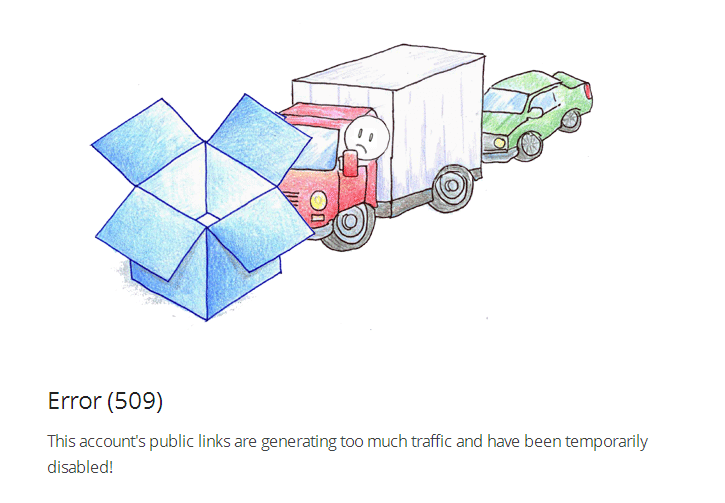 Dropbox: Error 509
References
- The phenomenon of messaging accounts being hijacked en masse also occurred previously with Skype; at the time, our analysis in 《Analysis and Explanation of Skype Account Hijacking Incidents》 pointed out vulnerabilities in the official system. The vulnerability was patched only after some time (around the period following Microsoft’s acquisition).
- Another vector operates through web pages. As mentioned previously in 《[Urgent Notice] New Facebook Scam Exploits Fake Contests to Steal SMS Verification Codes》, fraudulent contest entries requiring SMS verification are used to capture the victim’s authentication codes.
- In the article 《Tech Traps: Fraud Rings and Human Vulnerability—Long Live Warmth via Line and Facebook Messenger》, we discussed how to verify whether the person on the other end of the screen is truly your friend.
- Information Security: How to determine whether downloaded smartphone apps are safe.
- In the context of this specific scam technique, Apple’s iOS platform remains relatively much safer, as the vast majority of such attacks are currently targeted at Android.
Support Independent Perspectives & In-Depth Insights
Every thoughtful analysis and candid critique comes from our dedication to truth and quality. We choose not to follow sensational algorithms or clickbait headlines.
Sustaining independent research requires reader support. Make a one-time or monthly contribution, securely processed by Google.
Payments secured by Google · Manage or cancel anytime in your Google Account




Comments