

Like weeds in spring, scam campaigns never truly disappear. One wonders whether fraudsters read our tutorials, because the content of malicious SMS text messages has become remarkably versatile lately (see our previous guide, Tech Scams: Chatting About 1+1>2 Smartphone and Online Fraud Tactics). Even in an era where public vigilance is purportedly at an all-time high, countless people continue walking right into malware traps.
Over the past two days, I received two consecutive malicious SMS messages sent from different mobile numbers. A close look at their wording reveals how thoroughly rewritten they are: no longer relying on stiff, mechanical canned phrases, they now feature touches of conversational human warmth—as if fraudsters have any real warmth to offer!
Below, I have transcribed the full contents of both fraudulent messages in the hope of sharpening everyone’s guard.
First, an SMS sent from 0910527xxx read: "Is that you in the middle of this photo? I uploaded it to Chunghwa Telecom Cloud: http://cht.tw/h/u6xar".
The second SMS, sent from 0920772xxx, read: "You have a new message: http://cht.tw/h/sixd9".
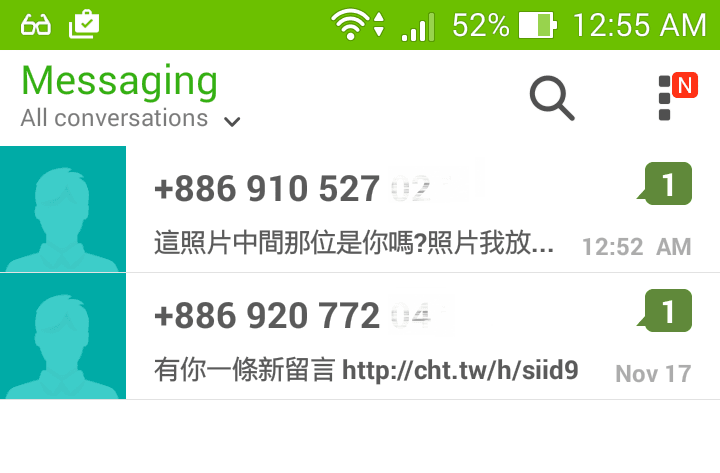 Figure 1: Receiving two consecutive scam SMS messages.
Did you notice what these two messages have in common?
I recall a news broadcast last month that erroneously branded all common URL shortening services (shorten URL services) as “malicious links,” which is a fundamental misconception.
For instance, both of these fraudulent messages used cht.tw as their redirect domain. However, that domain is simply the legitimate URL shortening utility provided by Chunghwa Telecom, which ended up unwittingly abused as a staging ground.
While I personally do not find Chunghwa Telecom’s shortening service as convenient as goo.gl or Oon.me, offering diversified tools is theoretically positive.
Still, being exploited by cybercriminals without proactive anomaly detection is deeply problematic. If anyone remembers, Chunghwa Telecom’s HiNet mail service once “ranked” among the top three sources of global spam.
Two completely different messages from two distinct senders, yet both utilized the exact same URL shortener. Moreover, these text snippets were carefully crafted to mimic natural remarks between friends, making casual recipients prone to acting impulsively.
Evolving fraud syndicates always seem capable of duping users who lack basic cybersecurity hygiene. Rather than abruptly ordering targets to click suspicious links, scammers now adopt modern marketing copywriting techniques—weaving curiosity-driven micro-narratives that compel recipients to instinctively do exactly what the syndicates “want” them to do.
It is also worth highlighting that these differing messages were not generated randomly by my phone. Instead, malware silently residing on other infected devices dispatched pre-configured copy from their built-in template libraries. This indicates that a non-trivial number of compromised smartphones are continually transmitting these spam messages across the telecom network.
The very first line of defense against fraud is cultivating fundamental cybersecurity principles: never passively carry out instructions delivered via unsolicited messages. Beyond keeping this rule in mind personally, educate the elderly members of your household never to click unfamiliar links, as seniors remain prime targets for predatory scam operations.
Since many older family members are unfamiliar with technical intricacies, rather than explaining complex phishing vectors, it is far simpler to teach them which specific trusted domains are safe to tap.
For example, trusted domains such as Vedfolnir.com (blush), Youtube.com, or standard www.Facebook.com are safe, representing typical content shared among their social circles. When total risk elimination is impossible, containment is key. However, caution them strictly against tapping subdomains like apps.facebook.com, as detailed in our earlier exposé: [Facebook Scam Alert] Security Warning! Your Account Has Been Reported for Violations…, which illustrated how malicious Facebook apps were deployed to hijack profiles.
References
- Website & Email Extortion Case: You Have Been Hacked, Pay Bitcoin to Ransom Privacy!
- Tech Scams: Chatting About 1+1>2 Smartphone and Online Fraud Tactics
- Are McDonald’s Taiwan Facebook Ads a Scam from Mainland China or Official Promotional Offers?
- What to Watch Out for When Receiving iCash Prize Notification SMS.
- Facebook Phishing Urgent Notice: Using Fake Photography Contest Info to Steal SMS Verification Codes
- Facebook Scam: Security Warning, Account Reported for Offensive or Insulting Behavior…
Support Independent Perspectives & In-Depth Insights
Every thoughtful analysis and candid critique comes from our dedication to truth and quality. We choose not to follow sensational algorithms or clickbait headlines.
Sustaining independent research requires reader support. Make a one-time or monthly contribution, securely processed by Google.
Payments secured by Google · Manage or cancel anytime in your Google Account



Comments