
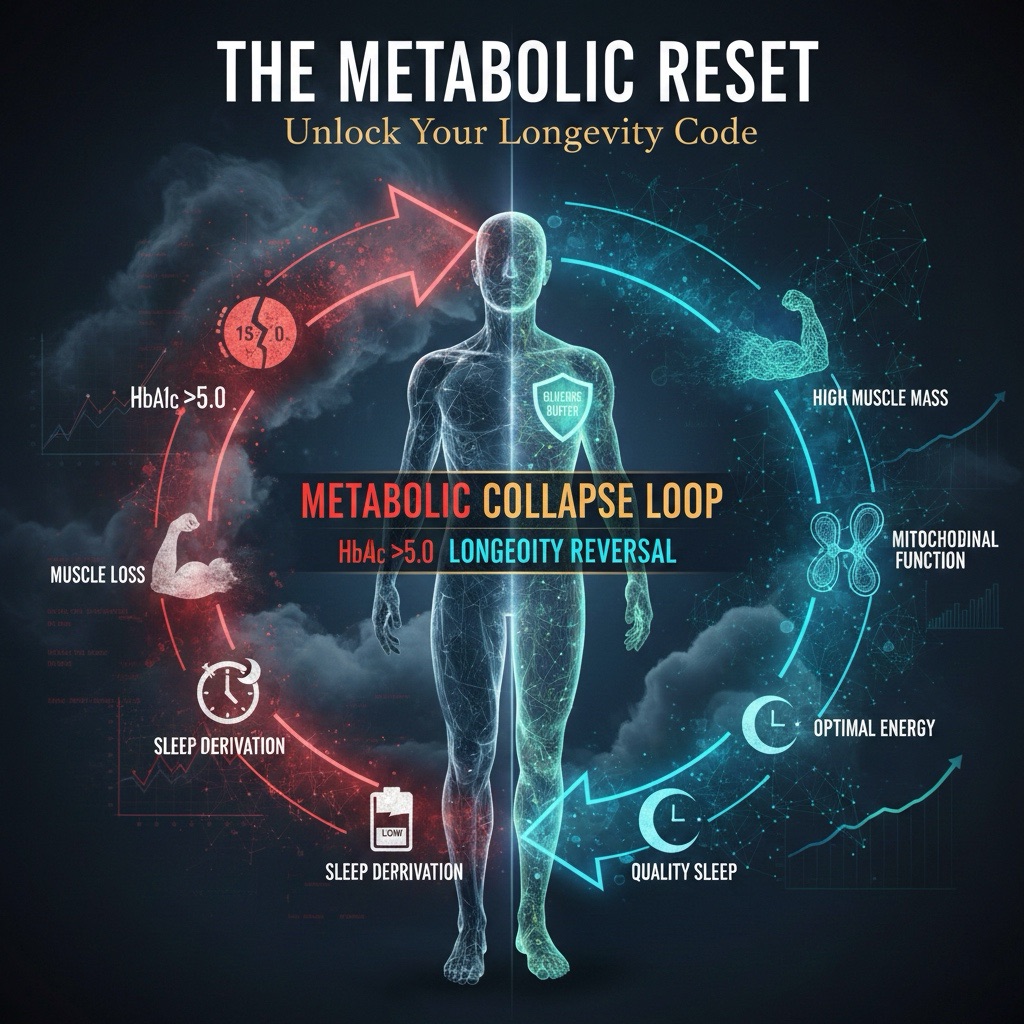
We often hear older adults remark: “Now that I am older, my metabolism has slowed down; no matter how little I eat, I still gain weight.” While clinically accurate in observation, the underlying etiology is widely misunderstood.
The primary driver of metabolic deceleration is not inherent organ degeneration, but rather that your skeletal muscle has atrophied, and whatever remaining muscle you have has become “hard of hearing.”
This is the hidden culprit behind late-life hyperglycemia and frailty: sarcopenic insulin resistance.
1. The Silent Threat: Sarcopenic Obesity
Many older individuals appear slender in their limbs and register normal readings on bathroom scales, yet their diagnostic panels show elevated fasting glucose, high HbA1c, and non-alcoholic fatty liver disease.
This represents classic sarcopenic obesity. With aging, skeletal muscle fibers—particularly explosive, glycolytic Type II fast-twitch muscle fibers—are selectively lost and replaced by intermuscular adipose tissue.
- External presentation: Thinning arms and legs, accompanied by expanding abdominal adiposity.
- Internal consequence: Up to 70% of the body’s glucose disposal capacity is lost, leaving excess circulating glucose trapped in the bloodstream or deposited as visceral fat.
2. Cellular Hard-of-Hearing: Understanding Anabolic Resistance
Why can young adults gain muscle mass effortlessly through casual sports, whereas seniors can walk thousands of steps daily yet still experience worsening sarcopenia?
The root mechanism is anabolic resistance.
Envision muscle synthesis and glucose clearance as a molecular switch:
- In youth: This switch is razor-sharp. Consuming modest protein or undertaking light activity immediately turns on the mTOR pathway, driving nutrient uptake and myofibrillar repair.
- In aging: The switch becomes rusted and blunted. The exact same protein portion or low-intensity walking completely fails to trigger downstream signaling. The cellular machinery simply ignores the cue.
This carries a clear biological implication: as you age, you require a stronger signal (greater mechanical load and higher leucine concentrations) to achieve the exact same anabolic response that a youth attains effortlessly.
3. Why Casual Walking Fails to Rescue Your Blood Sugar
A pervasive health myth among older populations is that “any movement is sufficient,” leading many to rely solely on gentle daily walks in the park.
While walking confers undeniable cardiovascular and mental benefits, it is virtually ineffective for reversing sarcopenic insulin resistance.
The physiological reasons are straightforward:
- Insufficient intensity: Walking relies almost exclusively on Type I slow-twitch muscle fibers. However, age-related atrophy preferentially ravages Type II fast-twitch fibers, which serve as the primary engines of systemic glucose clearance.
- Absence of mechanical tension: Overcoming anabolic resistance requires mechanical tension. Only resistance training delivers the requisite cellular deformation to force GLUT4 translocation independent of classical insulin pathways.
4. Physiological Alignment: How to Broadcast a Clear Signal to Muscle
Because the cellular switch has grown resistant, our signals must become unmistakably clear. This does not mean reckless exertion, but rather applying deliberate, structured stimuli:
Training alignment: prioritize mechanical tension over arbitrary repetitions
- Strategy: Put down the miniature decorative dumbbells. Under safe supervision, select loads that challenge your musculature within an 8–12 repetition window.
- Objective: Recruit and awaken dormant Type II fast-twitch fibers that have atrophied from disuse.
Nutritional alignment: surpassing the leucine threshold
- Strategy: Seniors require substantially more protein per feeding bolus than younger counterparts. While 20g may suffice for a 20-year-old, older adults frequently require 30g–40g per meal.
- Key cofactor: Ensure adequate intake of leucine, the essential branched-chain amino acid that unlocks the mTOR anabolic gateway.
Recovery alignment: curbing chronic low-grade inflammation
- Strategy: Aging is accompanied by systemic low-grade inflammation (inflammaging), which exacerbates insulin resistance. Prioritizing deep sleep and an anti-inflammatory dietary framework is non-negotiable for tissue regeneration.
Conclusion
Aging is never an excuse to surrender physical strength; it is the most compelling reason to cultivate it.
Gentle compromises—such as eating less and avoiding exertion—consistently fail to resolve sarcopenic insulin resistance. Only progressive resistance training combined with threshold-exceeding nutrition can send an unmistakable survival signal to your biology, reversing muscle wasting and guarding your metabolic longevity.
Support Independent Perspectives & In-Depth Insights
Every thoughtful analysis and candid critique comes from our dedication to truth and quality. We choose not to follow sensational algorithms or clickbait headlines.
Sustaining independent research requires reader support. Make a one-time or monthly contribution, securely processed by Google.
Payments secured by Google · Manage or cancel anytime in your Google Account

Comments