
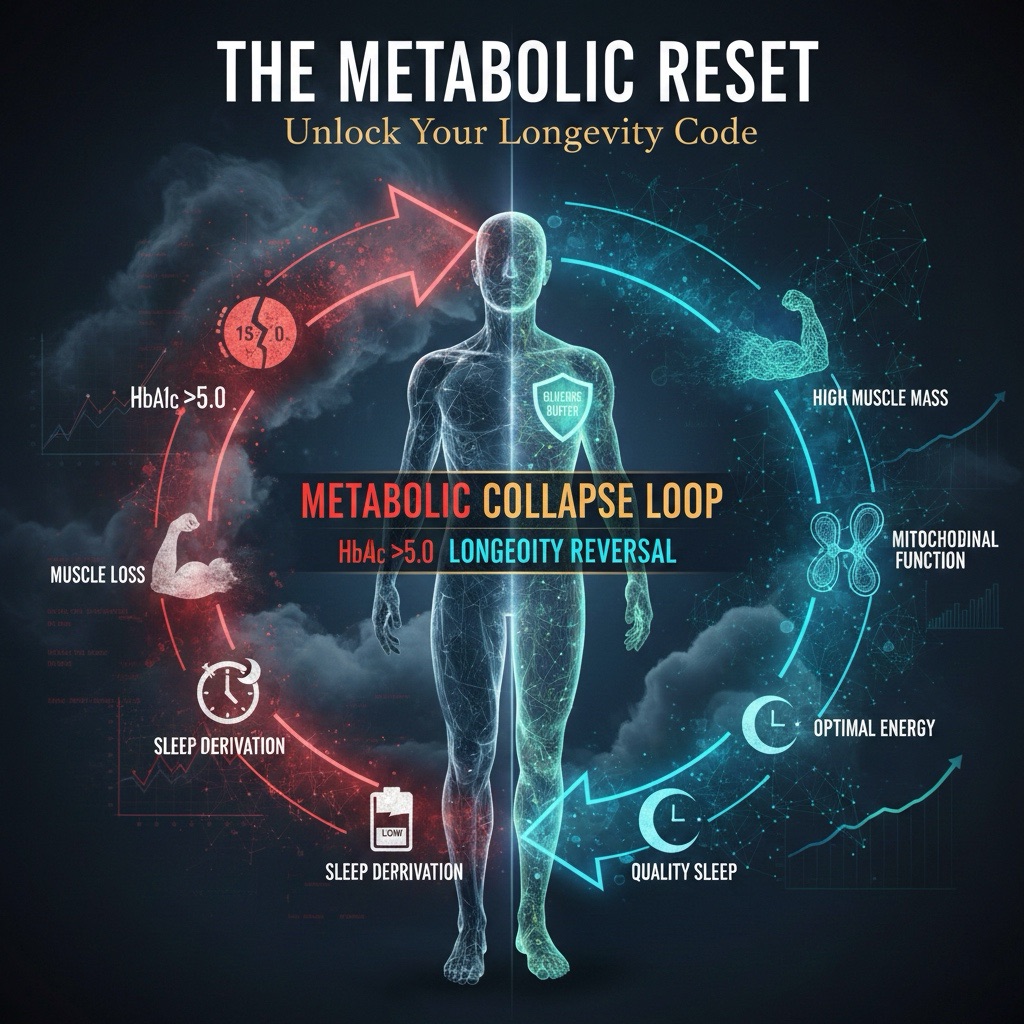
On your annual health check report, the standard range for glycated hemoglobin (HbA1c) is usually labeled as 4.0 to 5.6% for “normal.” If you receive a score of 5.2% or 5.4%, your doctor may tell you: “You’re fine, keep it up.”
But from the perspective of endocrinology and longevity science, once HbA1c exceeds 5.0%, your body is sending an early warning that its “metabolic buffer” is draining away.
1. HbA1c > 5.0 Is Not “Normal” — It Is “Barely Passing”
Why is the statistical “normal range” misleading? Because more than half of modern people have some degree of insulin resistance.
When your HbA1c sits at 5.2% or higher, it means your pancreas must secrete insulin more frequently and more forcefully than others just to keep blood sugar within range.
It is like an old car that must rev its engine into the red zone just to maintain 100 km/h. On the surface the speed is met, but the engine (your pancreas) is wearing out at an accelerated rate.
2. The Organ That Really Regulates Blood Sugar Is Actually Your Muscle
We habitually blame the pancreas for blood sugar problems, but in fact muscle is the body’s largest “blood sugar sink.”
- About 70–80% of all blood sugar in the body is handled by muscle.
- Muscle is the body’s largest warehouse for storing glycogen.
- The GLUT4 transporter proteins on muscle cells act like a “vacuum cleaner” that reclaims blood sugar.
In other words: high blood sugar is often not because you eat too much sugar, but because you have too little muscle.
When the capacity of your “sugar tank” shrinks, even a single unsweetened latte leaves the trace glucose your body produces with nowhere to go, forcing it to remain in the bloodstream and driving HbA1c ever higher.
3. Why “Eating Less” Cannot Save Your Blood Sugar
When many people discover their blood sugar is rising, their first reaction is to “eat less.” That is precisely where the tragedy begins.
When you fall into a prolonged low-calorie state (below your basal metabolic rate, BMR), the body detects a threat to survival and activates “threat mode”:
- Cortisol rises: to stay alive, the body begins breaking down muscle into energy.
- Gluconeogenesis: the liver actively manufactures sugar to feed the brain.
- Adaptive resistance: cells begin refusing to use blood sugar, reserving it for vital organs.
The result: you eat like a bird, yet your muscle melts away rapidly, and blood sugar refuses to fall because cortisol keeps pushing it up.
This is not illness — it is your body trying to “save” you, but with the wrong strategy.
4. The Reversal Strategy: Build Your “Longevity Buffer”
If you want HbA1c to return to the ideal 4.x% range and truly possess a longevity constitution, your goal should not be “eat less sugar” but “build a bigger sugar tank.”
- Resistance training is non-negotiable: only when muscle is stimulated by mechanical tension can the number of GLUT4 transporters increase, restoring the body’s ability to handle blood sugar.
- Stop aggressive fasting: take in enough protein and total calories to tell the brain “we are safe,” reducing cortisol interference.
- Muscle is your savings account: as you age, muscle synthesis becomes harder. Building muscle now is depositing a “buffer reserve” for your future metabolic health.
Conclusion
An HbA1c above 5.0 is not a demand that you cut sugar more strictly — it is a reminder that your body is weakening and needs more muscle to support its metabolic load.
True longevity is not the low blood sugar won through hunger, but the metabolic freedom supported by strong tissue.
Support Independent Perspectives & In-Depth Insights
Every thoughtful analysis and candid critique comes from our dedication to truth and quality. We choose not to follow sensational algorithms or clickbait headlines.
Sustaining independent research requires reader support. Make a one-time or monthly contribution, securely processed by Google.
Payments secured by Google · Manage or cancel anytime in your Google Account

Comments