
If you view physical exercise merely as a mechanism to “burn calories,” you are utilizing barely 10% of its clinical value.
Through the lens of longevity and metabolic medicine, resistance training is not about incinerating calories on a treadmill; it is about broadcasting systemic biological signals.
This signal communicates to your physiology: “The external environment is challenging; build a more robust metabolic engine.” And the master key that unlocks this evolutionary signal is “Mechanical Tension.”
1. Why Arm-Swinging and Light Pink Dumbbells Cannot Save Your Blood Sugar
Many older adults and diabetic patients display extraordinary dedication, performing hundreds of rapid arm swings, leg kicks, or waving light pink dumbbells every morning. While this high-volume, low-intensity activity promotes peripheral blood circulation, it suffers from fatal limitations regarding metabolic restoration:
- Recruiting Only Slow-Twitch Fibers: Light loads exclusively stimulate Type I slow-twitch muscle fibers. While they possess admirable fatigue resistance, their intracellular glycogen capacity is strictly limited.
- Inability to Stimulate GLUT4 Translocation Pathways: Without sufficient mechanical stretch and tension, cellular nuclei never receive the transcription cues demanding additional glucose transporter proteins.
- Failing to Overcome Anabolic Resistance: As explored previously, aging skeletal muscle exhibits biological “hardness of hearing”; soft whispers (light loads) fail to wake it up.
This explains why you can feel utterly exhausted from daily activity while your HbA1c remains completely unaffected. You are performing physical “labor,” not administering metabolic “therapy.”
2. Core Principle: Mechanical Tension > Training Volume
To transform skeletal muscle into an authentic longevity organ, you must prioritize mechanical tension.
This refers to the actual physical force exerted upon muscle fibers while they are contracting and lengthening under load.
- Ineffective Tension: Lifting a negligible resistance that you can casually perform for 50 repetitions. Before the target muscle fibers experience true strain, your joints or central nervous system fatigue first.
- Effective Tension: Moving a load where you are limited to 8–12 repetitions, with the final 2–3 reps demanding genuine effort and struggle.
It is precisely during this struggle that individual muscle fibers experience micro-structural strain, activating intracellular mTOR signaling pathways. This directly drives:
- Awakening of Type II Fast-Twitch Fibers: The body’s premier glucose reservoirs, and the exact muscle fibers most aggressively degraded by sarcopenia and aging.
- Fiber Hypertrophy: Expanding the physical volume of muscle tissue, drastically enlarging total glycogen storage capacity.
- Insulin-Independent Glucose Uptake: For 24 to 48 hours following high-tension resistance exercise, contracting skeletal muscle absorbs glucose directly from circulation without requiring insulin assistance.
3. The Longevity Training Prescription: Treat Resistance Training as Medicine
Because muscle acts as clinical medicine, we must attend meticulously to “dosage.” Below are the foundational rules for metabolic repair:
1. Focus on Controlled Eccentric Contractions
- Do not simply yank weights upward; the descent (the eccentric phase) is paramount. This phase generates the highest peak mechanical tension and yields the greatest adaptive remodeling stimulus.
- Cadence cue: 1 second concentrically, 2 to 3 seconds controlled eccentrically.
2. Intensity Benchmark: Rate of Perceived Exertion (RPE)
- You do not need to train to traumatic failure on every set, but you must approach within striking distance of it.
- If you finish a working set and can immediately browse social media without catching your breath, that set was metabolically ineffective. You should feel capable of completing perhaps 1 or 2 more clean repetitions, but definitively unable to complete a third (Reps in Reserve, RIR = 1–2).
3. Exercise Selection: Multi-Joint Compound Movements
- Set aside isolated single-joint movements like wrist curls or light kickbacks.
- Prioritize squats, hinges (deadlifts), pushes (presses), and pulls (rows/pulldowns). These fundamental movement patterns recruit the largest masses of skeletal muscle simultaneously, producing the most potent systemic metabolic signaling.
4. Frequency: 2 to 3 Sessions per Week Is Plenty
- High mechanical tension demands adequate recovery. In metabolically challenged individuals, chronic overtraining elevates systemic cortisol, neutralizing your gains. Train one day, rest one to two days, allowing muscle protein synthesis to unfold during deep sleep.
4. Redefining the True Purpose of Exercise
Never forget: we do not step into a gym to become hyper-shredded bodybuilders, nor to run ourselves into physical exhaustion on a cardio machine.
We enter to perform physiological “maintenance.”
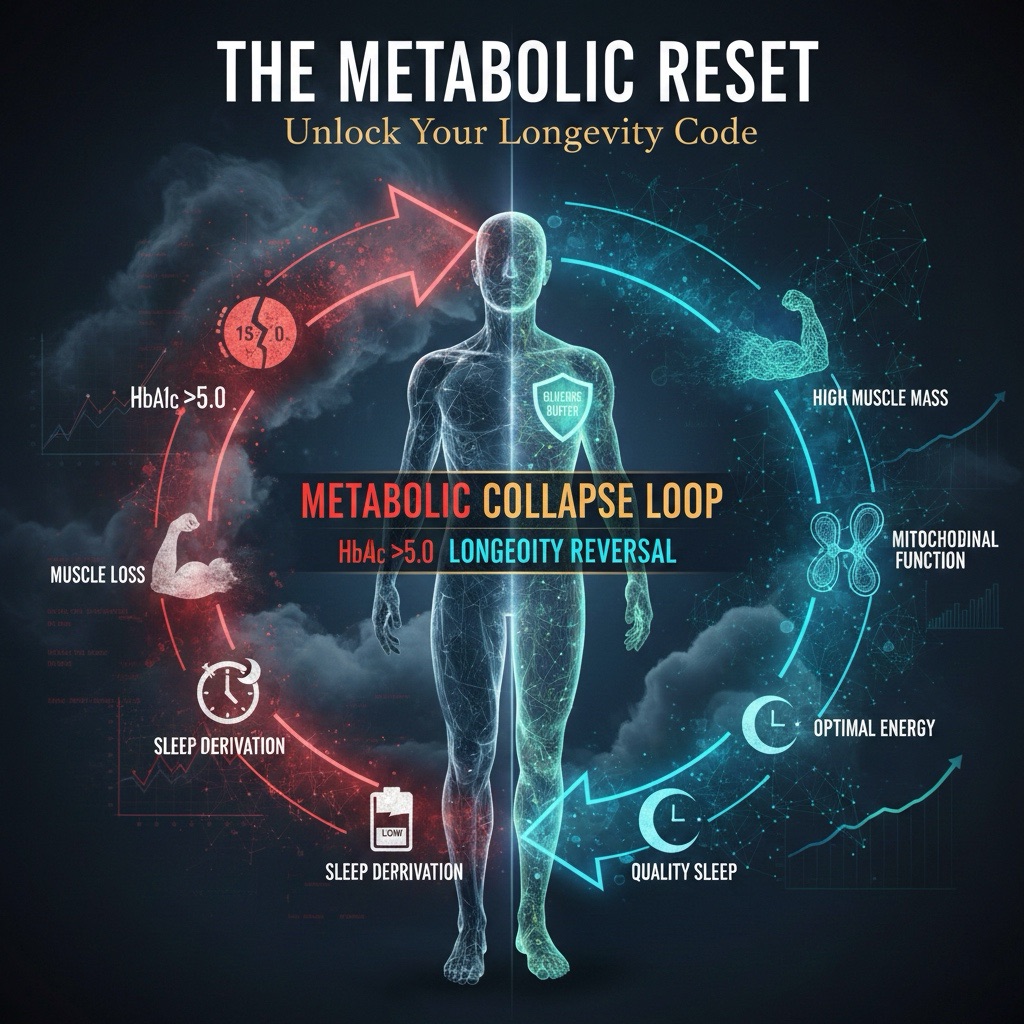
Every controlled press builds out your vascular glucose buffer zone; every deep squat forces sluggish cellular membranes to throw open their doors and absorb circulating nutrients.
Skeletal muscle is the sole longevity organ placed entirely under your voluntary command, and mechanical tension is its master ignition switch. Never let that switch rust away.
Support Independent Perspectives & In-Depth Insights
Every thoughtful analysis and candid critique comes from our dedication to truth and quality. We choose not to follow sensational algorithms or clickbait headlines.
Sustaining independent research requires reader support. Make a one-time or monthly contribution, securely processed by Google.
Payments secured by Google · Manage or cancel anytime in your Google Account

Comments