

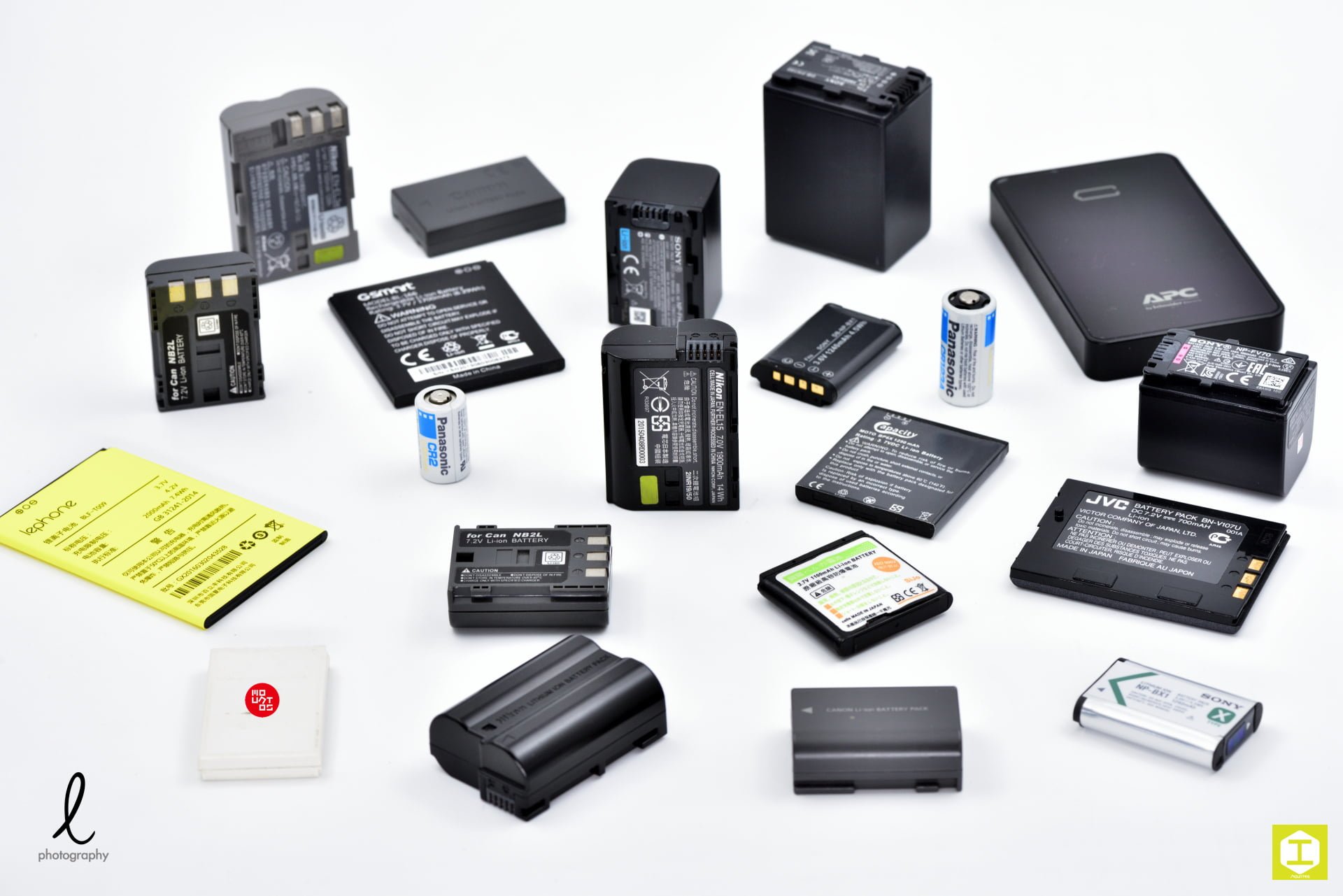
For enthusiastic DSLR and mirrorless photographers and heavy smartphone users alike, a timeless purchasing dilemma inevitably arises: Should you grit your teeth and buy expensive OEM original batteries, or settle for dirt-cheap third-party alternatives?
Walk into any camera district or browse online storefronts, and an original OEM lithium-ion battery frequently commands NT$1,500 to NT$2,500. By contrast, aftermarket alternatives can be had for just NT$300 to NT$500 apiece. Facing a staggering three- to five-fold price gap, many consumers quickly calculate the math: “For the price of a single original battery, I can buy four third-party spares! Rotating between them surely quadruples my shooting endurance, right?”
Yet behind this seemingly thrifty arithmetic lurk severe hardware flaws and safety traps that budget accessory sellers never mention.
Busting Myths: Two Common Third-Party Battery Marketing Ploys
Examine the retail packaging of generic aftermarket batteries, and you will find an abundance of reassuring jargon. But how much genuine substance backs up these grandiose claims?
Ploy 1: “Carefully Selected Imported AA-Grade High-Capacity Cells”
When raw lithium battery cells leave manufacturing facilities, they are indeed sorted into grades based on internal resistance, chemical purity, and discharge curves (such as Grade A, Grade B, and sub-par rejects). However, the label “AA Grade” is purely an invented marketing buzzword, not an international engineering standard.
Many rock-bottom third-party batteries utilize factory-rejected substandard cells, or even recycled second-hand cells stripped from discarded electronics and re-sleeved with fresh heat-shrink wrap. These low-tier cells exhibit poor thermal tolerance, internal resistance climbs precipitously with each charge cycle, and real-world capacity degrades far faster than expected.
Ploy 2: “Insured with NT$10 Million Product Liability Coverage”
Touting high-value product liability insurance is the favored trump card of generic consumer electronics brands. But keep this truth in mind: Insurance is simply a commercial tool for risk transfer; it NEVER equals certified product safety or build quality.
Securing a liability policy often requires a business to pay merely a nominal annual premium. In practical reality, if your smartphone catches fire or your camera’s mainboard fries, unless you can produce a legally valid, accredited forensic engineering report conclusively proving the battery cell directly triggered the catastrophe, receiving an insurance payout is nearly impossible.
The Hidden Cost of Penny-Pinching: 3 Critical Failure Modes of Third-Party Batteries
Original OEM battery packs are expensive not only because of brand markup, but primarily due to stringent cell binning, sophisticated fuel-gauge coulomb counter ICs, and flame-retardant polycarbonate enclosures. Budget third-party alternatives carry three major hidden hazards:
1. Swollen Batteries (“Pillow Pouch”) and Stuck Chamber Disasters
All lithium-ion chemistries can experience slight physical expansion after years of heavy cycling, but the incidence rate between OEM and cheap generic batteries is night and day.
Due to impure electrolytes and low-grade sealing gaskets, inferior aftermarket packs readily decompose internally when subjected to rapid charging heat or repeated high-discharge loads, generating gases that balloon the casing.
- On Smartphones: A swelling battery pushes against the display panel from within, lifting the glass, cracking fragile AMOLED layers, compromising water-resistant seals, and posing severe short-circuit fire risks.
- On Digital Cameras: Camera battery chambers are engineered with microscopic tolerances to snugly fit pack dimensions. When an aftermarket battery swells inside the bay, it becomes completely jammed and will not eject. Attempting to pry it out with pliers or tweezers risks puncturing the lithium pouch and triggering a thermal runaway explosion. Sending the body in for official service requires complete disassembly of the chassis, costing thousands in labor—completely wiping out any initial savings!
2. Inflated Specifications and Cliff-Drop “Phantom Power”
Many third-party packs are boldly stamped with 1200mAh or boast “Deluxe High-Capacity 1500mAh (20% more than OEM!).” Yet when hooked up to a calibrated laboratory battery analyzer, their genuine capacity often fails to reach even 900mAh.
Even worse is the discharge curve. High-grade OEM batteries maintain a smooth, steady voltage drop across their entire discharge cycle until fully drained. Inferior aftermarket packs, however, suffer sudden internal resistance spikes once their charge drops near 30%, causing voltage to plummet off a cliff. On your camera’s monitor, the battery indicator shows two bars of charge remaining, but the moment you press the shutter or shoot 15 seconds of video, the screen blacks out and forces an instant shutdown, causing you to irrevocably miss critical shots.
3. Reverse-Engineered Handshake Chips and Firmware Lockouts
Modern digital cameras from Sony, Canon, and Nikon incorporate bidirectional encrypted authentication chips inside their batteries. Third-party manufacturers rely on reverse-engineered clone chips to bypass these handshakes.
When camera makers issue official system firmware updates, the camera may suddenly display a stern warning: “Battery communication error; shutting down to ensure system safety.” Alternatively, the camera may power on but refuse to display battery percentage readouts, or disable in-body image stabilization (IBIS) altogether.
Comprehensive Comparison: OEM vs. Third-Party Batteries
| Evaluation Metric | OEM Original Battery | Third-Party Aftermarket Battery |
|---|---|---|
| Purchase Price | Premium (typically NT$1,500–2,500) | Low (approx. 1/3 to 1/5 of OEM cost) |
| Swelling Probability | Extremely low (pressure-relief valves, thermal seals) | High (swells under prolonged heat or rapid charging) |
| Capacity Accuracy | Honest, matches rated nominal capacity | Frequently inflated, actual runtimes fall short |
| Discharge Stability | Linear and predictable, precise fuel-gauge tracking | Prone to sudden voltage drops and unexpected shutdowns |
| Firmware Compatibility | 100% native handshake, covered by factory warranty | Risk of being rejected after camera system updates |
| Recommended Scenarios | Commercial gigs, weddings, critical travel, long 4K video | Lightweight casual backups when budgets are tight |
Unmasking the Truth: The Pay-to-Play “Quality Gold Award” Racket
Finally, we must address the prestigious-sounding “National Quality Assurance Golden Statue Award” or “Taiwan Top Quality Product Gold Medal Award” emblems that third-party battery brands love printing on their packaging.
Unsuspecting consumers seeing gleaming golden trophies paired with words like “National” and “Quality Assurance” naturally assume these represent government-backed product validations.
However, investigating the qualification requirements set by the private commercial associations hosting these ceremonies reveals conditions that are surprisingly mundane:
- A photocopy of the company or factory business registration certificate.
- No active intellectual property or trademark infringement convictions.
- Products self-developed, manufactured, or patented by the applicant enterprise.
- Lawful distribution of legitimate domestic or imported goods.
- Having previously received other commercial or industry honors.
- Paying substantial registration review fees and ceremonial sponsorship “tickets.”
Notice what is missing? Not a single criterion requires products to undergo actual laboratory stress testing—such as thermal baking, nail penetration, overcharge cycling, or vibration endurance inside a national standards facility!
This practice is fundamentally a paid public relations exercise between trade groups and manufacturers. Rather than relying on commercial trophy logos, savvy buyers should demand:
- Official certification markings and registration numbers from the Bureau of Standards, Metrology and Inspection (BSMI) under the Ministry of Economic Affairs (ROC).
- Genuine, verifiable laboratory safety reports from accredited international bodies such as SGS, ETC, or UL.
Conclusion: How Smart Shoppers Should Decide
This does not mean third-party batteries are inherently evil or devoid of value. If your budget is tight, purchasing reputable aftermarket batteries bearing legitimate BSMI certification from well-known accessory brands to carry as emergency spares when you unexpectedly run out of juice is a sensible, budget-friendly compromise.
However, never forget: Your primary, frontline workhorse batteries should always be OEM originals!
During weddings, once-in-a-lifetime baby milestones, international travels, or mission-critical commercial shoots, risking your entire camera body or suffering a dead black screen right before the shutter clicks to save a few hundred dollars is a tragic false economy. That missed moment costs infinitely more than any original battery.
Support Independent Perspectives & In-Depth Insights
Every thoughtful analysis and candid critique comes from our dedication to truth and quality. We choose not to follow sensational algorithms or clickbait headlines.
Sustaining independent research requires reader support. Make a one-time or monthly contribution, securely processed by Google.
Payments secured by Google · Manage or cancel anytime in your Google Account

Comments