
Sometime last year, my girlfriend mentioned coming across an intriguing electronic gadget called the “Raspberry Pi.” Seeing that I didn’t seem overly thrilled, the conversation quickly moved on. In my earlier academic research, our lab had developed comparable embedded systems primarily tailored for biomedical monitoring.
What makes the Raspberry Pi special is how it modularised computing hardware, paired it with robust software support, and packaged it into an accessible kit for enthusiasts and makers worldwide.
Beyond the Raspberry Pi, an expanding wave of developers has entered the hardware prototyping space, propelled by the widespread adoption of Google Android and ARM architectures. Examples range from Arduino to interactive modular circuit kits invented by MIT researchers using colour-coded logic blocks.
The primary aim of these platforms is abstracting away engineering complexity, freeing creators to dedicate their energies to pure innovation.
The earliest classic pioneer in this space was undoubtedly Lego and their iconic Lego Mindstorms ecosystem.
When discussing Raspberry Pi, the boards that initially built widespread market visibility were the Raspberry Pi Model A and Model B development boards shown in Figure 1, differing primarily in baseline performance and retail pricing.
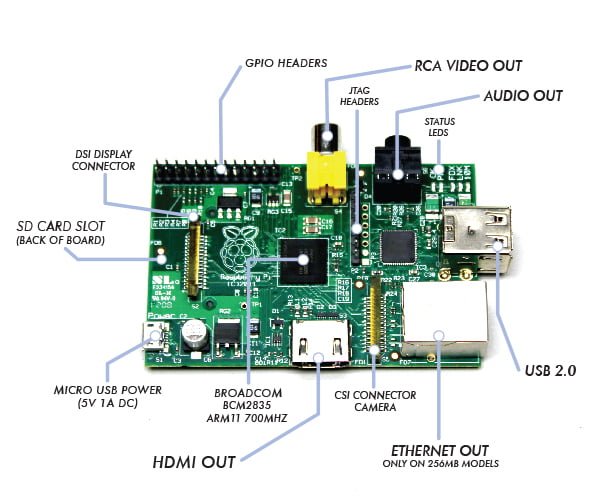 Figure 1: Raspberry Pi Model A/B circuit board features.
Yet the original A and B models are practically ancient history now. The latest release from the Raspberry Pi Foundation is the Raspberry Pi Compute Module Kit.
However, there is news that might give hobbyists pause: the pre-order price tag for this new kit is $229 USD—a sum easily capable of purchasing a decent standalone smartphone today.
For Pi beginners, that price might induce sticker shock. After all, the original Model A and Model B were famously positioned at budget-friendly price points of $25 and $35 USD.
Before jumping to conclusions, take a look at Figure 2, and let’s examine what this pricing entails and whether this kit fits your workflow.
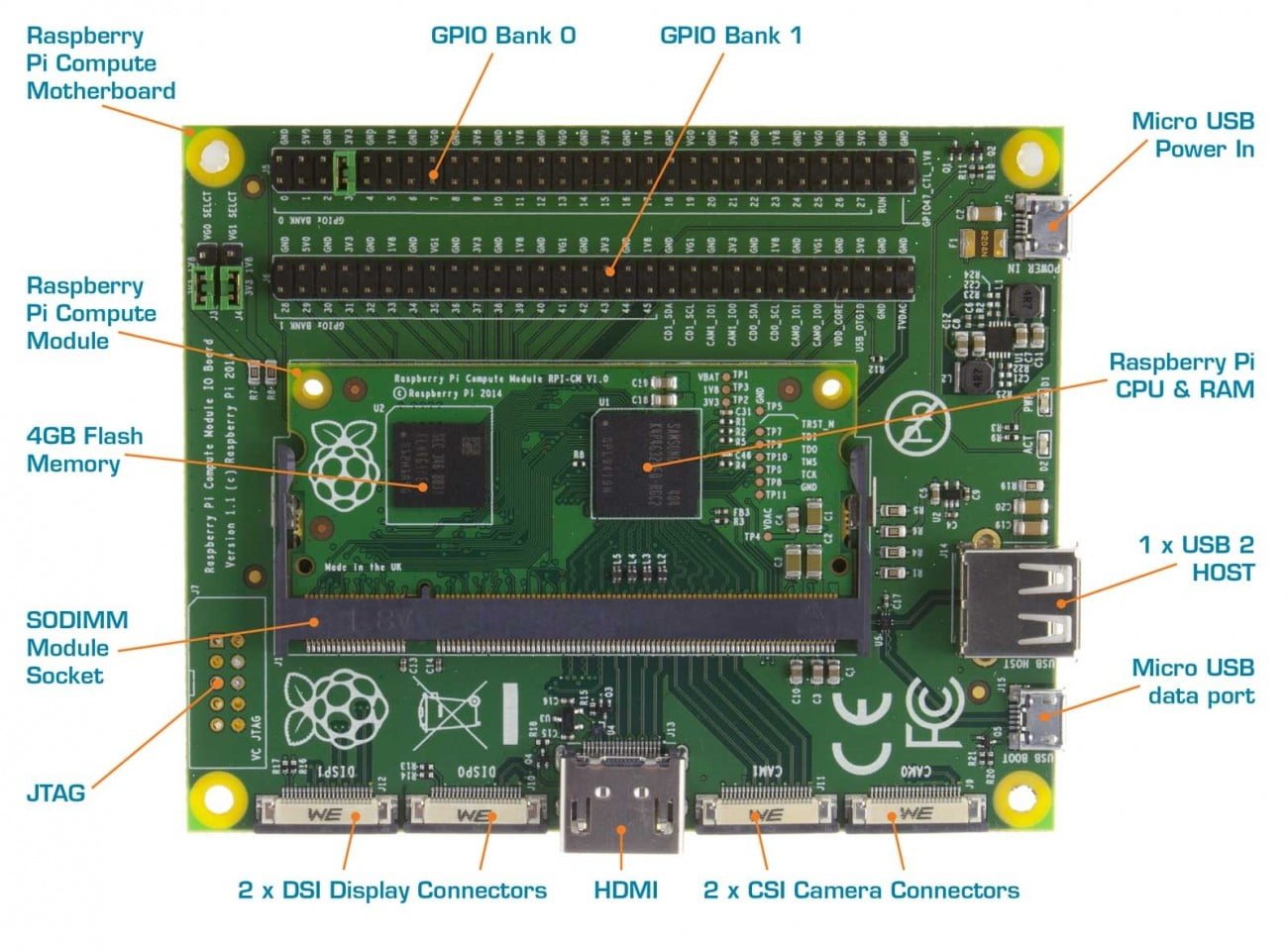 Figure 2: New Raspberry Pi board layout.
The Raspberry Pi Compute Module design closely mirrors the modular architecture our lab once built. The purpose is rapid prototyping and modular deployment. Aside from having the Raspberry Pi logo stamped on it, the fundamental distinction lies primarily in the SoC controller and firmware stack.
In this new iteration, the CPU and RAM are consolidated onto a compact Compute Module (CM) featuring a standard 200-pin SODIMM edge connector. The CM slots cleanly into an accompanying carrier board—the Compute Module IO Board (CMIO). The beauty of this modular design is that on a fully integrated board, few embedded projects ever utilize every peripheral header and port simultaneously.
Consequently, developers can prototype their concepts on the CMIO board, and once finalized, slot the compact Compute Module directly into their own custom carrier PCBs. This allows seamless mass replication across custom hardware while retaining the core Pi environment, eliminating the superfluous bulk and ports of the Model A/B boards.
In short, if you are architecting commercial IoT devices or complex embedded networks, the Raspberry Pi Compute Module Kit is designed specifically for you. Conversely, if you simply want an inexpensive media box, a torrent machine, or a casual desk toy, this kit is definitely overkill.
The reason the complete Raspberry Pi Compute Module Kit commands a $229 USD pre-order price is that in addition to the two boards shown in Figure 2, the bundle includes dedicated power supplies, display/camera adapter daughtercards, and flexible flat cables. The package contains:
- 1 x Quick start sheet
- 1 x Raspberry Pi Compute Module (CM)
- 1 x Raspberry Pi Compute Module IO Board (CMIO)
- 1 x Raspberry Pi CMIO to Raspberry Pi Camera adapter board
- 1 x Raspberry Pi CMIO to Raspberry Pi Display adapter board
- 2 x 22-way 0.5mm FFC cables (for camera and display adapter boards)
- 1 x 5V @ 2A power supply
- 1 x USB-A to micro-B data cable
Raspberry Pi System Specifications
Compute Module (CM)
- Broadcom BCM2835 700MHz ARM1176JZFS processor with FPU and VideoCore IV dual-core GPU
- GPU supports OpenGL ES 2.0, hardware-accelerated OpenVG, and 1080p30 H.264 high-profile decoding
- GPU capable of 1 Gpixel/s, 1.5 Gtexel/s, or 24 GFLOPs with texture filtering and DMA infrastructure
- 512MB SDRAM
- 4GB eMMC MLC Flash memory
- Direct access to all I/O pins via 200-pin edge connector
- Dimensions: 67 x 31 mm standard 200-pin SODIMM form factor
Motherboard (Compute Module I/O Board)
- Provides standard I/O breakout sockets for the Compute Module
- 200-pin SODIMM connector for Compute Module
- 4 x 30-pin headers (46 x GPIO, I2C bus, camera, power, and ground)
- GPIO logic level selectable via jumper link (1.8V or 3.3V)
- Full-size HDMI socket
- USB-A socket
- Micro-USB socket for flashing from an attached host PC and powering the unit
- 2 x CSI camera connectors
- 2 x DSI display connectors
- Footprint for JTAG debugging header
- Power LED indicator
- Boot Status LED indicator
Support Independent Perspectives & In-Depth Insights
Every thoughtful analysis and candid critique comes from our dedication to truth and quality. We choose not to follow sensational algorithms or clickbait headlines.
Sustaining independent research requires reader support. Make a one-time or monthly contribution, securely processed by Google.
Payments secured by Google · Manage or cancel anytime in your Google Account


Comments