
On October 20, 2006 (the 95th year of the Republic of China), Mizuc and his close friend Hsieh Tsung-hsiang (Kiding) joined forces to clean up visual clutter, synthetic mountaineering ribbons, and discarded trail litter along the Neiganzhai Historic Trail (also known as Maple Leaf Valley Waterfall or Balian Creek Waterfall), located in Sanzhi Township, Taipei County, Taiwan Province, Republic of China. This report documents our field observations and environmental takeaways.
Situated near Tamsui, the Neiganzhai Historic Trail is a scenic wilderness route that I often hike as casually as my own backyard. At the scenic waterfall marking the head of the trail, I even placed a hidden geocache (Geocaching treasure-hunting game; outdoor enthusiasts will immediately know the concept). The trail presents moderate difficulty. In earlier years, reaching the falls required scrambling across unstable landslide zones; nowadays, hikers have beaten a path tracing up a small creek past old stone ruins, significantly reducing the challenge.
In short, this is an accessible, moderately graded woodland trail. That brings up the obvious question: what on earth is that strange object propped against the rear bumper in the photo below?
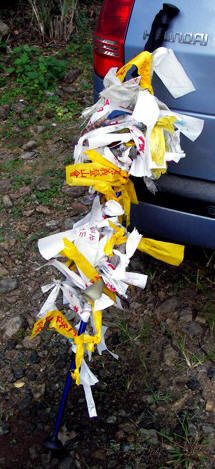
Mountaineering trail ribbons
Anyone with sharp eyes will recognize it as a mythical demon-slaying staff (major sarcasm).
In reality, the staff is an ordinary trekking pole bundled completely thick with salvaged plastic mountaineering ribbons (while shredded ribbons, bottle caps, and litter filled an entire heavy-duty garbage bag). For such a modest, short historic trail, finding this sheer volume of indiscriminately tied plastic ribbons was truly staggering.
As for the photo below that resembles a tree trunk, it is indeed an unfortunate living tree.
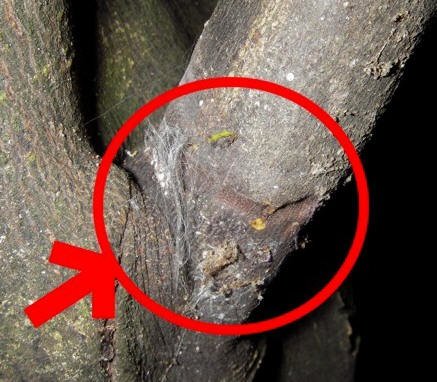
Mountaineering plastic ribbons damaging tree bark and branches
Looking closely at the photograph, one can clearly see that because plastic ribbons were tied tightly around the branch for years, the bark suffered severe constriction necrosis, forcing the branch to cease healthy lateral growth. It is directly comparable to tying a tight rubber band around a human finger or wrist—blood circulation ceases, tissue decays, and in extreme cases, surgical amputation becomes inevitable.
Those white, frayed filaments clinging to the bark are synthetic remnants left behind as brittle plastic degraded against the wood. Looking strikingly like spun sugar or cotton candy, can anyone really blame forest wildlife for fatally mistaking them for food?
Further Reading:
Support Independent Perspectives & In-Depth Insights
Every thoughtful analysis and candid critique comes from our dedication to truth and quality. We choose not to follow sensational algorithms or clickbait headlines.
Sustaining independent research requires reader support. Make a one-time or monthly contribution, securely processed by Google.
Payments secured by Google · Manage or cancel anytime in your Google Account



Comments