

A few weeks ago, BBC News reported on academic findings from the UK indicating that the number of mobile apps the average person regularly uses on their smartphone is only 5.
Meanwhile, an ABI Research survey published last year revealed that across all smartphones globally, the total lifetime app installations average 37 per device.
These statistics highlight a stark contrast: despite the sheer abundance of software across app stores on smartphones and tablets, actual everyday app engagement is shockingly narrow. Digital clutter and abandoned apps dominate the landscape.
At a time when cumulative global mobile app downloads have surpassed 35 billion, this discrepancy is striking. It means an immense amount of engineering effort and human ingenuity goes into apps that sit entirely forgotten on device home screens.
Interestingly, the United Nations announced in July of last year that global mobile phone subscriptions surpassed six billion—officially overtaking world population figures. To borrow popular science visualizations: laid end-to-end (assuming an average length of 10 cm), those phones could circle the Earth more than 15 times; stacked vertically (at 1 cm thickness each), they would build a tower equivalent to 118,110 Taipei 101 skyscrapers.
Regardless of whether one runs Google’s Android, Apple’s iOS, or rare alternatives like Windows Phone or BlackBerry, most people go on an exuberant installation binge during the initial “honeymoon” period after unboxing a new device.
Have you ever examined your own app consumption habits to see how long that honeymoon phase lasts?
Putting aside casual gaming hits—like Angry Birds or Candy Crush, which inherently display intense but short-lived fad cycles—productivity, utility, and social media apps tend to foster ingrained, long-term habits.
Speaking for myself: I use Facebook for social networking, Note Everything and Google Keep for notes, Google Maps for navigation, My Tracks for route tracking, WhatsApp, Facebook Messenger, and Skype for messaging, and Instagram for photo sharing.
While individual setups naturally vary, once we grow accustomed to, comfortable with, and proficient in a given tool, inertia takes hold. Unless an update severely degrades user experience, few users are eager to pay the switching cost of migrating workflows to an unfamiliar alternative.
A prominent example of this dynamic is the messaging sensation: “LINE”.
LINE gained viral momentum across Taiwan Province and broader Asia thanks to its expressive, cute sticker sets. Paired with early high-profile celebrity marketing featuring actress Kwai Lun-mei, LINE consistently commanded the number one spot among free downloads on Google Play.
Yet many users initially presumed LINE was an authentic Japanese export, an impression reinforced by early commercials. In truth, LINE’s parent company is rooted in South Korea (with ties to the Naver/Samsung ecosystem), where it was actually considered a secondary service compared to KakaoTalk.
When this background became widely known, certain users who held reservations stopped using the platform.
Concurrently, numerous domestic technology enterprises in Taiwan Province strictly prohibited employees from installing or running LINE during working hours to prevent proprietary trade secrets from being intercepted.
While the odds of active eavesdropping might appear low, when managing core industrial intellectual property, even a 1% risk cannot be tolerated. This precaution mirrors why government and defense personnel refrain from using tools like WeChat from mainland China on corporate devices.
Similarly, WhatsApp—a US competitor that was even more prominent than LINE at the time—recently announced plans to introduce annual subscription fees, prompting a wave of user churn. I was one of those who walked away, though because few in my immediate circle used it, the transition pain was negligible.
These two examples demonstrate that unlike the era when MSN Messenger held undisputed dominion, today’s market is a crowded battlefield where crown jewels are fragile.
This creates a serious conundrum for developers: market dominance is increasingly difficult to defend. Without securing intense, sustained user attention in the short term, any app is quickly supplanted or relegated to background obscurity.
Even when a development team successfully captures the public spotlight and secures venture backing, copycats and platform rivals emerge almost immediately.
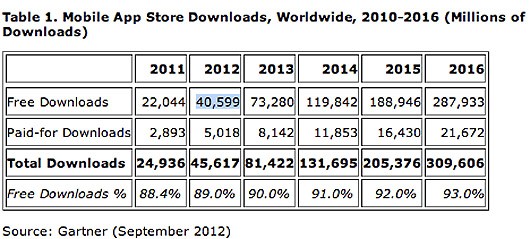
With the smartphone sector reaching maturity across hardware specs, software frameworks, and market penetration, Gartner projected global app store installations between 2010 and 2016 (shown below), predicting that free ad-supported applications would comprise over 90% of total downloads.
Yet despite the growing disparity between available apps and active usage, governments—including our own in the Republic of China (ROC)—continue to prioritize mobile app developer training as a major economic development pillar.
As noted earlier, however, the overwhelming majority of consumer apps flame out quickly. Sustainable commercial demand often gravitates toward short-lived promotional marketing apps that are vulnerable to price undercutters. It is difficult to envision independent studios extracting reliable margins under such cutthroat bidding.
Furthermore, aggressively subsidizing developer bootcamps risks creating an oversupply crisis, reminiscent of past initiatives that saturated the market with electrical engineering graduates.
For ambitious startups betting on mobile software amid the “free app” tidal wave: how many teams can afford the capital required to produce truly exceptional, polished experiences, knowing their monetization is constrained to freemium unlocks or intrusive mobile ads? For many, revenue is paper-thin—unless founders can spend tens of thousands every month rubbing shoulders with angel investors.
On that note, I must emphasize: plastering intrusive banner ads across compact smartphone screens is arguably the least inspired monetization strategy in mobile communications today.
What prospective mobile software entrepreneurs truly need is a clearer, more sustainable roadmap forward.
Support Independent Perspectives & In-Depth Insights
Every thoughtful analysis and candid critique comes from our dedication to truth and quality. We choose not to follow sensational algorithms or clickbait headlines.
Sustaining independent research requires reader support. Make a one-time or monthly contribution, securely processed by Google.
Payments secured by Google · Manage or cancel anytime in your Google Account

Comments