
A friend asked me on Facebook: he wants to install a home digital cordless phone, and on the market he sees DECT specs advertised at 1800MHz (1.8GHz), as well as the common 2.4GHz and 5.8GHz specs — which one actually suits him? If the house is a narrow, elongated long house, has many interior concrete walls, or is a multi-story townhouse, how should he choose to ensure calls don’t crackle or drop?
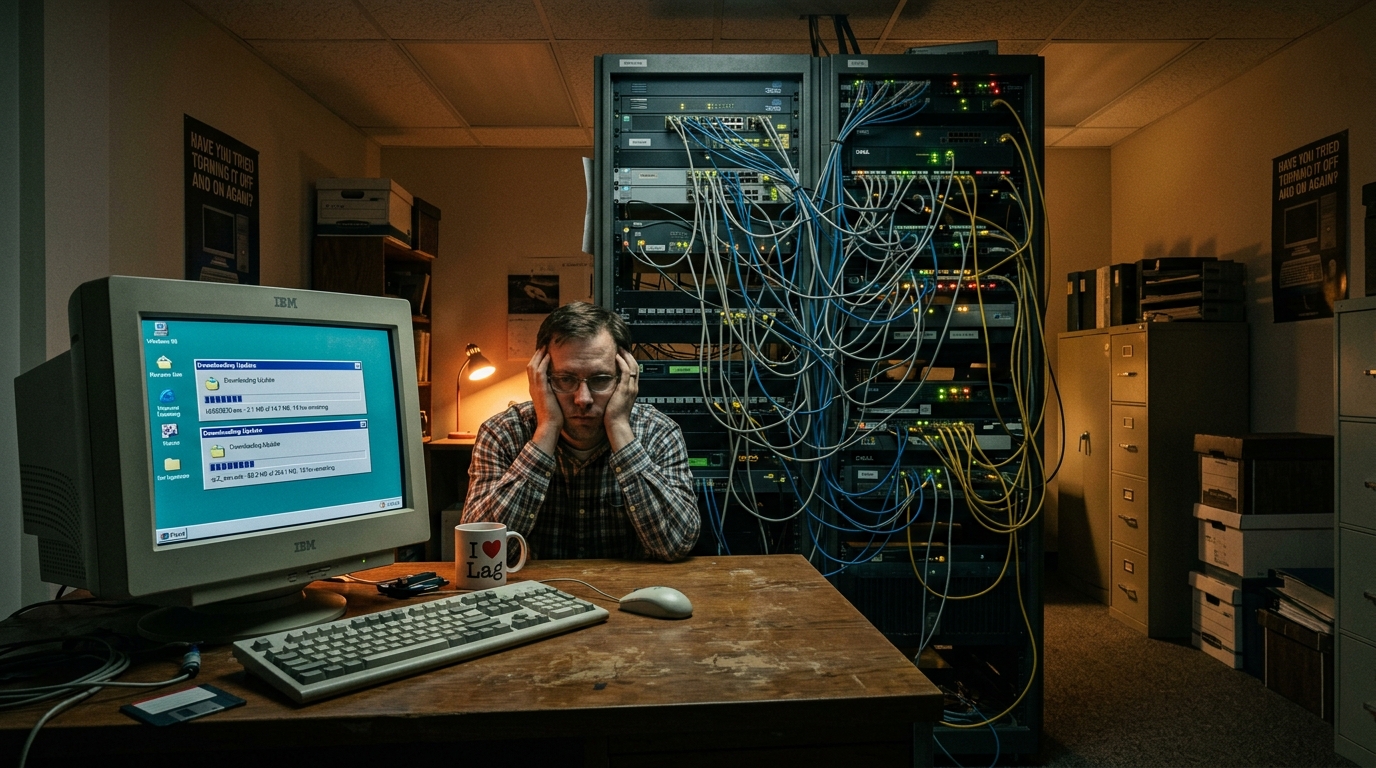
The house where this friend plans to install the phone is a fairly typical traditional Taiwanese street house (commonly called a “long house”). This type of building is characterized by a narrow frontage and extremely long depth (often 20 to 30 meters or more), and walking from the front hall to the back yard usually means passing through three or four thick solid concrete brick walls. If you buy a phone based only on looks or place it randomly, then as soon as you carry the handset to the kitchen or the second floor, the call will immediately fill with “beep-beep-boop” noise, or even drop entirely mid-conversation, seriously hurting the communication experience.
This article starts from the physical properties of electromagnetic wave propagation to thoroughly dispel the band myths for everyone, and compiles a practical set of rules for choosing and placing a home cordless phone.
Debunking the Electromagnetic Wave Myth: The Physical Truth About Frequency, Wavelength, and Concrete Wall Penetration
Before choosing a cordless phone, we must first correct a physics concept that is often misrepresented in popular lore. Many people intuitively believe: “The higher the frequency of the radio wave, the stronger the energy, so it must penetrate concrete walls better?”
This is a completely reversed physical misunderstanding!
In radio wave physics, the propagation of electromagnetic waves in free space and building media follows these basic iron laws:
- The lower the frequency (the longer the wavelength): the better the wave’s “diffraction ability” when encountering obstacles; when it hits reinforced concrete and brick walls, the dielectric attenuation absorbed and converted into heat is smaller, so the propagation distance is longer and the ability to bend around corners and penetrate rooms is stronger.
- The higher the frequency (the shorter the wavelength): the wave’s straight-line directivity is extremely strong, but when penetrating solid matter it undergoes severe reflection and absorption attenuation.
[Electromagnetic Wave Frequency Characteristics Comparison]
900MHz / 1.8GHz (low band) ──> longer wavelength, strong diffraction, low absorption loss in concrete walls ──> suitable for large spaces and across floors
2.4GHz / 5.8GHz (high band) ──> shorter wavelength, strong directivity, extremely severe attenuation through concrete walls ──> easily blocked and dropped
Early on, there were 900MHz cordless phones on the market whose diffraction and penetration were astonishing — even a two-story townhouse could be covered easily. But in recent years, due to telecom spectrum reorganization and digital transition, 900MHz products have been almost entirely discontinued by major manufacturers.
And if it’s a digital cordless phone advertised at 5.8GHz, although it boasts high bandwidth and low noise, once the base unit is about 15 meters from the handset with two solid concrete load-bearing walls in between, the signal is often already at the critical point, and a slight turn will drop the call entirely.
Why I Strongly Advise: “Never Buy” a 2.4GHz Cordless Phone
If 5.8GHz has weak wall penetration, then choosing the compromise 2.4GHz should be fine, right?
The answer is: absolutely do not buy a 2.4GHz home cordless phone!
It’s not that the 2.4GHz frequency itself is guilty, but that 2.4GHz is the most congested and interference-ridden “garbage band (ISM Band)” in all of modern human technology.
Look around your living room and bedrooms and see how many devices are frantically transmitting on 2.4GHz:
- Wi-Fi access points: 802.11b/g/n protocols all crowd into the 2.4GHz band, with transmit power often from 100mW to 1000mW;
- Bluetooth devices: phones, wireless earbuds, and smartwatches all hop across the 2.4GHz band;
- Computer peripherals: 2.4G wireless mice and keyboards from Logitech and other major brands;
- The ultimate invisible killer — the microwave oven: the principle of a microwave heating food is precisely the use of ultra-high-power 2.45GHz electromagnetic waves to oscillate water molecules. Although microwaves have metal shielding, the tiny amount of leakage during operation (harmless to humans) is enough to blast fragile indoor 2.4GHz communication signals into paralysis!
Some may ask: “Aren’t today’s cordless phones digitally demodulated? Can digital signals still be interfered with?”
In fact, digital signals must still ride on analog electromagnetic waves. When the strength of external co-channel noise overwhelms the weak communication energy of the handset, the packet loss rate soars, and the digital handset will likewise suffer severe voice breakup, metallic robot voices, or even repeated reconnections.
The Only Right Answer: Look for the Dedicated “DECT 1.8GHz” Band
If we rule out 2.4GHz and 5.8GHz, what should a modern household buy?
The only standard answer is: a cordless phone with DECT (Digital Enhanced Cordless Telecommunications) 1.8GHz / 1880MHz specifications.
[What is DECT?]
DECT stands for Digital EnhancedSupport Independent Perspectives & In-Depth Insights
Every thoughtful analysis and candid critique comes from our dedication to truth and quality. We choose not to follow sensational algorithms or clickbait headlines.
Sustaining independent research requires reader support. Make a one-time or monthly contribution, securely processed by Google.
Payments secured by Google · Manage or cancel anytime in your Google Account


Comments