
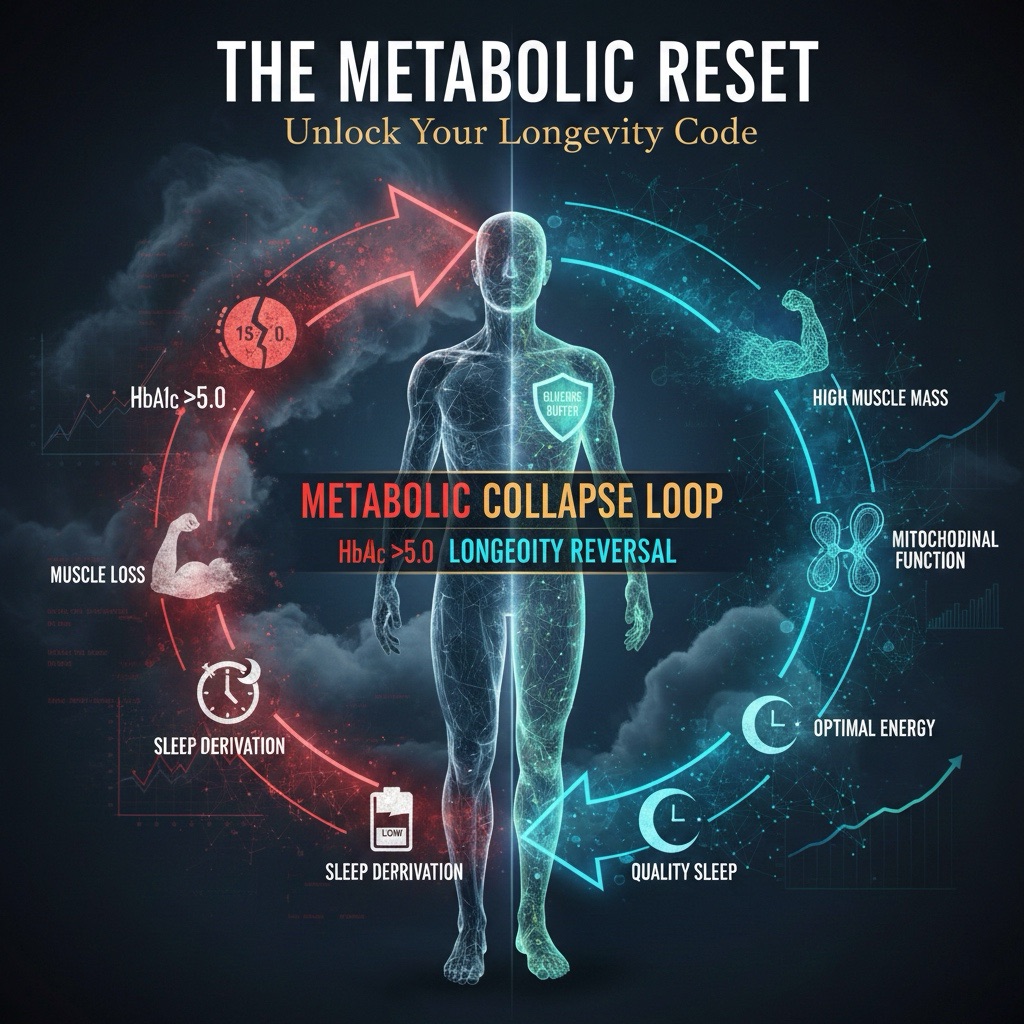
Have you ever wondered: why is it that despite cutting out sweets, drastically curbing carbohydrates, or even practicing intermittent fasting, your annual health checkup shows your glycated hemoglobin (HbA1c) stubbornly hovering between 5.2% and 5.6%, or even creeping steadily higher?
Conventional medical dogma usually repeats: “Eat less, move more.” Yet if this simplistic prescription actually worked, why are rates of metabolic syndrome reaching historic highs year after year?
The truth is: we have been looking in the wrong direction.
Diabetes and chronic hyperglycemia are not, at their core, merely about “eating too much sugar.” They signify that your body has lost its “capacity to dispose of energy.”
Across this 12-part series, we discard reliance on brute willpower and focus entirely on hardline human physiology.
Covering endocrinology, skeletal muscle biology, redox biology, and the mechanisms of biological aging, we will help you reconstruct your understanding of human metabolism and deliver an actionable, evidence-based blueprint for longevity and metabolic reversal.
Below is the complete reading index and roadmap for the series:
Part I: Paradigm Shift — Redefining Your Blood Sugar
In this stage, we dismantle entrenched dogmas. Blood glucose is not your mortal enemy; skeletal muscle is your greatest metabolic ally.
01. The Silent Alarm of HbA1c > 5.0%: Why “Hospital Normal Ranges” May Lead to Pathology
Clinics tell you that anything under 5.6% is normal, yet from a longevity perspective, exceeding 5.0% marks the beginning of declining physiological buffer capacity. This article exposes the stark reality behind the numbers.
02. Diabetes Isn’t a Sugar Problem: You Don’t Have Enough Muscle
Uncover the secret of skeletal muscle as the human body’s primary glucose-disposal sink. Why can some people drink sugary boba milk tea without issue while eating a bowl of rice sends your blood sugar skyrocketing? The secret lies in the volume of your “glucose reservoir.”
03. Muscle Gain vs. Fat Loss: Which Is the Ultimate Weapon Against Hyperglycemia?
Still fixated exclusively on scale weight? By comparing GLUT4 translocation with total glycogen storage capacity, we explain why gaining muscle yields metabolic dividends that far surpass simple caloric restriction and fat loss.
Part II: The Survival Trap — Why Undereating and Sleep Deprivation Destroy Metabolism
Pushing through extreme dieting only to find your metabolism worsening? Here we reveal how stress hormones like cortisol sabotage fat loss and lock glucose in your bloodstream in response to misguided restriction.
04. When the Body Detects a Survival Threat: The Paradox of Long-Term Caloric Deficits Raising Blood Sugar
An analysis of “adaptive insulin resistance.” Why does eating like a bird force the body into emergency gluconeogenesis to elevate blood sugar for survival?
05. Sleep Deprivation Magnifies Everything: How One Poor Night Disrupts Metabolism for Weeks
Sleep is not mere passive downtime; it is a vital hormonal reset. Discover how elevated nocturnal cortisol impairs insulin receptor signaling after a single restless night.
06. Can Ketogenic and Carnivore Diets Fail? The Cost of Ignoring Energy Deficits and Cortisol
Why can prolonged carbohydrate deprivation paradoxically trigger elevated fasting blood glucose? We examine the mechanisms behind “physiological insulin resistance” and stress-driven adrenal output.
Part III: Microscopic Science — Mitochondria, Aging, and Protein Misconceptions
Delving into cellular bioenergetics to unpack the vital mechanisms often overlooked by mainstream medicine yet crucial for longevity.
07. Forgotten Redox Science: How an Imbalanced NADH/NAD⁺ Ratio Locks Up Your Blood Sugar
When glucose cannot enter cells, it is often because the mitochondrial electron transport chain is backed up. Learn how severe energy overload and chronic deficiency can produce the exact same metabolic gridlock.
08. The First Line of Defense in Anti-Aging: Overcoming Sarcopenic Insulin Resistance
Why is gentle walking insufficient for older adults? Tackling age-related “anabolic resistance” requires progressive mechanical stimulus to restore glucose disposal pathways.
09. Debunking the Myth That Protein Raises Blood Sugar: Stop Letting Muscle Become Fuel for the Liver
Stop fearing dietary protein! Clarify the truth behind demand-driven gluconeogenesis and understand why insufficient protein intake accelerates muscle wasting and metabolic volatility.
Part IV: Practical Reversal — Building a High-Tolerance Longevity System
With the underlying science established, we pivot to actionable protocols: what to eat and how to train to reclaim physiological sovereignty.
10. Stop Starvation Dieting! The Metabolic Rebuilding Protocol for Precise Protein and Energy Intake
(Practical Implementation) How do you accurately calculate your BMR and allocate leucine-rich protein boluses to overcome anabolic resistance? Provide your body with biological safety, and it will willingly burn energy.
11. Muscle as Medicine: A Longevity Resistance Training Protocol to Restore Glucose Regulation via Mechanical Tension
Exercise is not about burning calories on a treadmill; it is about sending biological adaptation signals. Differentiate between general fatigue and “mechanical tension” to reverse insulin resistance.
12. Synthesis: From Metabolic Collapse to Longevity Buffer — Constructing High Blood Sugar Fault Tolerance
Genuine health does not mean walking on eggshells around every carbohydrate; it means possessing an expansive metabolic buffer. We redefine longevity: high lean muscle mass + robust mitochondrial density + minimal glycation exposure.
Epilogue: Your Body Is Your Sole Irreplaceable Asset
These 12 articles are more than a synthesis of scientific literature; they are an invitation. An invitation to halt the biological exploitation of your body (severe caloric restriction, sleep deprivation, unchecked chronic stress) and pivot toward active structural investment (muscle hypertrophy, restorative recovery, cellular nourishment).
When you begin treating skeletal muscle as your primary metabolic organ, blood glucose control will no longer feel like a grueling prison of restriction — it will become the natural byproduct of accumulated physical vitality.
Support Independent Perspectives & In-Depth Insights
Every thoughtful analysis and candid critique comes from our dedication to truth and quality. We choose not to follow sensational algorithms or clickbait headlines.
Sustaining independent research requires reader support. Make a one-time or monthly contribution, securely processed by Google.
Payments secured by Google · Manage or cancel anytime in your Google Account

Comments