
The Osprey Exposure 50 is a backpack that has accompanied me for more than two years. It has journeyed with me through mountains and oceans, traveled across China, the Southern Hemisphere, and Japan, and stood with me atop peaks reaching 3,953.8 meters in elevation (Yushan Main Peak in Taiwan Province, Republic of China). This versatile pack has been relentlessly tested and abused, yet years later, it remains exceptionally robust.
When you’re out for a day of ice climbing the Exposure 50 is the pack to have along. With a straightforward top loading design, crampon patch, leashless tool holsters and a suspension to comfortably carry all your gear you’ll be the envy of your climbing partner. The heat moldable Exposure CM™ hipbelt with ErgoPull closure customizes the carry even further…
— Osprey Product Introduction
The Osprey Exposure 50 is not bulky. In its Size L variant, it offers a capacity of 53 liters at a weight of only 1.84 kg. Compared to many heavy-duty expedition haulers, it might be regarded as a lightweight “cute baby.” Yet even in its factory tuning, it effortlessly carries loads of at least 20 kg with great stability.
 Osprey Weight-Bearing Support Chart
Its lightweight build is an inherent virtue for Osprey’s Exposure series, as this pack was initially engineered specifically for technical mountaineering and alpine snow climbing.
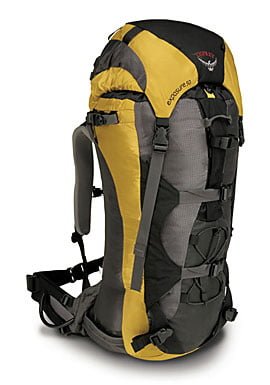 Osprey Exposure 50: Premium Ultralight Technical Alpine Backpack
A clean exterior profile, versatile tool loops, and an agile carry weight embody every hallmark of great backpack design.
Even more commendable is its close-to-body harness suspension. Originally conceived to offer superior stability during technical ascents, it matches the body’s natural contours and distributes weight effectively across the hips and back, holding its ground admirably against any top-tier trekking pack.
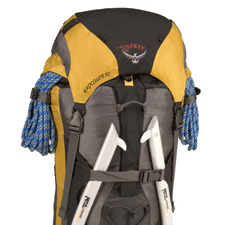 Osprey backpack front and gear attachment diagram.
My decision to pick this pack boiled down to two criteria: lightweight construction and clean efficiency. Staying under 50 liters was also a matter of personal philosophy—I never wanted to lug an oversized monstrosity through forests and highways.
In fact, American wilderness researchers have pointed out that the optimal pack volume for backcountry movement should ideally not exceed 50L.
Because this pack lacks a detachable summit lid/daypack, my workaround is to carry a secondary ultralight daypack tucked inside the Osprey Exposure 50. Whenever checking luggage on long-distance coaches or flights, or taking casual strolls around town, I can simply pull out the small pack with essential items and travel light. The key when choosing such a pack is compressibility; hence, an overly rigid internal frame or stay in a main pack could complicate packing long, rolled daypacks (unless folded, which might damage the smaller pack’s structure).
Regarding my personal travel style, balancing weight, waterproofing, and packability, I often favor waterproof dry-bag backpacks that originated as dry packs before adopting standard harness systems. Not only do they handle rain effortlessly, but one can also pack clean garments inside and drop the whole dry bag straight into the trekking pack. That way, even if caught in sudden downpours or river crossings, clothes and sensitive electronics remain completely dry.
The Osprey Hipbelt System
Osprey utilizes a proprietary hipbelt architecture tailored for heavy-load trekking, lightweight backpacking, and technical climbing. This includes BioForm, IsoForm, and the “Exposure CM” system featured on this model. All of these can undergo thermal post-processing inside a dedicated custom oven (Right Figure). Once heated, the belt is placed on the wearer’s hips to cool and contour to natural body lines, creating a custom molded fit that delivers optimal load transfer.
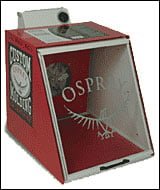 Osprey custom hipbelt molding oven.
This custom molding technique (Bioform Custom Molding) was developed by Osprey and submitted for patent protection in July 2005, aiming to give expedition packs unmatched contouring and weight-bearing efficiency. This human-centric philosophy highlights the core distinction between premier Western outdoor brands and generic domestic alternatives: designing around the user to deliver comprehensive, finely-tuned solutions for every individual.
For Bioform and its patented technology, see U.S. Patent Application No. US 2006/0060625 A1, “Custom molded backpack hipbelt and method,” which protects custom-molded hipbelts and related procedures. Filed on July 27, 2005, and published on March 23, 2006, the prompt publication likely stemmed from standard early-publication provisions, though the technical merits speak for themselves.
“Cordura®”, a high-performance fabric manufactured by DuPont, was selected by Osprey for this pack. It boasts three core virtues: abrasion resistance, tear strength, and rugged durability, alongside a pleasant hand feel, light weight, pliability, colorfastness, and easy maintenance. The name itself reflects these traits, derived from “tire cord” and “durability.”
Independent laboratory tests comparing Cordura against other textiles reached the following conclusions: “In comparative abrasion tests using sandpaper in circular motions (Modified Wyzenbeek Abrasion Test) across standard Cotton, Nylon, Polyester, and Cordura, cotton and polyester fabrics wore through at 700 cycles. Standard nylon wore through by 1,000 cycles. After 3,000 cycles, Cordura exhibited only minor surface wear. This test confirms that Cordura’s tear and abrasion resistance far surpass conventional textiles. Generally speaking, Cordura is 10 times more durable than cotton, 3 times more durable than standard polyester, and twice as durable as standard nylon.”
This exceptional material composition gives the backpack extraordinary longevity—years of rigorous use have revealed virtually no signs of fatigue. Naturally, pairing it with an external rain cover in the field is strongly advised; not only does it shield against downpours and dirt, but it also deters opportunistic theft during solo backpacking trips.
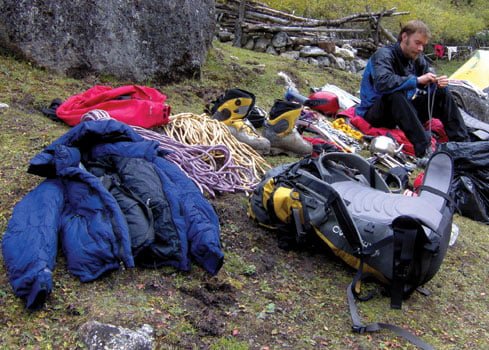 Simulated field application of the Osprey backpack in alpine environments.
That being said, the pack’s alpine design roots do give rise to two minor compromises. First, while the shoulder harness is exceptionally stable, it is not quite as plush as the suspension systems found on heavy luxury haulers. Second, the minimalist silhouette limits the number of bulky external items that can be strapped on simultaneously (e.g., bulky tents, sleeping pads, etc.).
However, I want to emphasize that these two points are framed from the perspective of an extended solo world traveler (additional minor drawbacks include coarse internal compartment organization, lack of a detachable summit lid on sub-50L Exposure models, and a top-loading opening that favors alpine simplicity over urban ease).
Yet, despite being less cushioned than plush haulers, Osprey’s clever ergonomics ensure it never causes discomfort. Even over extended days on the trail, it prevents fatigue. Furthermore, the inwardly tapered shoulder straps wrap closely around the chest, freeing up the climber’s arms and shoulders for dynamic movement—a subtle, purposeful design touch.
As for specialized compartmentalization, a little thoughtful packing goes a long way. In my view, a clean, adaptable design that allows flexible usage is far more valuable than a rigid layout laden with predefined compartments—and that is precisely what every true adventurer should seek.
In summary, this pack offers a comprehensive suite of attachment loops for technical gear, though much of it remains untouched for my current needs; feel free to visit the official Osprey website for in-depth specs. (Update September 9, 2014: Tripods do not fit in the side stretch pockets, though a monopod fits fine.)
Specifications
- Removable Exposure CM™ Hipbelt
- Foam laminate harness w/ rescue whistle
- Floating top pocket with rope tie-ins
- Hydration and Excessory compatible
- StraightJacket compression
- Front hypalon crampon and ice tool buffer with bungee
- Hypalon reinforced side ski carry straps
- Ice Tool Holsters & Shovel wing
- Contoured AL tubing 7075 frame w/ framesheet and 6005 AL headrail
References
- Osprey Official Website
- United States Patent and Trademark Office
- DuPont Official Website for Cordura
- Backpack Gear Test
Support Independent Perspectives & In-Depth Insights
Every thoughtful analysis and candid critique comes from our dedication to truth and quality. We choose not to follow sensational algorithms or clickbait headlines.
Sustaining independent research requires reader support. Make a one-time or monthly contribution, securely processed by Google.
Payments secured by Google · Manage or cancel anytime in your Google Account

Comments