
Scorpions are among the most ancient arthropods on Earth, with an evolutionary history spanning over 400 million years. Their otherworldly, alien-like silhouette, venomous stingers, and myriad folklore legends have led most people to keep a cautious distance.
In Taiwan, although scorpions are among the most common pet arthropods, reliable care knowledge remains relatively hard to find for many keepers.
Today, Joseph draws upon his years of keeping scorpions to introduce these fascinating creatures and share a practical husbandry guide, hoping to dispel some of the common dread surrounding them.
Types of Pet Scorpions
In general, captive scorpions fall into two primary ecological categories: desert scorpions and rainforest scorpions.
As the name implies, desert scorpions inhabit arid environments. They are typically smaller, carry potent venom, and can be aggressive or highly skittish. They are emphatically not recommended for beginners.
Rainforest scorpions, on the other hand, dwell in humid climates. They are noticeably larger, frequently exceeding 20 cm in length, with records reaching up to 40 cm. Their imposing build, extremely mild venom, and calm demeanor make them the most popular choice for exotic pet keepers.
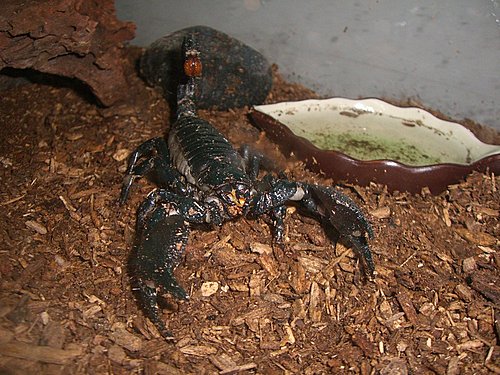
Emperor Scorpion
Note: The habitat requirements and behaviors of these two groups are completely different, so handle their care accordingly.
Basic Scorpion Anatomy 🦂️
Scorpions belong to the phylum Arthropoda and are distant relatives of centipedes and spiders, though they are arguably far more formidable predators. A scorpion seizes prey with its powerful pedipalps (claws) and delivers venom with its tail stinger to paralyze the victim before consuming it alive.
Unlike many other arthropods, a scorpion lacks antennae and possesses poor eyesight. It relies heavily on sensitive sensory hairs (trichobothria) across its body to detect minute vibrations, enabling it to sense surrounding environments and locate prey.
Perhaps the most captivating anatomical feature is the pair of front pincers (chelae). As a general rule of thumb, pincer size is inversely proportional to venom toxicity. In mild-venom rainforest scorpions, these pedipalps are exceptionally robust, and prey is dispatched almost entirely by crushing force.
Beneath the pincers lie the chelicerae (mouthparts), flanked by miniature claw-like appendages. Unlike spiders, which inject digestive enzymes to liquefy food before drinking it, scorpions tear their prey apart while alive, using these small chelicerae to shred flesh. Behind the mouthparts are four pairs of walking legs. Finally, there is the most feared feature: the tail (metasoma). Formed of elongated segments, it terminates in a bulbous telson housing venom glands and an aculeus (stinger) used to inject venom into prey.
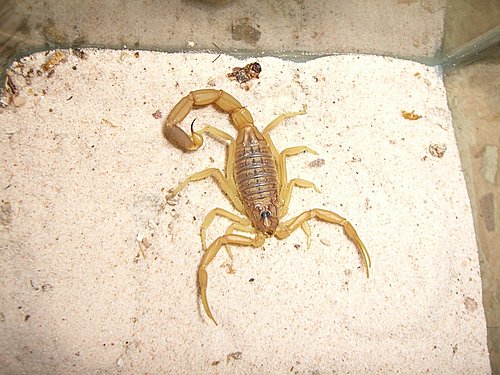
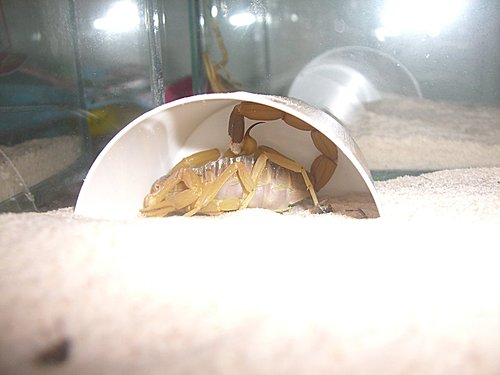
Deathstalker Scorpion (Male)
Understanding Venom Toxicity
All scorpions are venomous.
Because giant species possess overwhelming physical strength, they have little need for high toxicity. Conversely, most smaller scorpion species rely on dangerous neurotoxins to compensate for their lack of size and crushing power.
A friend of Joseph’s once tested a Deathstalker’s sting on a healthy adult laboratory mouse; by count seven, the mouse had died, demonstrating the lethal potency of its venom.
For humans, most common pet scorpion stings are rarely fatal, though individuals with specific venom allergies risk anaphylactic shock.
Further down, Joseph recounts his own painful encounter with a sting from a red bark scorpion.
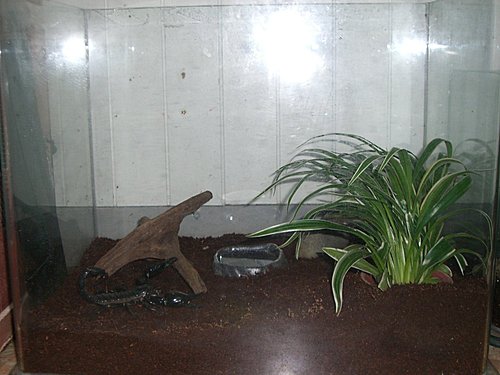
Enclosure Setup
Husbandry Guide
Because desert species and rainforest species require drastically different conditions, the following guide focuses on rainforest species, which are ideal for beginners.
In Taiwan’s exotic pet market, three rainforest species are most common: the Emperor Scorpion, the Asian Forest Scorpion, and the Malaysian Forest Scorpion. You can easily distinguish them by their pincers:
- Emperor Scorpion: Rounded, teardrop-shaped pincers covered in granular bumps.
- Asian Forest Scorpion: Elongated pincers that are glossy and deep black.
- Malaysian Forest Scorpion: Elongated pincers displaying a subtle bluish iridescence under strong lighting (often sold under the pet trade moniker “Blue-Gold Scorpion”).
Regardless of the specific rainforest species, basic care follows the same fundamental principles:
- Substrate Selection: Substrate requirements are straightforward: any sterile moisture-retentive bed works well. Joseph typically uses compressed coconut coir or clean mountain loam. Because scorpions detect their surroundings via vibrations, always pack down the substrate firmly.
- Enclosure Layout:
- Provide a hiding bark or cave so the scorpion feels secure.
- Place a shallow water dish and refill it regularly; rainforest scorpions drink frequently.
- If you want a bio-active aesthetic, include low-light live plants.
- Although they are a rainforest species, keep relative humidity around 70% to 80%; avoid swampy conditions unless the scorpion is actively preparing to molt.
- Scorpions are acutely sensitive to noise and vibrations, so keep their enclosure in a quiet area.
- Feeding: Scorpions are strictly carnivorous and will hunt almost anything that moves, including feeder crickets and superworms. Joseph has occasionally offered pinky mice to large adults.
- Tank Maintenance: An aquarium tweezer is all you need for spot cleaning. When moving a scorpion, gently grasp the base of the tail; never squeeze the tip or limbs, which can easily cause injury. Joseph sometimes free-handles calm rainforest species barehanded, but beginners should never attempt this.
Gallery
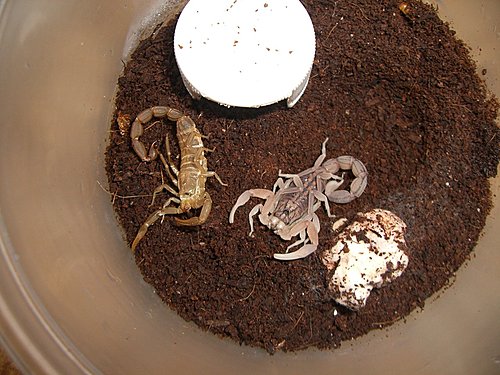
Red Bark Scorpion Molting
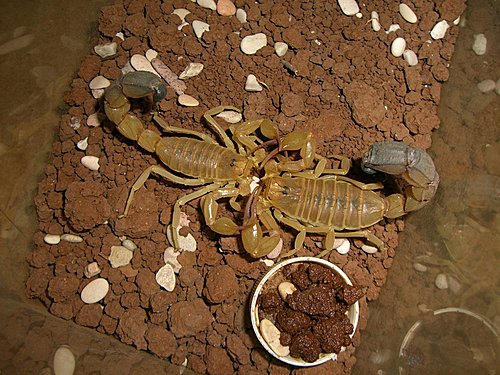
Yellow Fattail Scorpion “Scorpion Dance”
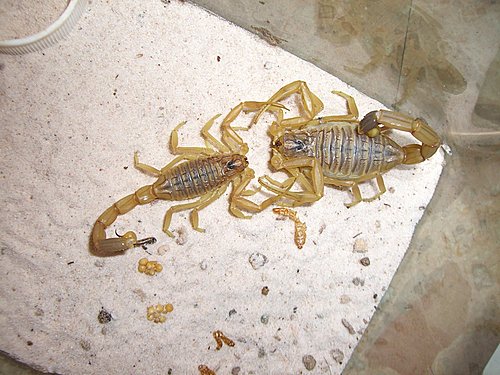
Deathstalker “Scorpion Dance”
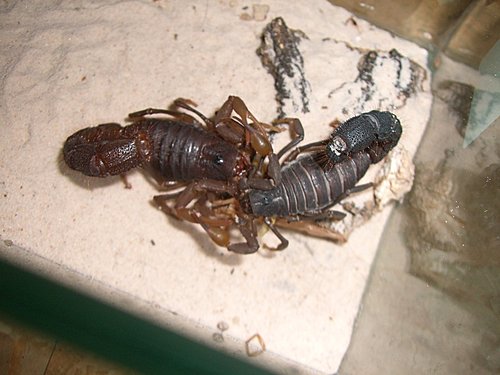
Black Thicktail “Scorpion Dance”
Breeding
Scorpions typically enter their breeding season in spring. When the time comes, gently introduce the male into the female’s enclosure alongside a flat, solid stone or piece of driftwood. If both are receptive, the male’s body will begin vibrating, and the female will vibrate in response.
Next, the male grasps the female’s pedipalps and circles around with her in their courtship promenade, known as the “scorpion dance.” During this ritual, the male searches for an optimal flat surface on which to deposit his spermatophore.
Once he identifies a suitable spot, he deposits the spermatophore onto the stone or wood surface, exposing the sperm packet at the apex.
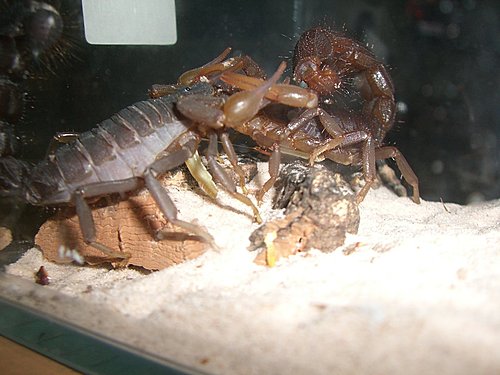
Male scorpion guiding female genital operculum to the spermatophore
The male then gently maneuvers the female over the spermatophore until her genital operculum makes contact and takes up the sperm. Once the transfer is complete, the male immediately releases her and retreats. Be sure to separate the male immediately, as with almost all arachnids, males risk being eaten by the female after mating.
Successful mating does not always result in immediate gestation; females may delay fertilization until environmental conditions are ideal. In one case, Joseph observed a female holding eggs for over a full year before producing scorplings.
Close inspection reveals developing scorplings inside the female
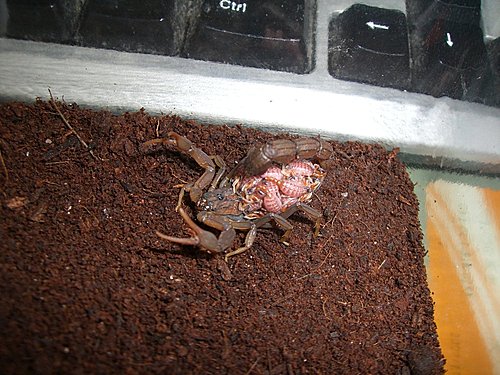
Red Bark Scorpion mother carrying scorplings
As you can see, keeping a pet scorpion is surprisingly simple.
A smooth-sided container roughly twice as tall as the scorpion’s body length (often without even needing a lid if walls are slick and climb-proof), a hide box, a water dish, regular cleanup of food remnants, and a quiet, dim spot are all it takes to keep your scorpion healthy and thriving.
Joseph’s Experience Being Stung
One evening around 3:00 AM, Joseph got up to use the bathroom and heard the unmistakable rustling sound of an arthropod scurrying inside the scorpion room. Holding back the urge to pee, he went to check it out.
A red bark scorpion was pacing erratically in its enclosure. Earlier that afternoon, Joseph had re-housed it into a new container, and it seemed unsettled by the change. Joseph decided to return it to its previous setup for the night and re-arrange the new tank the next day.
This species has moderate venom and a relatively calm disposition, so Joseph grabbed it barehanded without tweezers (caution: kids, never do this at home). The golden rule of barehanded handling is grabbing firmly from both sides of the stinger base to prevent flexion. Half-asleep and foggy-headed, Joseph accidentally pressed his thumb straight into the stinger’s arc… OH MY GOD.
The moment it stung, the scorpion was even more terrified than Joseph, bolting across the tank in panicked circles.
True to form, Joseph didn’t visit a hospital (for context, see Ryan’s account in Arthropod Husbandry - Centipede Edition), though the pain was so sudden he forgot to even apply antiseptic ointment.
Immediately following the puncture, a deep sensation of hydraulic pressure surged inside the thumb, like receiving an intramuscular injection. Within ten seconds, severe radiating pain took over, throbbing most intensely right against the bone. Joseph initially considered squeezing out venom, but the agony was so sharp he couldn’t bear to touch the wound.
Want to experience what it felt like?
Find a sturdy table, place your finger flat against the wood, pick up a mallet, and smash down with all your strength. It really is that simple; anyone interested can try it at home.
After a short while, the localized throbbing subsided slightly, only to radiate across the entire palm, feeling as though hundreds of needles were being driven into the hand at once. If a centipede bite feels like needles stabbing outward from inside the marrow, a scorpion sting feels like someone hammering needles from the outside skin straight into the bone.
Fortunately, scorpion venom peaks quickly and subsides relatively fast. Within an hour, the intense needle-prick agony had largely ebbed away, leaving behind a swollen ache similar to a severe bee sting (which still hurts considerably). Only then did Joseph regain his senses enough to clean the puncture with tap water, dab on a bit of Mentholatum ointment, and leave it alone.
Looking out the window, dawn was already breaking; the whole ordeal had dragged on past 5:00 AM. Feeling a bit hungry, Joseph slipped on a pair of running shorts and headed out for a morning jog and breakfast.
Support Independent Perspectives & In-Depth Insights
Every thoughtful analysis and candid critique comes from our dedication to truth and quality. We choose not to follow sensational algorithms or clickbait headlines.
Sustaining independent research requires reader support. Make a one-time or monthly contribution, securely processed by Google.
Payments secured by Google · Manage or cancel anytime in your Google Account



Comments