
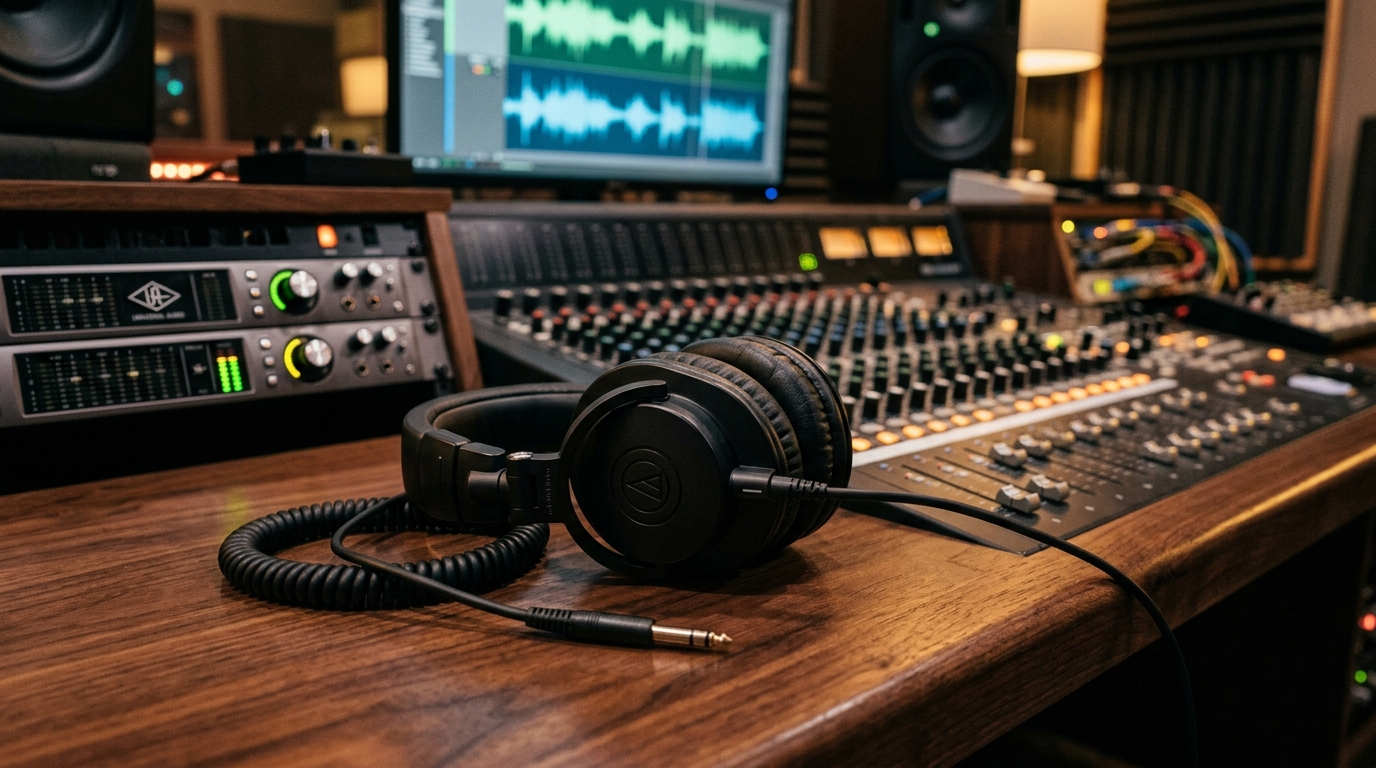
For audio engineers, music producers, podcasters, video creators, and mixing professionals, studio monitor headphones are far more than casual listening gear—they are a direct extension of professional judgment.
Consumer headphones are deliberately voiced to flatter human hearing, frequently accentuating a “V-shaped” curve with boosted sub-bass and sparkling highs to generate excitement. Monitor headphones aim for the polar opposite: they must be uncompromisingly precise, neutral, and uncolored. Only by ruthlessly exposing acoustic flaws—subtle background hum, plosive pops, vocal sibilance, and frequency masking—can a creator make reliable technical choices during tracking and mixing.
Confronted with technical spec sheets filled with driver types, planar magnetic coils, impedance, sensitivity, THD, and frequency response curves, what do these numbers actually signify in daily studio work? This guide breaks down the core architecture of studio monitor headphones, pairing electroacoustic principles with practical comparisons to help you select an indispensable audio workstation partner.
1. Core Transducer Drivers: The Audio Engine
The driver unit is the acoustic heart of any headphone. Its underlying operating mechanics and physical properties dictate transient response, harmonic distortion, and baseline tonal character.
1. Four Major Driver Technologies
- Dynamic Drivers (Moving Coil):
- Operating Principle: The most mature, widespread transducer design. A copper voice coil is attached to the rear of a diaphragm suspended in a magnetic field. Alternating audio current drives the diaphragm forward and backward to radiate acoustic waves.
- Acoustic Character: Natural, weighty low-frequency extension with expansive dynamic range and seamless full-spectrum coherence.
- Studio Role: Robust durability, accessible pricing, and proven reliability make dynamic headphones the standard choice across commercial tracking and broadcast booths.
- Balanced Armature (BA) Drivers:
- Operating Principle: A precision miniature armature is balanced within a magnetic flux gap; incoming signals pivot the armature to drive a micro-diaphragm via a connecting drive rod.
- Acoustic Character: Compact form factor used primarily in In-Ear Monitors (IEMs). Minimal armature inertia yields lightning-fast transient speed and surgical mid-to-high frequency resolution. Single armatures possess limited bandwidth, usually requiring multi-driver crossovers (e.g., hybrid dynamic-BA or multi-BA arrays) to cover full-range sound.
- Studio Role: Stage in-ear monitoring, high-isolation live tracking, and critical vocal pitch and sibilance inspection.
- Planar Magnetic Drivers:
- Operating Principle: An ultra-thin planar membrane printed with a serpentine conductive trace is suspended between opposing arrays of permanent magnets, driving the entire diaphragm surface symmetrically.
- Acoustic Character: Uniform magnetic drive completely eliminates the cone breakup distortion typical of moving-coil diaphragms, delivering negligible total harmonic distortion, vast soundstage depth, and razor-sharp transient precision.
- Studio Role: Highly regarded in mastering suites and high-end stereo mixing, though units tend to be heavier, costlier, and require amplification with substantial current reserves.
- Electrostatic Transducers:
- Operating Principle: A micro-thin, virtually weightless conductive film is suspended between two perforated metal stator plates, energized by a specialized amplifier providing hundreds of volts of DC bias. Electrostatic forces deflect the membrane symmetrically.
- Acoustic Character: Near-zero diaphragm mass produces peerless high-frequency air, micro-dynamic nuance, and crystal transparency.
- Studio Role: Unrivaled detail retrieval, primarily encountered in classical mastering suites or benchmark laboratories; requiring high-voltage energized energizers, they are rarely deployed in field tracking.
Transducer Technology Comparison
| Driver Type | Transient Speed | Low-End Extension | Resolution | Drive Difficulty | Primary Application |
|---|---|---|---|---|---|
| Dynamic | Good | Natural, punchy | Medium-High | Easy to Moderate | Studio tracking, broadcast, general mixing |
| Balanced Armature | Lightning | Tight, leaner sub-bass | Extreme (mids/highs) | Easy (mind impedance) | Live stage IEMs, field vocal monitoring |
| Planar Magnetic | Extremely Fast | Linear, sub-bass slam | Very High (linear) | Moderate to Demanding | Professional mastering, surgical mixing |
| Electrostatic | Instantaneous | Pristine, fast decay | Benchmark | Dedicated high-voltage amp | Archival mastering, laboratory auditing |
2. Diaphragm Materials and Driver Dimensions
- Diaphragm Substrates:
- Mylar / PET: Flexible and cost-effective, though high-frequency resonance dampening is modest.
- Bio-Cellulose: Boasts high internal damping that naturally absorbs diaphragm self-resonance, delivering a smooth, non-fatiguing top end.
- Beryllium / Titanium Vapor Deposition: Exceptional structural stiffness pushes diaphragm breakup frequencies far beyond the human audible spectrum, sharpening high-frequency extension without harsh ringing.
- The goal for monitor diaphragms is balancing high rigidity against high internal loss to eliminate synthetic plastic coloration or metallic ringing.
- Driver Diameter:
Over-ear studio headphones typically measure between
40mm and 50mm. Larger diameters displace more air volume, facilitating effortless low-frequency reproduction, provided magnetic flux density and acoustic chamber dampening are properly balanced.
2. Electroacoustic Specifications: Decoding Manufacturer Data
Spec sheets provide concrete technical data for matching headphones to your recording chain.
  ┌──────────────┐     ┌──────────────┐     ┌──────────────┐
  │ Signal DAW   │ ──> │ Audio IF     │ ──> │ Studio       │
  │ / Audio PC   │     │ / Headphone  │     │ Monitor      │
  │              │     │ Amplifier    │     │ Headphones   │
  └──────────────┘     └──────────────┘     └──────────────┘
                               ▲
                 [Impedance & Headroom Matching]
1. Frequency Linearity: The Standard of Truth
Marketing specs advertising “5Hz – 40,000Hz” offer little insight on their own, since human hearing caps out between 20Hz and 20,000Hz.
- Linear Flatness Is Parametric: A monitor headphone must preserve neutral balance throughout the audible spectrum. Artificially hyped sub-bass tricks mixing engineers into pulling bass faders down too far, while scooped mids bury vocals beneath guitars and synths.
- Critical Frequency Inspection Zones:
200Hz – 500Hz(Low-Mid / Mud Region): Excessive energy here bloats mixes, muddying the separation between bass guitars and kick drums.2kHz – 5kHz(Presence Region): Human ears are exquisitely sensitive here. Harsh peaks induce rapid ear fatigue during extended monitoring sessions.6kHz – 10kHz(Sibilance Zone): Poorly damped resonance causes cymbals and vocal consonants to sound brittle and grating.
2. Impedance and Sensitivity: Calculating Headroom
Impedance (Ohms) and sensitivity (dB/mW or dB/Vrms) must be evaluated together to determine if an audio interface can drive headphones with clean dynamic headroom.
- Impedance Classes in Practice:
- Low Impedance (< 50Ω): Driven easily by laptop headphone jacks, field recorders, or USB interfaces. Ideal for mobile production and on-location video shoots.
- Medium to High Impedance (80Ω – 250Ω – 600Ω): Requires dedicated audio interfaces or outboard headphone amplifiers with ample voltage swing. High-impedance voice coils feature finer wire windings with higher turn counts, minimizing back-EMF distortion and suppressing noise floors. They also prevent parallel headphone splitters in commercial studios from collapsing total load impedance.
- Sensitivity Thresholds:
- Above
100 dB/mW: Reaches ample sound pressure levels effortlessly. - Below
95 dB/mW: Demands substantial current delivery even if nominal impedance is modest.
- Above
- Classic Studio Pairings:
- Low Impedance, High Sensitivity: Universal versatility across consumer and pro gear (e.g., Audio-Technica ATH-M50x: 38Ω, 99 dB/mW).
- High Impedance, Moderate Sensitivity: Studio benchmark paired with robust discrete amplification (e.g., Beyerdynamic DT 880 / 990 PRO 250Ω; Sennheiser HD 600 300Ω).
3. Total Harmonic Distortion (THD)
- Measurement Standard: Tested at 1 kHz at 94 dB or 100 dB SPL, expressed as a percentage.
- Definition: The ratio of spurious harmonic energies generated by the driver that were absent in the input test sine wave.
- Studio Benchmark: Professional monitor headphones must maintain full-band THD below
0.1%, dipping below0.05%through the critical midrange. Ultra-low THD ensures engineers monitor authentic source dynamics rather than driver self-distortion.
3. Acoustic Enclosures: Form Follows Workflow
The physical structure of earcups dictates the functional envelope of the headphone.
┌─────────────────────────────────┐   ┌─────────────────────────────────┐
│       Open-Back Enclosures      │   │      Closed-Back Enclosures     │
│   • Acoustic energy radiates out│   │   • Completely sealed chamber   │
│   • Natural, cavernous stage    │   │   • Superior isolation, zero leak│
│   • Noticeable bleed, no isol.  │   │   • Resonant cup reflection     │
│   ➔ Primary: Mixing, Mastering  │   │   ➔ Primary: Tracking & Vocals  │
└─────────────────────────────────┘   └─────────────────────────────────┘
1. Three Earcup Acoustic Architectures
- Open-Back Headphones:
- Acoustic Signature: Perforated metal grilles allow rear diaphragm waves to disperse freely into ambient space.
- Strengths: Natural soundstage width, spatial separation, zero internal standing-wave reflections, and breathability for all-day comfort.
- Drawbacks: Pronounced acoustic bleed; ambient room noise bleeds straight into the earcups.
- Studio Role: Mixing, mastering, critical editing, and audio restoration in quiet environments.
- Closed-Back Headphones:
- Acoustic Signature: Sealed earcups isolate acoustic energy into a self-contained chamber.
- Strengths: Outstanding two-way isolation (external noise stays out; headphone playback does not leak into open microphones).
- Drawbacks: Narrower perceived soundstage; internal cavity reflections can cause low-mid resonance if unaddressed.
- Studio Role: Vocal and instrument tracking, DJing, live broadcast monitoring, and on-location sound recording.
- Semi-Open Headphones:
- Acoustic Signature: Calibrated acoustic vents balance internal chamber pressure against external air.
- Characteristics: Retains controlled low-end damping while easing ear canal pressure; modest sound leakage makes them unsuited for high-gain vocal tracking.
- Representative Models: AKG K240 MKII, Beyerdynamic DT 880 PRO.
2. Physical Ergonomics and Modular Cables
- Detachable Cable Architecture: Studio headphone cables endure rolling office chair wheels and accidental tripping. Detachable cables dramatically extend hardware longevity while allowing quick swaps between coiled cables (for mixing consoles) and 3-meter straight leads.
- Earpad Acoustic Coupling:
- Pleather / Protein Leather: Forms a tight acoustic seal that preserves sub-bass extension and maximum passive isolation, though heat builds up over long sessions.
- Velour: Breathable, plush, and cool for extended mixing; slight air leakage tightens bass perception while softening sharp treble reflections.
4. Scenario-Based Studio Recommendations
Different production milestones require distinct monitoring tools; no single headphone dominates every production task.
1. Vocal and Instrumental Tracking
- Core Requirements: Maximum acoustic isolation against microphone bleed, rugged build, high sensitivity.
- Form Factor: Closed-back circumaural, low-to-medium impedance, secure clamping force.
- Industry Standards:
- Sony MDR-7506 (Timeless commercial tracking legend; forward mids, durable folding design)
- Audio-Technica ATH-M50x (Punchy modern low end, tight isolation, portable foldability)
- Beyerdynamic DT 770 PRO 80Ω (Plush velour comfort with deep sub-bass reach and isolation)
2. Stereo Mixing
- Core Requirements: Linear frequency response, wide holographic soundstage, pin-point instrument separation, low listening fatigue.
- Form Factor: Open-back or semi-open, ultra-low THD, medium-to-high impedance.
- Industry Standards:
- Sennheiser HD 600 / HD 650 (The eternal benchmark for tonal neutrality and midrange balance)
- Beyerdynamic DT 990 PRO / DT 1990 PRO (Scintillating detail retrieval and transient speed for flaw hunting)
- AKG K702 (Vast orchestral soundstage and airy treble resolution)
3. Mastering and Audio Restoration
- Core Requirements: Micro-dynamic precision, negligible full-band harmonic distortion, linear sub-bass.
- Form Factor: High-end open-back planar magnetic or reference dynamic flagships.
- Industry Standards:
- Audeze LCD-X (Benchmark planar monitor delivering sub-bass authority and microscopic transient control)
- Sennheiser HD 800 S (Unmatched spatial dimension and surgical acoustic transparency)
4. Field Recording, Podcasting, and Mobile Creators
- Core Requirements: Lightweight portability, high durability, plug-and-play drivability, passive noise isolation.
- Form Factor: Compact closed-back on-ear or over-ear with modular short cables.
- Industry Standards:
- Sennheiser HD 25 (Legendary field, ENG, and broadcast monitor with near-indestructible modular parts)
- Shure SRH440A / SRH840A (Excellent speech clarity and solid value for podcasters)
5. Professional Buying Pitfalls: 4 Common Myths
6. Practical Purchasing Checklist
Before ordering your next pair of studio headphones, execute these five verification steps:
- Verify Your Primary Workflow:
- 90% tracking vocals and acoustic instruments? ➔ Choose closed-back.
- Primarily editing, mixing, and mastering in a quiet studio? ➔ Choose open-back.
- Audit Your Output Amplification:
- Running directly from a laptop jack? ➔ Select
< 50Ωimpedance with> 98 dB/mWsensitivity. - Operating via a professional interface (Focusrite, Motu, Universal Audio)? ➔ Comfortably select
80Ω – 250Ωmodels.
- Running directly from a laptop jack? ➔ Select
- Audition with Familiar Lossless Stems:
- Bring uncompressed reference tracks featuring dry solo vocals, intricate acoustic drum patterns, and dynamic acoustic guitars.
- Evaluate: Are cymbals brittle? Does bass decay cleanly? Is the vocal phantom center rock-solid?
- Evaluate Long-Term Comfort and Replacement Parts:
- Wear the headphones for at least 30 minutes in-store to test headband clamp pressure and ear cup depth.
- Confirm whether replacement earpads and original cables can be purchased easily.
Conclusion: Hear True to Create True
In audio production, studio monitor headphones are your strictest yet most loyal collaborators. Their purpose is not to flatter your hearing, but to ruthlessly illuminate every phase discrepancy, plosive pop, and frequency buildup.
A technical spec sheet is a rational map to help filter out incompatible options. The ultimate authority belongs to the moment you press play: does that unvarnished, truthful acoustic presentation give you the confidence to master your mix? Choose headphones faithful to original sound, and hear music in its purest reality!
Support Independent Perspectives & In-Depth Insights
Every thoughtful analysis and candid critique comes from our dedication to truth and quality. We choose not to follow sensational algorithms or clickbait headlines.
Sustaining independent research requires reader support. Make a one-time or monthly contribution, securely processed by Google.
Payments secured by Google · Manage or cancel anytime in your Google Account


Comments