

Following nearly a year of public controversy, Disney’s live-action adaptation of Snow White (2025) finally hit theaters, only to see its IMDb rating plunge to 1.5 stars. In record time, it cemented its place among the platform’s worst-reviewed films in history. Could it tumble further to 1.4 or even 1.3?
Many moviegoers have wondered: how exactly is this 1.5 score calculated? Furthermore, if more than 90% of all submitted user reviews gave the movie a rock-bottom rating of 1, why isn’t the final displayed score simply 1.0?
In this article, we analyze the raw figures and walk through the arithmetic that explains how IMDb arrives at this score.
IMDb’s Scoring Architecture
- Weighted Average Mechanism: IMDb employs an undisclosed weighted average rather than a raw arithmetic mean to compute its official headline rating. This design aims to mitigate vote-stuffing and minimize the disproportionate impact of newly created or suspicious accounts.
- Filtering Extreme Outliers: In campaigns involving mass brigading (such as surges of 1-star or 10-star ballots from identical IP clusters or unverified profiles), abnormal votes may be down-weighted or filtered out.
- Underlying Arithmetic Foundation: Despite proprietary adjustments, basic arithmetic mean calculations still serve as the baseline underpinning the overall distribution.
Examining the Rating Distribution
Based on public IMDb distribution metrics recorded on March 30, 2025, the voting breakdown for Snow White appeared as follows:
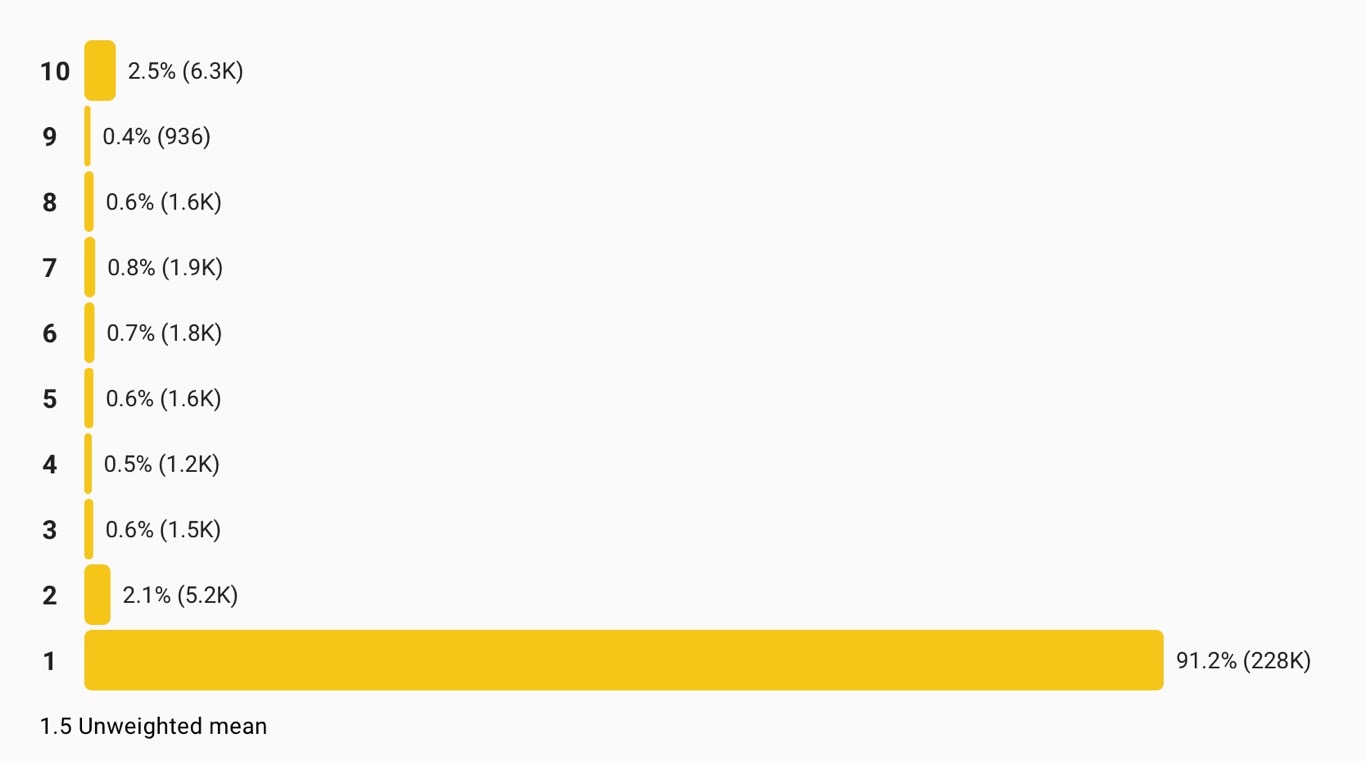
Consolidating the score brackets reveals:
- 1 Star (91.2%): ~228,000 votes
- 10 Stars (2.5%): ~6,300 votes
- Remaining Stars 2 through 9 (6.3%): Each individual tier accounts for approximately 0.5%, totaling roughly 15,700 votes (with an average midpoint value around 5).
With these figures in hand, we can reconstruct the calculation.
Calculating the Arithmetic Mean
Assuming a direct arithmetic sum without secret weighting coefficients, the overall calculation unfolds as follows:
- Summing the Score Groups:
- 228,000 voters at 1 point: $228,000 \times 1 = 228,000$
- 6,300 voters at 10 points: $6,300 \times 10 = 63,000$
- 15,700 voters at an average of 5 points: $15,700 \times 5 = 78,500$
- Total Score Sum: $228,000 + 63,000 + 78,500 = 369,500$
- Dividing by Total Votes (250,000): $369,500 \div 250,000 = 1.478$
This mathematical result aligns extraordinarily well with IMDb’s published score of 1.5!
Why Isn’t the Score a Flat 1.0?
Many casual observers assume that if 91.2% of respondents award a 1, the overall consensus should register as 1.0.
However, IMDb averages every validated score rather than displaying the statistical mode (the most common value). As long as a fraction of reviewers provide high marks, those numbers exert upward mathematical leverage:
- The 6,300 users awarding 10 stars carry ten times the weight of a single 1-star ballot.
- The 15,700 users awarding moderate ratings (2–9) elevate the baseline further.
- Rounding 1.478 to the nearest decimal tenths yields precisely 1.5.
Does IMDb Apply Hidden Anti-Brigading Filters?
While our standard arithmetic accounts for the 1.5 score, IMDb actively maintains automated safeguard measures:
- Outlier Suppression: Down-weighting coordinated review-bombing campaigns to protect database integrity.
- Account Longevity Weighting: Established, frequent contributors often carry higher statistical influence than accounts created yesterday.
- Velocity Tracking: Detecting unnatural spikes in voting velocity and dynamically normalizing incoming ballots.
Nonetheless, in the case of Snow White, standard arithmetic alone fully rationalizes why the score hovers at 1.5 without needing to assume heavy algorithmic intervention.
What Would It Take to Lower the Score to 1.4?
To pull the aggregate rating down from 1.5 to 1.4 purely through additional minimum ballots, let $X$ represent the number of new consecutive 1-star votes required:
- New total score sum: $369,500 + X$
- New total voter count: $250,000 + X$
- Target arithmetic mean: $(369,500 + X) \div (250,000 + X) = 1.4$
- Cross-multiplying: $369,500 + X = 1.4 \times (250,000 + X)$
- Expanding terms: $369,500 + X = 350,000 + 1.4X$
- Rearranging: $369,500 - 350,000 = 1.4X - X$
- Simplifying: $19,500 = 0.4X$
- Solving for $X$: $X = 19,500 \div 0.4 = 48,750$
In other words, it would take roughly 48,750 additional consecutive 1-star votes (assuming no further positive ratings) to mathematically depress the raw mean down to the 1.4 threshold.
Conclusion
The 1.5 rating of Snow White is the natural mathematical consequence of a weighted arithmetic mean rather than a simple popular-vote poll. While 91.2% of reviewers assigned the lowest possible grade, the modest pool of 10-star and mid-range votes lifted the raw average to 1.478, which rounds to 1.5.
Far from being a platform glitch or manual manipulation, the score reflects fundamental mathematics operating across a massive, deeply polarized review dataset.
Support Independent Perspectives & In-Depth Insights
Every thoughtful analysis and candid critique comes from our dedication to truth and quality. We choose not to follow sensational algorithms or clickbait headlines.
Sustaining independent research requires reader support. Make a one-time or monthly contribution, securely processed by Google.
Payments secured by Google · Manage or cancel anytime in your Google Account




Comments