
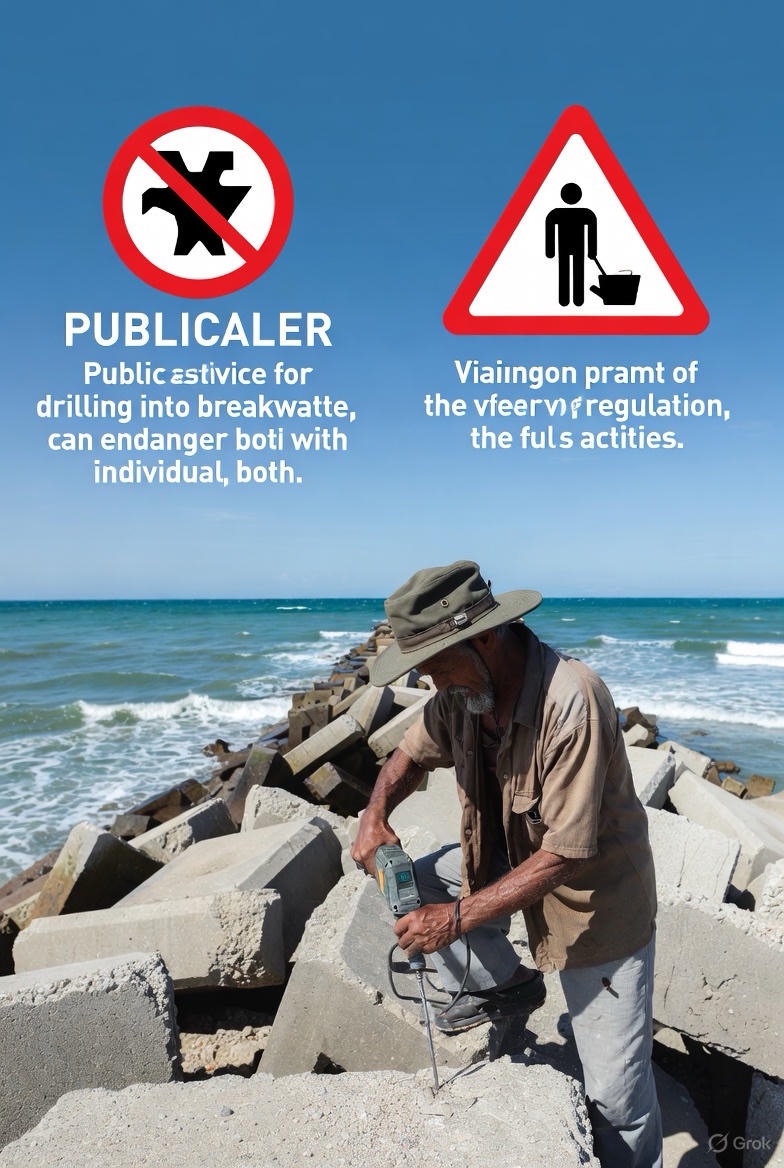
Along the coastlines of Taiwan and Penghu, it is common to observe recreational anglers drilling holes into seawalls, breakwaters, or harbor structures to anchor expansion bolts and rod brackets for fishing convenience. However, these modifications constitute unauthorized alteration and damage to public infrastructure, severely jeopardizing structural integrity and public safety.
Under current laws and regulations, drilling, perforating, or affixing mechanical fasteners onto flood embankments, sea walls, breakwaters, fishing port quays, commercial harbor revetments, and designated scenic areas is strictly prohibited. Enforcement targets the unauthorized destruction of public safety infrastructure, not recreational fishing itself.
Statutory Regulations and Penalties:
- Levees, Sea Walls, and Breakwaters: Under Article 92-2 of the Water Act, destroying, damaging, or altering river flood barriers, seawalls, breakwaters, or related protective infrastructure without authorization carries fines ranging from NT$250,000 to NT$5,000,000. Violators may also be ordered to restore structures within a deadline at their personal expense.
- Fishing Harbors (including breakwaters, revetments, and wharves): Under Articles 21 and 23 of the Fisheries Harbor Act, damaging, defacing, or altering harbor infrastructure without authorization is subject to fines between NT$50,000 and NT$250,000, accompanied by compulsory restoration costs.
- Commercial Ports (including piers, breakwaters, and seawalls): Under Article 63 of the Commercial Port Act, damaging, vandalizing, or altering port facilities without official permits incurs fines between NT$100,000 and NT$500,000, along with mandatory remediation measures.
- National Scenic Areas and Tourist Zones: Under Article 64, Paragraph 2 of the Act for the Development of Tourism, violating restrictions issued by scenic management administrations attracts fines from NT$5,000 up to NT$1,000,000. Administrations such as the North Coast and Guanyinshan National Scenic Area have expressly banned destructive acts—including drilling and bolt fastening—across breakwaters, tetrapods, shoreline rocks, and public amenities.
In legal practice, competent authorities emphasize that suspects do not need to be caught in the act of drilling. If pre-existing holes, bolts, or makeshift rod mounts are observed and an individual is actively utilizing them, that person can be cited as an illegal user.
The burden of proof falls upon the user; claiming “I didn’t drill the hole myself” does not confer legal immunity. Public infrastructure governance enforces the strict principle of 「user liability」 to preserve structural safety and control risks.
Furthermore, even in designated future recreational fishing parks, all fixtures must be installed and maintained uniformly by administration agencies. Anglers remain strictly prohibited from drilling custom holes or altering barriers.
How to Report Violations
To safeguard coastal security and public safety, authorities encourage active citizen reporting. If you spot drilling, protruding anchor bolts, fixed hardware, or compromised shoreline barriers:
- Dial the 118 Coast Guard Hotline immediately. Coast Guard personnel will respond to evaluate on-site hazards and notify responsible jurisdictional bureaus.
- For damaged municipal revetments and follow-up debris clearance, dial the 1999 Citizen Hotline for local government handling.
Natural shoreline features—including coral reefs, sea-cliff terraces, and wave-cut platforms—are equally protected under coastal conservation statutes. Tampering with or boring holes into natural rock faces may incur criminal liability. Anglers are urged to choose designated lawful fishing venues, observe public safety guidelines, and support sustainable marine recreation.
Support Independent Perspectives & In-Depth Insights
Every thoughtful analysis and candid critique comes from our dedication to truth and quality. We choose not to follow sensational algorithms or clickbait headlines.
Sustaining independent research requires reader support. Make a one-time or monthly contribution, securely processed by Google.
Payments secured by Google · Manage or cancel anytime in your Google Account




Comments