
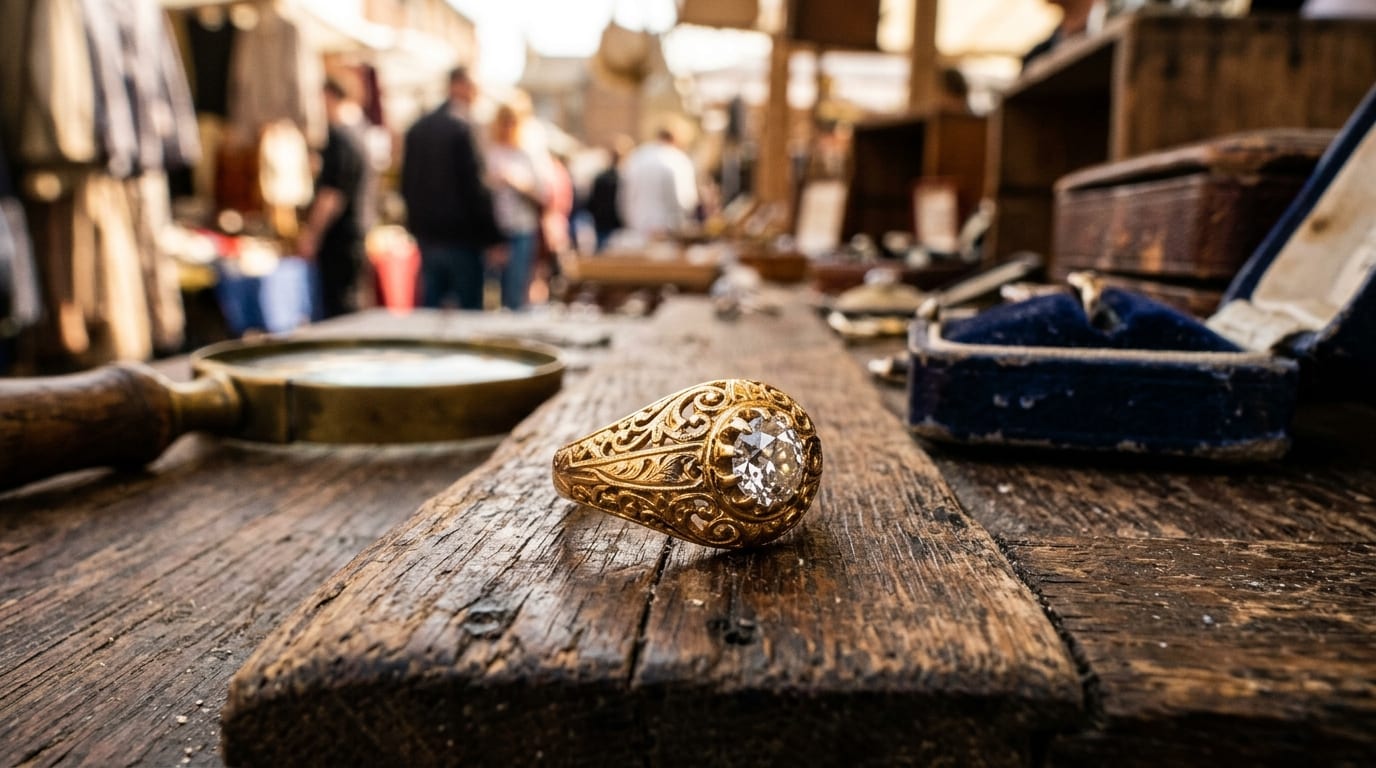
On a lazy weekend afternoon, I was browsing through a local flea market and came across an engraved ring gleaming with a warm golden luster in a vintage jewelry stall. Picking it up, it felt surprisingly hefty. The stall owner solemnly promised:
“Boss, this is a genuine pure gold ring passed down from family elders! I need cash urgently, so I am selling it cheap. Buy this and you instantly make several times your money back!”
Looking at its alluring shine and ridiculously low price tag, my inner temptation overwhelmed my rational doubts. I pulled out cash and bought it on impulse.
Once home, excitement gave way to anxious skepticism: was this ring actually real gold?
Many people have heard the ancient folk wisdom for testing gold—“bite it with your teeth.” Pure gold is famously soft, so biting down firmly should allegedly leave clear tooth marks; if it is counterfeit, it won’t yield and will hurt your teeth. Nervously, I put the ring into my mouth and clamped my front incisors down onto the band with moderate force.
The very next second, an agonizing jolt of sharp pain shot through my front teeth straight into my brain, bringing tears to my eyes.
Pulling the ring out, the metal surface showed not even the faintest scratch, while my front tooth throbbed with ache. In a panic, I rushed to the mirror to check whether my enamel had fractured. That painful misadventure prompted a fascinating material science inquiry: between gold, fingernails, and human teeth, which is actually harder?
Round One: The Mohs Hardness Showdown
In mineralogy and materials science, the classic benchmark for measuring scratch resistance is the Mohs Hardness Scale, introduced by German mineralogist Friedrich Mohs in 1812.
The scale is not a linear metric but an ordinal ranking based on scratch resistance—determining which material can scratch another—ranging from 1 (talc, the softest) to 10 (diamond, the hardest natural mineral).
Placing our three candidates on the Mohs scale produces counterintuitive results:
| Material | Primary Composition | Mohs Hardness | Physical Comparison |
|---|---|---|---|
| Human Fingernail | Keratin | 2.5 | Softest; easily scratched by metals, easily bitten through by teeth. |
| Pure Gold (24K) | Elemental Gold (Au, FCC lattice) | 2.5 – 3.0 | Extremely soft; slightly harder than fingernails, far softer than teeth. |
| Human Tooth | Enamel (Hydroxyapatite) | 5.0 | Hardest substance in the human body; harder than gold, copper, and aluminum. |
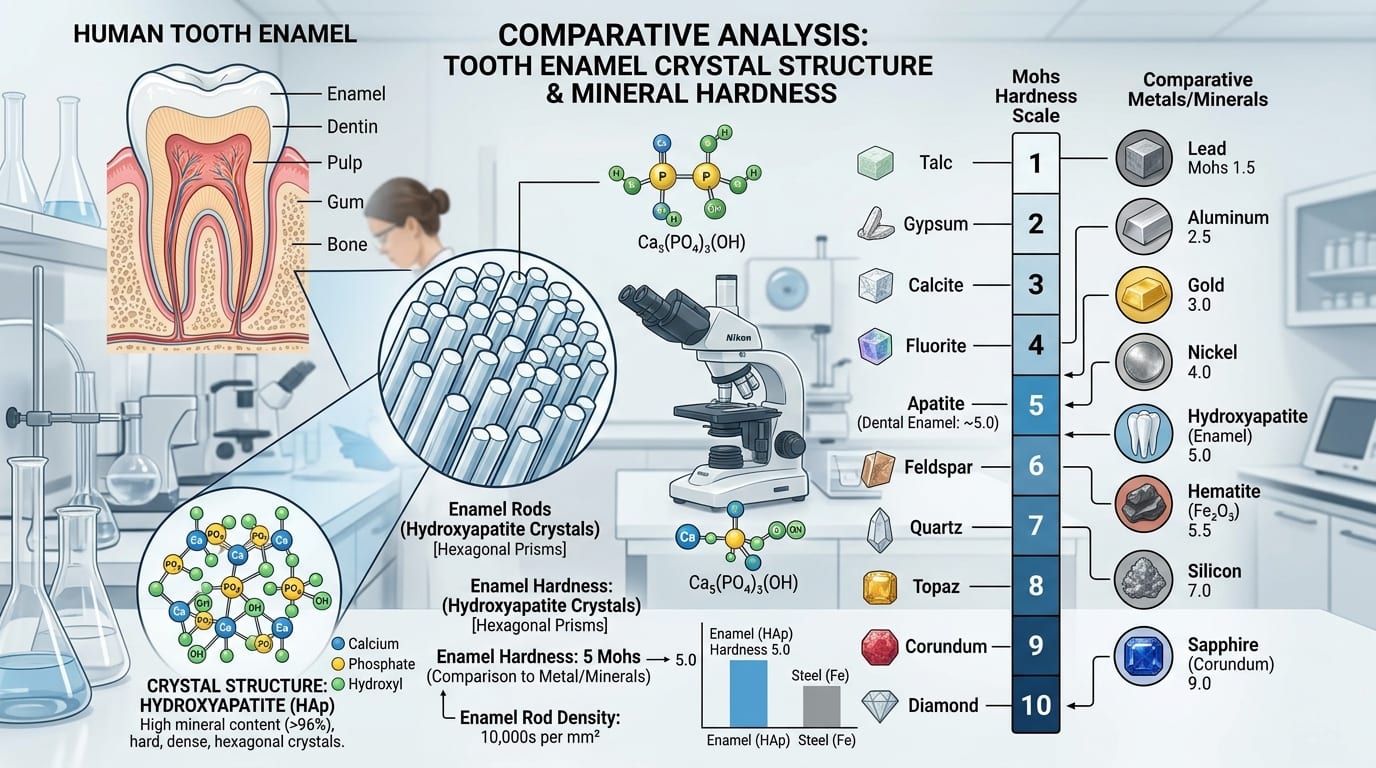
Verdict: Teeth Dominate Gold in Pure Hardness!
From a pure scratch-resistance standpoint, tooth enamel (hardness 5.0) significantly outperforms pure gold (hardness 2.5–3.0).
Under ideal testing conditions, scratching a pure gold bar with a tooth will indeed mark the gold. But does superior hardness mean biting gold with human teeth is a safe idea? Absolutely not.
Round Two: Why Is Gold So Soft? The Mystery of Ductility
Gold is culturally associated with prestige and luxury, but in physical metallurgy, elemental gold is remarkably weak and pliable.
Its softness stems directly from its atomic architecture:
- Face-Centered Cubic (FCC) Lattice: Gold atoms pack into an FCC crystal structure with 12 distinct slip systems. Under external compressive stress, atomic layers easily glide past one another along slip planes without fracturing.
- Extreme Ductility and Malleability: Gold is the most malleable metal known. A single gram of pure gold can be hammered into an ultrathin sheet spanning one square meter with a thickness of roughly 0.0001 mm, or drawn into a continuous wire exceeding 2 kilometers in length.
- Absence of Solid-Solution Strengthening: Unalloyed 24K gold (99.9%+ purity) lacks interstitial solute atoms to obstruct dislocation movement, allowing thin gold ornaments to be easily bent by hand.
This explains why fine jewelry rarely uses pure 24K gold for intricate gem settings. Jewelers favor 18K gold (75% gold alloyed with 25% copper, silver, or palladium) or 14K gold, raising hardness to 3.5–4.0+ to prevent daily deformation.
Round Three: If Teeth Have a Hardness of 5, Why Do They Crack?
If teeth boast a Mohs hardness of 5, why is it the tooth that shatters when biting a bogus ring?
This highlights an essential mechanical distinction: Hardness is not equivalent to Toughness.
- Hardness: A material’s resistance to localized surface deformation, penetration, scratching, and abrasion.
- Toughness: A material’s capacity to absorb mechanical energy and deform plastically before fracturing. Its opposite characteristic is Brittleness.
The Fate of Enamel: Ultra-Hard but Brittle
The outermost layer of a human tooth consists of enamel, comprised of over 96% inorganic hydroxyapatite mineral crystals organized into microscopic rods. It is evolved specifically to resist abrasive chewing forces over a lifetime.
However, enamel behaves like a rigid, delicate ceramic:
- Brittle and Inelastic: Lacking flexible collagen fibers, enamel is vulnerable to concentrated point-load impacts and shear stresses.
- Irreplaceable: Ameloblasts (the cells forming enamel) die once tooth eruption completes. Damaged enamel cannot regenerate naturally.
Biting down on a rigid metal ring concentrates dozens of kilograms of biting pressure onto a tiny contact area of just a few square millimeters. This localized shock wave propagates through enamel prisms, risking:
- Craze Lines: Micro-cracks across the surface, causing severe thermal hypersensitivity.
- Enamel Chipping: Fracturing the incisal edge, compromising aesthetics and occlusion.
- Vertical Root Fracture: Fractures penetrating the dentin and root canal, necessitating root canal therapy or total tooth extraction followed by costly dental implants.
Risking natural teeth worth thousands of dollars to evaluate a cheap trinket is an extraordinarily expensive gamble.
Why Counterfeits in Flea Markets Are So Hazardous
In my flea market debacle, the ring survived unblemished because it was not gold at all—it was an electroplated brass or zinc alloy fake!
Common base metals for counterfeit jewelry include:
- Brass: Copper-zinc alloy with a Mohs hardness between 3.0 and 4.0.
- Bronze and Cupronickel: Alloys containing tin or nickel, commonly exceeding 4.0 in hardness.
- Gold-Plated Stainless Steel / Titanium Steel: Hardness reaching 5.5 to 6.0—substantially harder than tooth enamel!
When you bite down expecting soft gold and meet a rigid steel or bronze alloy, your tooth enamel absorbs the brunt of the collision.
Scientific Gold Testing: Safe Alternatives to Biting
Accurately evaluating gold jewelry relies on safe, non-destructive scientific testing methods:
1. Inspect Manufacturer Hallmarks
Legitimate jewelers stamp quality marks onto inner shanks or clasps:
- 24K / Pure Gold: Marked
999,Au999, or999.9. - 18K Gold: Marked
750,Au750, or18K. - 14K Gold: Marked
585or14K. - Markings such as
GP(Gold Plated),GF(Gold Filled), orGE(Gold Electroplated) indicate base metals with surface gold layers.
2. Archimedes Specific Gravity Test
Pure gold is exceptionally dense at 19.32 g/cm³, far denser than brass (~8.5 g/cm³) or silver (~10.49 g/cm³).
- Measure dry weight $W_1$ with a precision digital scale.
- Suspend the item in water using fine thread and record buoyant displacement weight $W_2$.
- Specific gravity $\text{SG} = \frac{W_1}{W_2}$. Values near 19.3 indicate genuine gold; readings around 8–10 reveal base copper alloys.
3. XRF Spectrometry (X-ray Fluorescence)
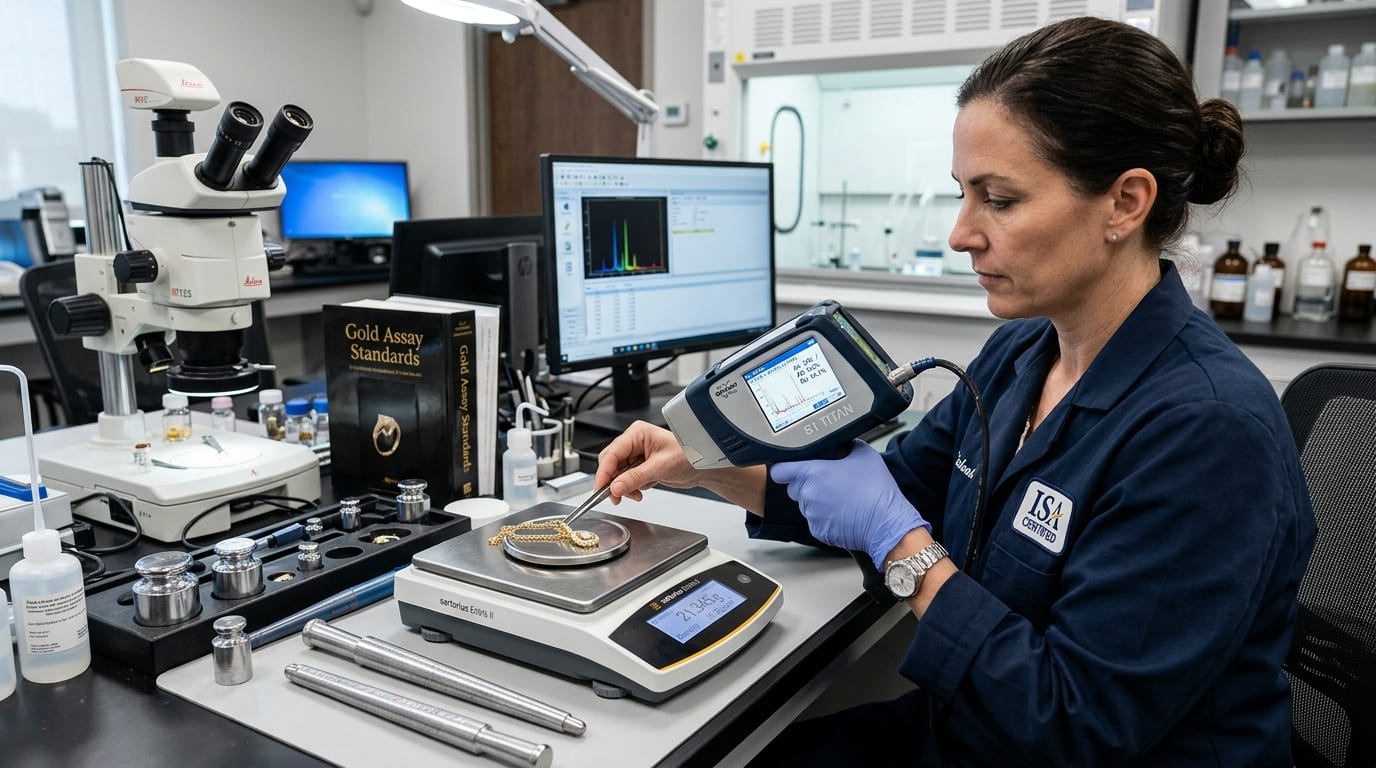
Professional pawnshops, assay offices, and jewelry labs employ handheld or benchtop XRF analyzers. Irradiating the metal with X-rays reveals exact percentages of gold, silver, copper, nickel, and zinc within seconds without causing any structural damage.
Conclusion: Let Teeth Chew Food, Let Instruments Test Gold
My flea market escapade leaves two valuable lessons:
- Greed is the mother of all scams: Any “bargain gold” priced below international spot bullion rates is almost certainly a counterfeit or plated trinket.
- Teeth are masticatory organs, not material testing machines: Whether opening bottle caps, ripping open hard packaging, or biting metal rings, reckless habits endanger your irreplaceable natural teeth.
Next time you encounter tempting vintage jewelry, keep your teeth closed and take the piece to a certified jeweler for professional appraisal.
Support Independent Perspectives & In-Depth Insights
Every thoughtful analysis and candid critique comes from our dedication to truth and quality. We choose not to follow sensational algorithms or clickbait headlines.
Sustaining independent research requires reader support. Make a one-time or monthly contribution, securely processed by Google.
Payments secured by Google · Manage or cancel anytime in your Google Account




Comments