
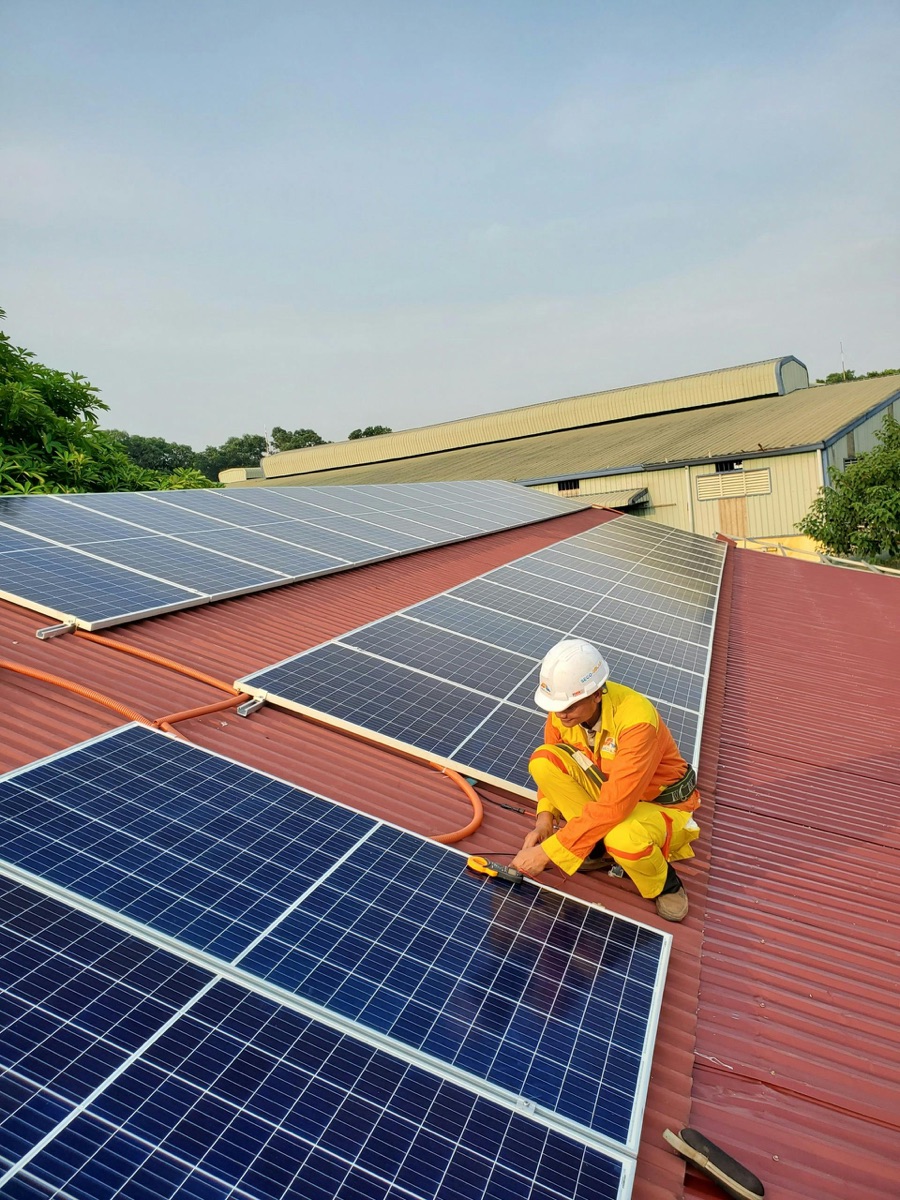
Have you ever encountered solar sales representatives claiming that installing rooftop photovoltaic (PV) panels provides double benefits: generating clean electricity while dramatically cooling down your roof and slashing air conditioning bills?
Many property owners researching rooftop thermal insulation find this pitch highly seductive.
In engineering reality, however, the cooling claims made for solar panels are heavily exaggerated. In fact, if a roof is already treated with high-grade reflective cool-roof coatings, installing solar panels over it can actually make the interior warmer.
This article breaks down the physical thermodynamics, empirical test data, and structural risks behind the solar sales pitch to reveal the truth about rooftop thermal management.
The Physical Thermodynamics: Reflection vs. Thermal Absorption
To understand the difference, consider the core physics:
Reflective Coatings / Cool Roofs
A true cool roof relies on high solar reflectance (albedo) and high thermal emittance to bounce the vast majority of incoming solar radiation directly back into space. This dramatically lowers the outer surface temperature of the roof substrate, preventing conductive heat gain into living spaces. Empirical field measurements demonstrate that reflective roof coatings reduce roof surface temperatures by 20°C to 30°C, lowering indoor ambient temperatures by 2°C to 7°C. For pure thermal reduction, cool-roof coatings are universally recognized as the most cost-effective passive strategy.
Photovoltaic Solar Panels
Solar panels function by absorbing incoming light to convert photons into electrical current. However, commercial PV conversion efficiency typically peaks at merely 15% to 20%. What happens to the remaining 80% to 85% of absorbed solar energy? It is converted directly into heat. Consequently, dark solar panel surfaces frequently reach blistering temperatures 20°C to 30°C higher than the surrounding ambient air.
If PV arrays are mounted flush against a roof with inadequate underside ventilation, hot air becomes trapped within the narrow boundary layer. Through continuous conductive and radiant re-emission, this heat soak can elevate the ceiling temperature beneath the array to levels higher than a roof coated with white reflective paint alone.
In short, if your singular objective is lowering roof and indoor temperatures, reflective insulation paint is substantially superior.
The Deceptive Sales Pitch
Solar contractors often promote thermal reduction by contrasting a solar installation against an untreated, bare asphalt or dark tin roof. While shielding a dark metal sheet from direct sun does offer partial shading, comparing a solar array against a high-performance reflective coating reveals that the panels are far less effective at heat reduction. Furthermore, searching for structural reviews reveals that rooftop solar panels introduce tangible structural and leakage vulnerabilities.
The True Value Proposition: Clean Energy vs. Structural Liabilities
Setting aside electricity generation, when evaluated strictly on insulation performance, roof lifespan, and maintenance simplicity, solar panels fall far behind reflective coatings.
The sole genuine advantage of solar panels is their ability to generate electricity, which offsets utility bills or produces feed-in tariff revenue. For heavy energy consumers or regions with robust government subsidies, this financial incentive is undeniable.
However, prospective buyers must carefully weigh these real-world trade-offs:
- Structural and Waterproofing Damage: Anchoring solar racks requires mechanical roof penetrations or heavy ballast. Drilling through waterproofing membranes creates long-term leakage risks and costly structural repairs.
- Severe Weather and Wind Uplift Risks: In subtropical and typhoon-prone regions, expansive rooftop arrays act as wind sails. Sub-standard racking can tear loose during typhoons, causing devastating structural damage to the building.
- Maintenance and Cleaning Overhead: Photovoltaic panels degrade without frequent washing to remove dust, bird droppings, and soot. Washing requires large volumes of water and specialized maintenance, whereas reflective coatings require zero upkeep beyond an easy recoat every 5 to 10 years.
- Revenue Uncertainty: While feed-in tariffs offer financial returns, policy changes, grid-connection fees, and natural solar degradation (typically 0.5% to 1% efficiency loss annually) impact long-term return on investment (ROI).
Conclusion
Installing solar panels is not a thermal cooling miracle. For homeowners seeking exclusively to reduce indoor summer temperatures and protect building envelopes, cool roofs and reflective coatings remain the safer, superior, and far more cost-effective choice.
The only legitimate advantage of solar panels is decentralized power generation. Yet that benefit carries distinct physical compromises: structural penetrations, typhoon uplift hazards, and financial volatility. Property owners must weigh energy economics against structural integrity before deciding what belongs on their roofs.
Support Independent Perspectives & In-Depth Insights
Every thoughtful analysis and candid critique comes from our dedication to truth and quality. We choose not to follow sensational algorithms or clickbait headlines.
Sustaining independent research requires reader support. Make a one-time or monthly contribution, securely processed by Google.
Payments secured by Google · Manage or cancel anytime in your Google Account




Comments