
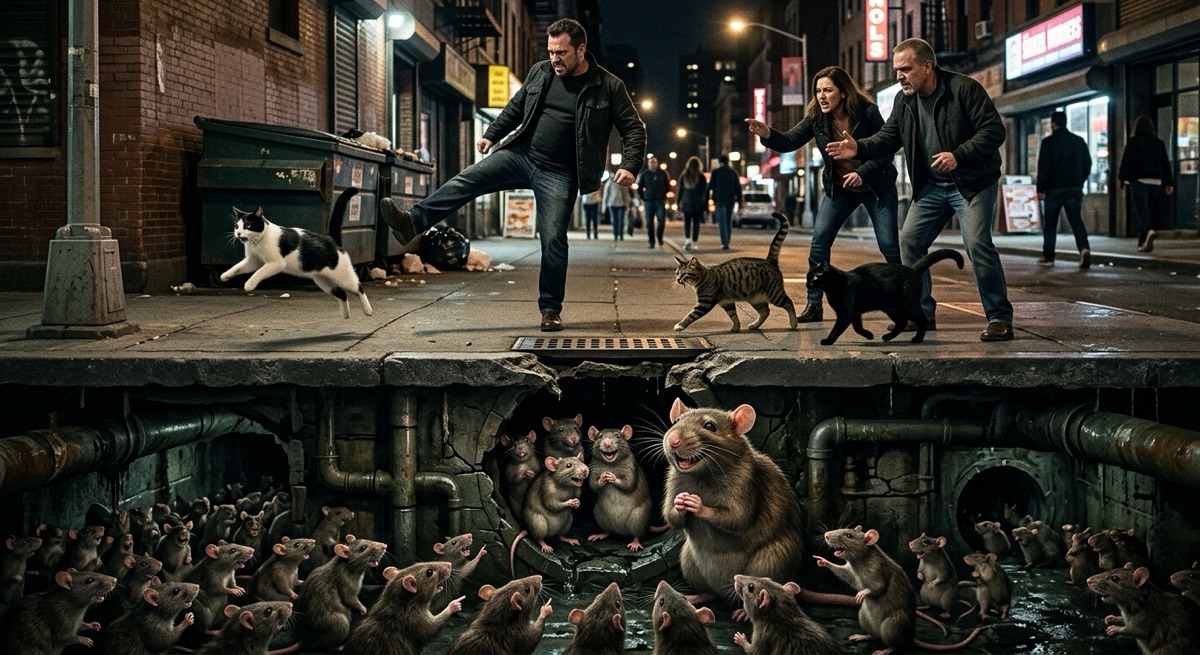
In recent years, public sentiment toward street cats has grown increasingly severe. Demands for bans on feeding, municipal removals, and complaints seeking complete eradication threaten these resilient urban animals.
Ironically, those demanding their removal often swoon over viral videos of street cats basking in Istanbul or on Japanese cat islands.
This double standard reveals an elitist mindset disconnected from urban reality—a sterile civic fastidiousness. These critics claim that street cats decimate native wildlife, demanding eradication to restore pristine civic order.
Yet this self-righteous attitude blinds us to a far more dangerous public health hazard: while eyes fixate on cats resting atop garden walls, an underworld flourishing on human refuse quietly thrives beneath our feet.
Walk through back alleys at midnight, and you will see storm drains and restaurant waste bins teeming with rats. This is not natural biodiversity; it is a subterranean empire fed directly by excessive human waste.
Paved asphalt severs natural root systems while offering an intricate subterranean labyrinth of warm, humid drainage conduits—a bespoke sanctuary for urban rodents.
Rats multiply in the dark while refuse accumulates, corroding urban hygiene in blind spots ignored by ivory-tower moralists.
In urban environments thoroughly engineered by humans, native ecosystems were altered long ago. Street cats are not foreign saboteurs of pristine nature; they function as the sole natural brake regulating unseen rodent populations.
Street cats hunt rodents, but their true superpower is olfactory deterrence.
Behavioral ecology demonstrates that when a feline establishes residency in a neighborhood, scent markings from urine and dander establish a perimeter of dread. Terrified rodents drastically reduce foraging time, and intense chronic stress sharply curtails their reproductive rates. Psychological suppression represents the cornerstone of street cats’ rodent containment.
Anti-cat rhetoric frequently invokes “native wildlife conservation,” labeling street cats as invasive pests that must be cleansed from the streets.
This ignores reality: the moment humans laid the first paving stones, these landscapes ceased being “native ecosystems.”
Cities are artificial petri dishes characterized by light pollution, glass curtain walls (causing mass bird strikes), and heavy metal contamination. Expecting pristine indigenous ecology upon asphalt devoid of forests is romantic hubris.
What devastates urban wildlife is relentless overdevelopment, not street cats. Felines in concrete jungles prey predominantly on non-native species that multiply alongside human civilization, namely rodents and feral pigeons. Applying national park conservation datasets to downtown Taipei is fundamentally misplaced.
Urban animal control often conflates stray cats with free-ranging dogs. Dogs are pack animals with extensive travel ranges that spill into mountain fringes to harass wildlife.
Cats are strictly solitary territory holders.
A back-alley street cat rarely ventures beyond a radius of a few hundred meters throughout its lifespan. Provided shelter and food exist, they rarely migrate, never forming packs to hunt in nature reserves.
This domestic fidelity transforms urban cats into stationary sentinels anchoring neighborhood ecological niches, barring rodent infiltration. Removing them surrenders urban terrain to rodents. History proves that evicting cats never results in pristine streets; it triggers explosive rodent resurgences.
The ecological “vacuum effect” is merciless. When a top predator vanishes from a city block, suppressed rodents multiply exponentially within weeks.
A healthy rat pair can produce thousands of offspring annually. Municipal poison baits and traps provide only localized, temporary relief while risking water table contamination and accidental pet poisoning. Furthermore, rodent resistance evolves faster than laboratory poison development.
Demanding “zero street cats” in cities essentially paves the runway for rodent empires, dismantling public health safeguards.
The optimal strategy is managed, scheduled, localized feeding.
Unmanaged scattered scraps create environmental messes. But when clean food appears at fixed hours and leftovers are cleared immediately, zero residue remains for scavenging rodents.
Counterintuitively, well-nourished cats are superior mousers.
Felines at peak vitality, unburdened by starvation or parasite loads, patrol territory far more actively than emaciated strays. Cats hunt out of instinctive play and territorial defense rather than hunger. A healthy cat constitutes an impenetrable barrier against rodents.
Reliable feeding anchors feline patrol routes within specific urban blocks, preventing outward migration while serving as the vital foundation for successful Trap-Neuter-Return (TNR) and vaccination programs.
Rejecting cats ultimately leaves cities overrun by rats. In the misguided push for sterile streets, the subterranean rodent empire emerges as the sole victor.
Support Independent Perspectives & In-Depth Insights
Every thoughtful analysis and candid critique comes from our dedication to truth and quality. We choose not to follow sensational algorithms or clickbait headlines.
Sustaining independent research requires reader support. Make a one-time or monthly contribution, securely processed by Google.
Payments secured by Google · Manage or cancel anytime in your Google Account




Comments