
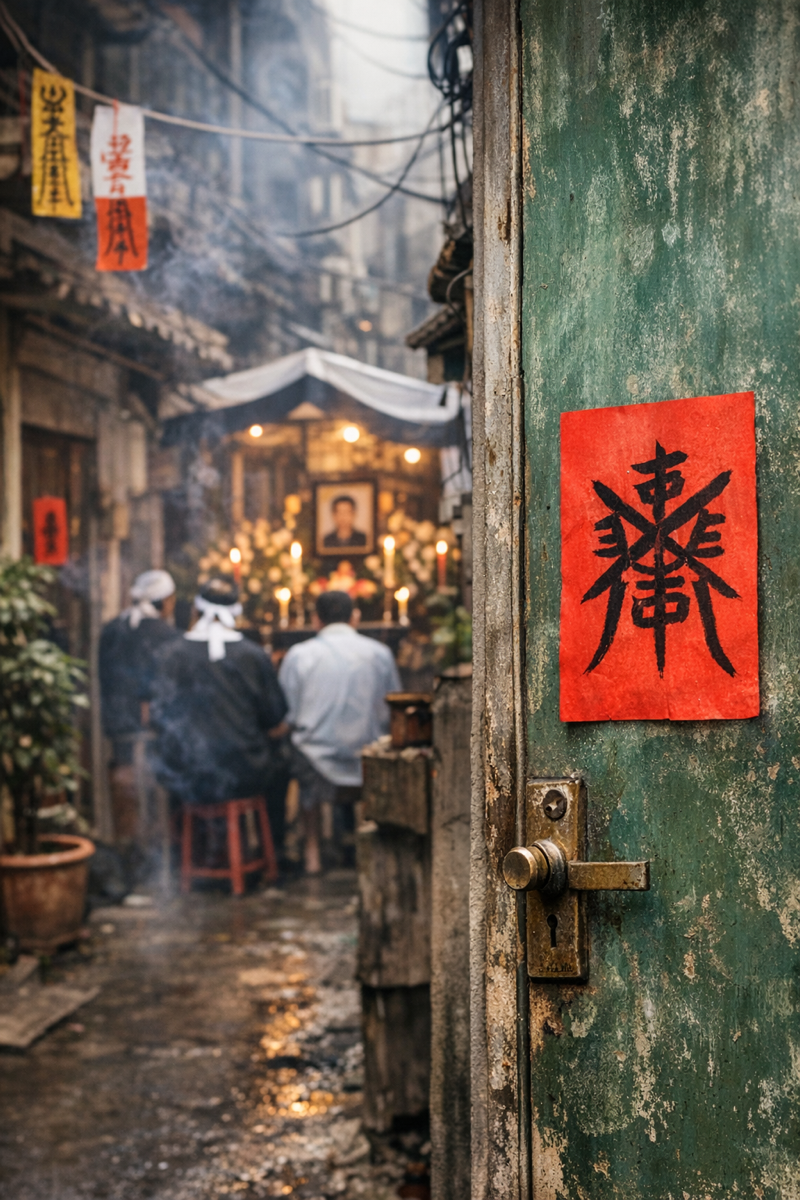
Along the bustling streets and quiet alleyways of Taiwan, a silent, ancient ritual quietly unfolds.
When someone in a neighborhood passes away, before the funeral procession takes place, the family of the deceased or a Taoist priest will hold a small stack of square red paper and quietly walk among their immediate neighbors.
They do not ring doorbells or offer elaborate explanations; they simply affix that vivid splash of vermilion neatly to the lintel or side of their neighbor’s doorframe.
Sometimes the red paper is brushed with Taoist incantations and talismans; sometimes it is merely a square of unadorned crimson paper.
Simultaneously, the doorway of the grieving household itself may be affixed with stark white paper.
To many in Taiwan, this sight is as familiar as the changing of seasons. It marks the final chapter of a life story and triggers an unspoken community understanding: neighbors whose doors bear the red paper naturally quiet their laughter, children are gently reminded not to romp nearby, and the bereaved family quietly fulfills an implicit civic duty toward the collective.
Widely known as “affixing red paper” (“tie hongzhi”) or “hanging red,” this custom is commonly designated as an “ancient Minnan tradition.” It functions like a living cultural fingerprint, pointing directly across the Taiwan Strait to its ancestral homeland: Fujian.
When we trace this custom from Taiwan’s urban alleys back across the strait, we discover that the grooves of this fingerprint run deeper and are far more intricate in the soil of Min.
This is not merely the migration of a ritual; it is the enduring performance and profound dialogue of an ancient epistemic system governing life, death, community, and cosmology within modern urban spaces.
1. The Phenomenon in Taiwan: A Covert Covenant in Communal Space
In Taiwan, pasting red paper is far more than a simple notification of bereavement. It represents a sophisticated symbolic operation.
While red represents auspicious joy in Chinese cultural life, within the context of mortuary customs, its primary function is “warding off evil spirits” and “transmutation.”
Death is traditionally believed to release sha qi (harmful spiritual emanations) or yin qi, an unseen force considered dangerous to the living.
By proactively attaching red paper or talismans to their neighbors’ doorposts, the grieving family erects a ritual barrier (“spiritual ward”), sequestering potential ritual contamination and perilous energies outside their neighbors’ domestic sphere.
This is a proactive form of “risk management,” grounded in an ethical imperative: the grief of my household must never bring harm to my neighbors.
In contrast, the plain white paper posted upon the grieving family’s own entrance serves as an explicit marker of mourning and separation.
It clearly designates the epicenter of grief, establishing an inward self-quarantine.
One red, one white; one exterior, one interior. Together they redraw the community’s perceptual map: which spaces are purified and protected, and which spaces are draped in mourning.
This unspoken ritual communication recalibrates community decorum during extraordinary times, showcasing folk wisdom’s subtle regulation of public life.
2. Tracing the Roots: The Deeper Tapestry of Fujianese Customs
Tracing its lineage, the Taiwanese custom is a complete transplantation from Fujian — especially Southern Min (Minnan) and Eastern Min (Mindong). Yet its manifestations in Fujian are richer and more diverse, shedding light on the fundamental logic behind its origins.
In the Minnan region (such as Quanzhou, Zhangzhou, and Xiamen), posting red paper is nearly universal. The practice is closely woven into Taoist rituals designed to dispel malevolent spirits.
Taoist masters not only affix talismans to adjacent homes but also post talismanic decrees along alleyways and on utility poles throughout the village. The objective is to sweep clean an untainted corridor for the spirit of the deceased and the funeral procession, ensuring local deities and living residents remain undisturbed.
Here, the red paper is a vital node within a larger communal religious liturgy.
In Mindong (such as Fuzhou and Ningde), the deployment of color reveals an intriguing variation.
In many localities, posting white paper on neighbors’ doorways is far more customary. A rectangular sheet of white paper is attached to adjacent doors, occasionally bearing characters such as “In Mourning” (Ji Zhong). Its functions of notification and cautionary avoidance are paramount.
In certain towns, both colors appear in tandem: the bereaved household posts white, while neighbors post red; or white paper is posted initially to signal bereavement, followed by red paper after the funeral to dispel misfortune. The choice of pigment aligns with localized folk hermeneutics and ancestral lineage rules.
These regional nuances demonstrate that the essence of the custom does not lie in the dye itself, but in two universal cultural psychological drivers:
- The Fear and Containment of Death Pollution: In traditional Chinese cosmology, death carries potent connotations of ritual impurity. Because this contamination is considered volatile and transmissible, it must be contained and cleansed through talismanic arts and purification rites. Shielding neighbors is treated as an active public duty.
- Community Ethics and Social Covenant: In traditional Han society, individuals and households were embedded within dense lineage networks. Births and funerals were communal affairs. Affixing paper was an obligation of ritual notification and protection; the neighbor’s acceptance and adjusted behavior constituted reciprocal adherence to the social contract. It reinforced solidarity through taboo observance.
3. Shared Grammar: A Trans-Strait Cultural Idiom
The striking correspondence between Fujian and Taiwan regarding this mortuary custom is no coincidence.
It was part of the essential “cultural baggage” carried across the strait by waves of Minnan and Mindong migrants during the Ming and Qing dynasties.
This ritual of demarcating sacred boundaries between life and death took root in Taiwan’s pioneering society, serving as a cultural tool for establishing social order and collective identity.
In early frontier settlements, it delineated boundaries and mitigated intangible hazards; in contemporary metropolises, it evolved into traditional wisdom for sustaining human relational ethics and reconciling public and private domains.
More crucially, the custom reflects a shared cultural grammar: a common logic for confronting mortality, managing relations between the living and the spirit realm, and organizing social order.
Whether in rural Fujian hamlets or Taipei high-rises, people share a reverence for the unseen, a desire for neighborhood harmony, and a reliance on symbolic acts (a slip of paper, a talisman) to reconcile the cosmos with human life.
Epilogue: Modernity and Cultural Resilience of Talismanic Paper
Today, in the modern cities of Fujian and Taiwan alike, this ritual faces contemporary challenges. The anonymity of modern apartment complexes, shifting generational worldviews, and residential property management rules often create friction with an ancient custom that intervenes directly in neighborly spaces.
Consequently, adaptations emerge: red paper is posted near elevator banks or bulletin boards; intricate talismans are streamlined into blank red stickers; or bereaved families gift sweets and towels alongside verbal courtesies to express equivalent consideration.
These permutations signify cultural resilience rather than decline.
That unassuming square of red paper, carried across the ocean from ancestral halls in Fujian, now rests quietly upon the iron gate of a Taiwanese apartment. It is far more than a ritual artifact of a Taoist priest; it remains an enduring cultural emblem, a silent manifesto.
It testifies that beneath the surface of contemporary existence flows an ancient undercurrent of reverence, mutual responsibility, and communal connection.
What that paper binds is far more than a physical doorframe; it binds historical memory and shared emotional architecture across the Taiwan Strait, quietly reaffirming what it means to be a neighbor and a home.
Support Independent Perspectives & In-Depth Insights
Every thoughtful analysis and candid critique comes from our dedication to truth and quality. We choose not to follow sensational algorithms or clickbait headlines.
Sustaining independent research requires reader support. Make a one-time or monthly contribution, securely processed by Google.
Payments secured by Google · Manage or cancel anytime in your Google Account




Comments