
A few years ago, during a casual chat with Wanzhen, she made a specific request: find her a snack that tastes great, can be eaten regularly, and won’t make her gain weight. I pondered that challenge ever since. To this day, whenever I browse confectionery snack stalls, I recall that promise and evaluate every ingredient against that very benchmark.
At first, the earliest answer that came to mind was no different from what most people would expect: chewy, springy konjac jelly.
However, konjac is far from synonymous with “delicious.” Moreover, commercially seasoned and processed konjac snacks often carry surprisingly high caloric counts, not to mention their chemical additives.
Extending that product concept yields agar jelly and agar-agar seaweed desserts—refreshing, guilt-free staples for hot summer days and weight loss. Sadly, they lack textural bite and rarely satisfy the psychological cravings of snackers seeking a substantial oral fix.
Later, I discovered a low-sodium, low-calorie biscuit that served as a decent runner-up candidate. I even obtained an SGS nutritional analysis report from the manufacturer through the Food and Drug Administration, Ministry of Health and Welfare, Republic of China (ROC). However, that will be the subject of my next post, so stay tuned for that upcoming reveal (shameless self-promotion).
Still, commercial products could never completely meet my uncompromising pursuit of both optimal health and satisfying texture. The answer to this problem led inevitably to one conclusion: make it myself from scratch.
That was when I found an ingredient that, through the simplest culinary technique, satisfies every single criterion mentioned above.
That humble ingredient is: “corn kernels.”
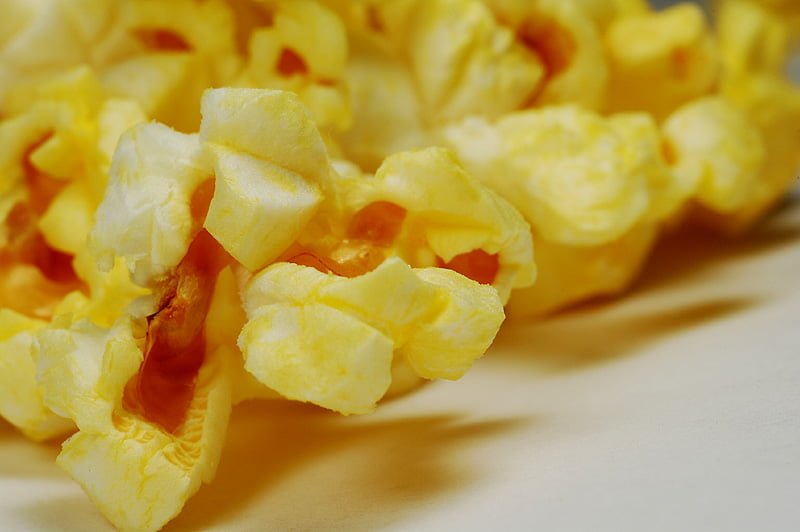
Yes, you didn’t mishear. Today I’m introducing the culinary transformation of dried corn: “popcorn.”
 Popcorn kernels
Hearing popcorn mentioned so suddenly, does it clash wildly with your traditional impression?
In general perception, popcorn is often seen as a high-calorie food laden with additives and health risks, even as it reigns as the undisputed movie companion.
Yet if we simply ask whether whole-grain corn is a wholesome food, few would disagree.
Beyond being a staple food that feeds the world, corn is naturally packed with vitamins and minerals, boasting low calories and high fiber. It has long been recognized internationally as one of the most bountiful, nutrient-dense crops on earth.
With so many natural benefits inherent to corn, why does popcorn occupy such a villainous reputation in our collective imagination?
The answer is simple: it is solely the result of artificial flavorings and commercial preparation methods.
Whether classic butter popcorn or decadent caramel popcorn, commercial success demands these flavor bombs to boost appeal, locking commercial production into an ultra-processed formula.
The most notorious consequence of this excessive processing is the generation of chemicals such as “diacetyl” (often found in artificial butter flavorings) and “trans fats,” along with the bodily harm they bring.
Yet enjoying popcorn with complete peace of mind and nutritional integrity is entirely achievable. What follows is my personal popcorn recipe, detailing the ingredients and steps:
- Heat a flat skillet over medium heat. Once hot[1], add the dry corn kernels[2], cover with a lid, and then… wait.
- When you hear the first kernel pop inside the pan, turn the heat down to low, and then… keep waiting.
- Throughout the cooking process, if you get bored, give the skillet a gentle shake every now and then.
- When the popping frequency slows down from rapid-fire bursts to isolated pops, turn off the heat completely and let the residual pan heat finish popping the rest.
As for the exact timing to cut the flame, refer to the diagram below. When the popping frequency drops from its peak continuous eruption back down to the slow, single-pop frequency seen at the start—represented by the vertical red dotted line[3]—cut the heat and let the latent heat coax out any remaining unpopped kernels.
 Popcorn time-frequency profile :P
Once you pour out the freshly popped corn, you don’t even need to add any sweet or salty seasonings to enjoy a deeply satisfying crunch.
If you are preparing it for kids, you can dust a bit of natural Okinawa brown sugar powder over the top. This imparts a subtle natural aroma with delicate sweetness that children will devour happily![4]
Further Reading
- My method uses no cooking oil whatsoever. If that makes you uneasy or if your trial fails, you may add a touch of unsalted butter or heart-healthy olive oil. Remember, just enough to lightly coat each kernel is plenty.
- A palmful of raw corn kernels will pop up to fill a standard soup-sized bowl (voice from the void: talk about an unscientific measurement!).
- Heat retention varies across cookware materials; be sure to calibrate the ideal shut-off moment for your own pan.
- Flavorings can be endlessly varied; feel free to get creative. A trendy contemporary twist involves drizzling condensed milk or dark melted chocolate over the popcorn, then baking it briefly in an oven until lightly toasted.
Support Independent Perspectives & In-Depth Insights
Every thoughtful analysis and candid critique comes from our dedication to truth and quality. We choose not to follow sensational algorithms or clickbait headlines.
Sustaining independent research requires reader support. Make a one-time or monthly contribution, securely processed by Google.
Payments secured by Google · Manage or cancel anytime in your Google Account


Comments