
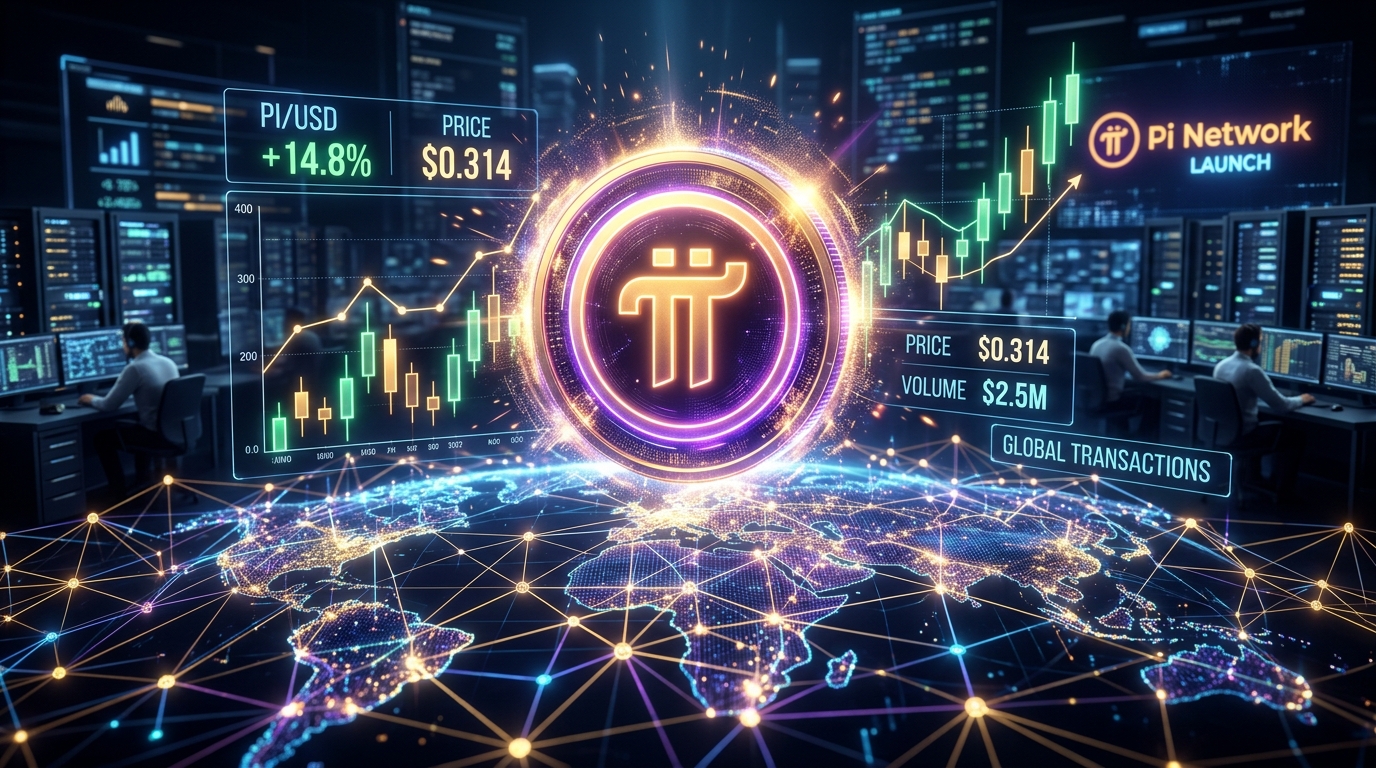
After years of mobile development, persistent skepticism, and an extended “Enclosed Mainnet” testing phase, the world-renowned mobile-first crypto project, “Pi Network,” has officially unlocked its open mainnet and debuted on public secondary exchanges.
With major cryptocurrency exchanges such as OKX, Pionex, and MEXC listing spot trading pairs, this historic milestone has not only ignited feverish celebration among tens of millions of community “Pioneers,” but has also delivered a major shockwave to cryptocurrency market pricing models, liquidity distribution, and retail consensus dynamics.
Key Dimensions of Market Impact from the Pi Token Listing
From daily mobile taps and peer-to-peer bartering to order-book matching across global centralized exchanges, Pi Network’s open launch has triggered significant market reactions:
1. Liquidity Release and Market Cap Discovery: From Paper Wealth to Liquid Markets
Founded in 2019 by Stanford graduates, Pi Network accumulated over 45 to 50 million active participants via its frictionless, zero-hardware mobile mining model. Prior to the open mainnet transition, however, tokens remained locked within an enclosed ecosystem, unable to trade freely against fiat or stablecoins. Holders had to treat their holdings as speculative digital promissory notes.
With listing on established exchanges, liquidity has achieved a qualitative leap:
- Establishing Transparent Pricing: Relying on subjective internal barter agreements is no longer necessary; exchange order books now provide real-time, transparent price discovery.
- Enabling Fiat Off-Ramps: Pioneers who cleared identity verification (KYC) and completed mainnet wallet migration have gained legitimate gateways to swap assets into USDT or fiat.
- Testing Liquidity Depth: Early trading sessions witnessed heavy profit-taking met by speculative buying. Sustained trading volume has replaced raw registration metrics as the definitive benchmark of project health.
2. Upending the Crypto Hierarchy: Massive Market Cap and Consensus Shifts
During the initial trading frenzy, constrained circulating supply on exchanges pushed fully diluted valuations (FDV) into astronomical territory, temporarily placing Pi Network among top-tier global digital assets.
This market phenomenon offers deep structural insights:
- The Power of Grassroots Retail Consensus: While Bitcoin and Ethereum anchor their security in PoW compute or PoS capital lockups, Pi Network demonstrated that an extensive social network and passionate community cohesion can command massive institutional and market attention.
- Liquidity Crowd-Out in Altcoin Markets: The token listing attracted non-traditional retail traders into active market accounts, absorbing significant retail liquidity and influencing broader altcoin market dynamics.
3. Restoring User Confidence and Real-World Ecosystem Adoption
For years, delayed timelines and stringent KYC backlogs sparked external skepticism regarding whether the project was merely an ad-revenue vehicle.
The successful exchange debut has significantly altered this narrative:
- Validating Long-Term Commitments: Transitioning to open secondary trading directly refuted scam allegations, solidifying core community loyalty.
- Incentivizing DApp Development: With a reliable market valuation, Web3 developers and real-world merchants now have tangible economic incentives to build decentralized commerce, gaming, and local payments via the Pi Browser and Pi Pay ecosystem.
4. Structural Challenges and Investment Risks
Despite the listing euphoria, significant structural challenges remain:
| Risk Category | In-Depth Analytical Breakdown |
|---|---|
| Pending Token Unlocks | As millions of queued users clear KYC and unlock vested wallet balances, waves of secondary market selling pressure could severely test order-book absorption capacity. |
| Lack of Protocol Cash Flows | Unlike smart contract platforms supported by gas burn mechanisms or decentralized protocol revenues, Pi Network’s valuation remains heavily reliant on sentiment and narrative rather than organic cash flow. |
| Global Regulatory Scrutiny | Financial watchdogs (including the US SEC and EU MiCA regulators) scrutinize viral referral and multi-tier distribution mechanics, leaving lingering compliance risks. |
| IOU Discrepancies vs. Real Tokens | Prior unauthorized trading of synthetic IOU contracts across certain platforms caused severe price distortions; retail participants must verify native deposit pathways. |
5 Practical Risk Management Rules for Investors and Holders
Whether managing long-held mined tokens or trading secondary market volatility, participants must exercise disciplined risk management:
- Protect Private Keys and Mnemonic Passphrases: During periods of heightened listing hype, phishing portals offering “accelerated mainnet migration” or “airdrop bonuses” proliferate. Remember: Core team members will never ask for your 24-word passphrase. All operations should remain within the official Pi Browser.
- Distinguish Between Dashboard Balances and Usable Liquidity: Unverified referral bonuses cannot be freely transferred. Only the net transferable balance migrated to your active mainnet wallet represents deployable capital.
- Adopt Staggered Profit-Taking Strategies: For tokens accumulated at zero capital cost, incremental scaling out locks in gains. Avoid unrealistic speculative targets that lead to missed rebalancing opportunities.
- Monitor On-Chain Metrics Rather Than Social Slogans: Gauge the project’s long-term viability through daily active on-chain addresses, ecosystem transaction volume, and smart contract activity, rather than social media chatter.
- Avoid Over-Leveraged Derivatives: Newly listed assets exhibit extreme volatility and thin initial liquidity depths. Trading high-leverage futures contracts carries extreme liquidation risks during market corrections.
Conclusion: From Social Experiment to Financial Reality
The open mainnet launch and exchange listing of Pi Network represents a landmark chapter in cryptocurrency history. It has transitioned a multi-year global experiment in human consensus into the transparent, unforgiving arena of modern capital markets.
Whether Pi Network evolves into a genuine utility currency with widespread merchant adoption depends on developer retention, sustainable utility, and the management of future token emissions. For rational market participants, objective risk analysis and emotional detachment remain essential for navigating the evolving crypto landscape.
Support Independent Perspectives & In-Depth Insights
Every thoughtful analysis and candid critique comes from our dedication to truth and quality. We choose not to follow sensational algorithms or clickbait headlines.
Sustaining independent research requires reader support. Make a one-time or monthly contribution, securely processed by Google.
Payments secured by Google · Manage or cancel anytime in your Google Account



Comments