
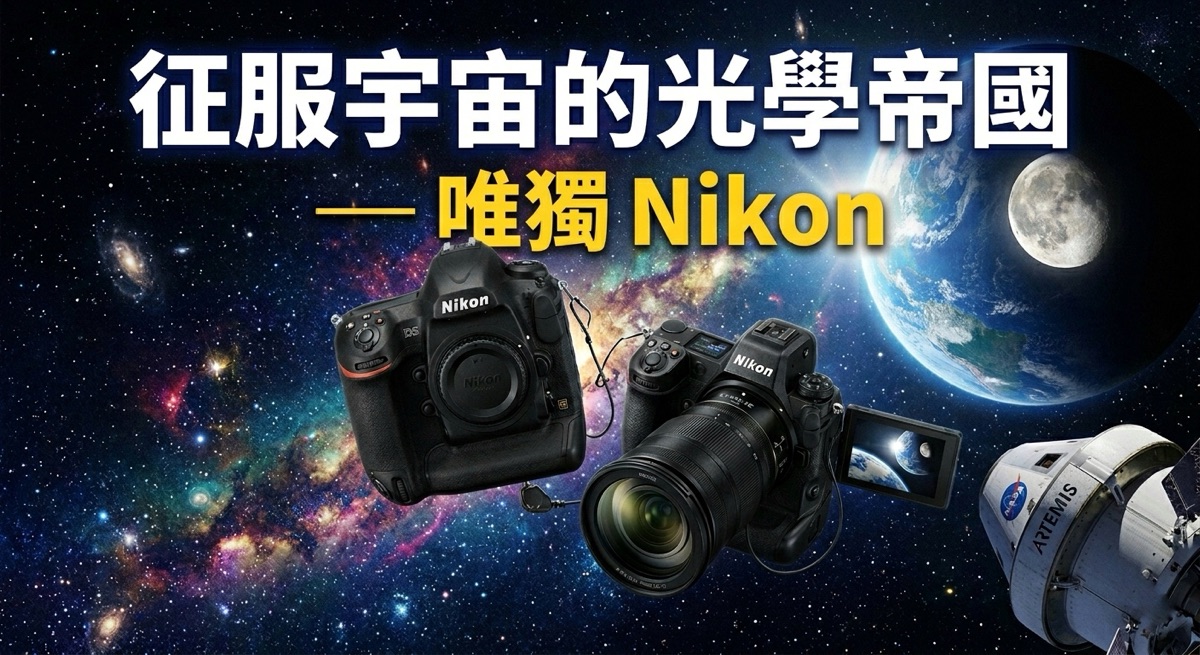
In the deep space of 2026, Nikon is declaring sovereignty over its territory. As Artemis II prepares for its lunar flyby mission, the equipment list commander Reid Wiseman displayed at the press conference once again left photography enthusiasts worldwide holding their breath: besides the modern mirrorless performance monster Z9, he also specially brought along a veteran that has served for over a decade — the Nikon D5.
This is an honor, and even more a technical dignity that other commercial brands find hard to match. While other manufacturers are still chasing the pixel game of the consumer market, Nikon has long since carved its name into the vacuum of the universe, into an optical empire surrounded by cold and radiation.
A Bloodline of Honor: Making Aerospace Specs a “Standard Factory Feature”
Nikon’s relationship with NASA (the National Aeronautics and Space Administration) was never a simple procurement contract, but an almost rigorous co-evolution.
Early space cameras needed to undergo a painful “rebirth,” replacing all volatile lubricants and reshaping circuit barriers. But Nikon displayed the engineering pride of an optical giant. They disdained making expensive special-spec models just for NASA, and instead chose to pour these extreme Space-Ready standards directly into the production lines of their consumer products.
The 2009 D3s was a legend. It was the first mass-market camera in history that could be taken straight off a camera store shelf and sent into a space capsule without any surgery. This obsession with quality allowed Nikon to successfully “parasitize” itself within NASA’s standard system. While competitors were still scrambling over how to pass vibration tests, Nikon’s machines were already calmly recording the outline of the Earth in zero gravity.
The Line Between Mediocrity and Genius: The Absence of Canon and Sony
Why, in the hands of astronauts, do we not see those white long-lens phalanxes that flaunt themselves on Olympic fields?
This involves a cruel commercial reality: a compromise with the ultimate mediocrity of humanity.
Canon did not lack opportunities in the early days, but this company displayed the shrewdness of a merchant rather than the passion of an engineer. After evaluating NASA’s order, they concluded that developing special high-temperature-resistant, radiation-resistant processes for an extremely small space demand was, on paper, extremely unprofitable.
So Canon chose the easier shortcut — mass production on the ground, reaping profits from the mass market, and leaving that thankless task of “challenging the limits of physics” to Nikon — and as long as they priced things a little cheaper than Nikon, a crowd of trend-chasers would pay up.
As for emerging forces like Sony, although dazzling in electronic specifications, they appear like delicate toys in the face of resilience in extreme environments. In a deep-space environment full of high-energy particles, the failure risk of electronic viewfinders and the fragility of sensors have kept them from ever gaining one hundred percent trust in life-or-death space missions.
Muscle Memory and Lens Legacy: This Is a War That Cannot Be Counterattacked
What Nikon built on the International Space Station (ISS) is a complete “optical empire.”
Within the station’s limited modules are packed more than 35 top-tier Nikkor lenses. The shipping cost of each lens is several times that of the camera itself. For NASA, switching brands would mean abandoning assets accumulated over decades and already verified in the vacuum environment.
More crucial is the astronauts’ “faith.” In a space environment of oxygen deprivation, high pressure, and every second counting, operating a camera must become Muscle Memory.
The world’s most elite astronauts, during training, encounter every manual and hear every piece of advice whose operating logic all originates from Nikon. This brand loyalty is not bought with advertising, but earned through the real-world credibility of a shutter that still fires steadily in the darkness of minus two hundred degrees.
The Summit of the Moon: Hasselblad’s Ancient Monument and Nikon’s Future
We cannot erase the magnificent images Hasselblad left behind in the Apollo era; those 12 bodies left on the lunar surface are the swan song of the film age. But Hasselblad’s legend is now a thing of the past, its expense and delicacy long unsuited to the high-frequency demands of modern aerospace.
Now, as Reid Wiseman flies toward the far side of the Moon with the Z9 and D5, Nikon is completing the final piece of the puzzle. This is not merely about taking photographs; this is Nikon telling the whole world:
Even on humanity’s most distant journey, wherever there is light, there must be Nikon.
Support Independent Perspectives & In-Depth Insights
Every thoughtful analysis and candid critique comes from our dedication to truth and quality. We choose not to follow sensational algorithms or clickbait headlines.
Sustaining independent research requires reader support. Make a one-time or monthly contribution, securely processed by Google.
Payments secured by Google · Manage or cancel anytime in your Google Account




Comments