
This article is a record of the author’s reflections after reading Huang Yafei’s article “Eyes and Photography,” submitted to Artco magazine after visiting Japanese photographer Takashi Homma.
The eye is the most honest organ, yet also the one most easily deceived. It is honest because it directly captures the external world for us; it deceives because we thereby lose the ability to doubt what we see and hear. However much the symbolic and meaning systems of the external world swell and complicate, the reality we see will be distorted to that same degree. Photography, as a transcription of reality, finds itself in unprecedented complexity.
Photography is a kind of emerging art form. From its early days as an auxiliary tool for painting, to today’s diverse creations, and to its unknowable future development, I think its complexity has never diminished by even a trace.
The Nature of Vision / The Gap of Reality
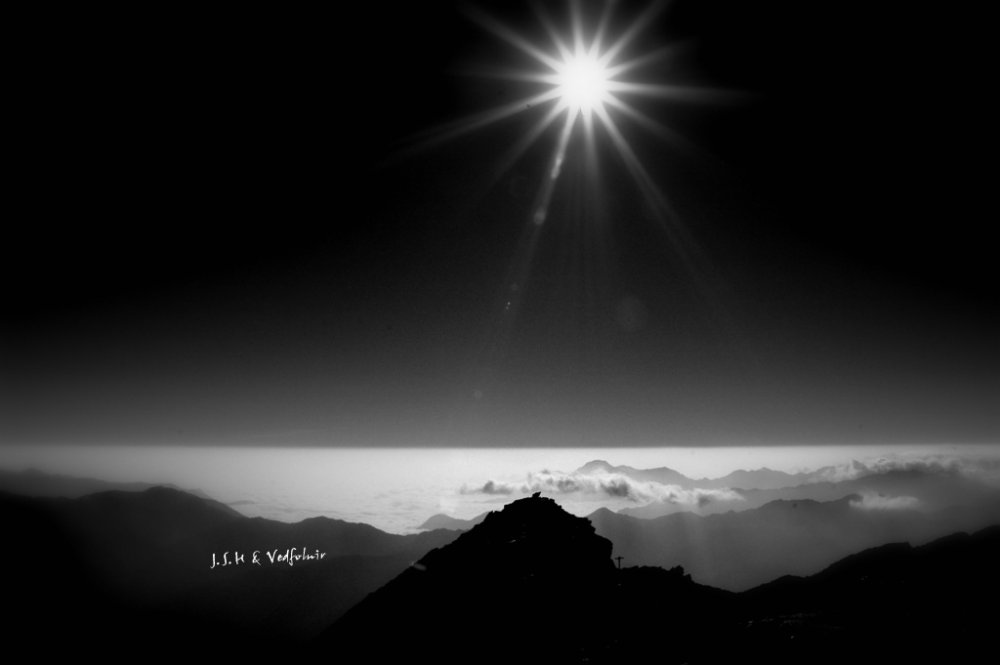
From January 8 to March 21 this year, at the large solo exhibition “New Documentary” by Takashi Homma at the 21st Century Museum of Contemporary Art, Kanazawa, the installation Seeing Itself, made from photographs of the world’s high mountains, expressed its complex foundational elements. Seeing Itself consists of 11 lightbox photographs of high mountains, one indoor lightbox photograph, and one LCD screen playing a video of high mountains. Viewers stand outside the exhibition room and gaze through binoculars at the lightbox images showing through from the other end of the room. This method and distance, simulating gazing at a natural mountain scene, may make us mistakenly fall into the perception of actually holding binoculars to view a real scene. But the moment our gaze shifts to the nude lying indoors and the flowing images, our cognition is disrupted, our tight bond between vision and reality is forcibly torn apart, and the gap between “what we think” and “what we see” gradually widens.
This feeling is like during festivals, when you choose either to go to the crowded venue to watch fireworks you may not even see, or to stay in the comfort of home watching a giant screen broadcasting fireworks filmed by a TV company from a perfect position — the gap between what you “think” and what you can “actually” see.
Of course, staying at home means you cannot feel the air on site, the smell of gunpowder, the touch of people crowding against one another, or even the loneliness of not seeing the fireworks; but perhaps, too, what we think we see and what we actually see are not so very different after all — the only thing that exists is the viewer’s own feeling, and the one who makes the choice is, in the end, each solitary individual.
Takashi Homma’s concern with photography lies in “the photography of contemporary art” and “the photography of photography” (that is, photography made by treating photography itself as a material or object). …Not a subjectivity with a decisive moment, but an objective, plain record — photographic works that make all mountain scenes “equivalent.”
A Photography Reading Without a “Location”
Overall, Takashi Homma has a strong interest in conceptual thinking about the way photography looks, the distance from photography, preconceptions about photography, and the interpretation of photography — that is, the concept of thinking about the nature of photography. This is what Takashi Homma himself calls “somewhere in-between,” or what critic Noi Sawaragi calls “he is neither inside what postwar (Japanese) photography protected, nor in a safe outside, but begins from a nearby, surrounding place with no ‘location.’”
The meaning of “no location” is hard to understand. Apart from founding a new school, does having no location not mean having no meaning? Because without a location it cannot exist; an existence that cannot be proven must rely on more language to explain — has it already strayed from the original intent of photography?
“No ‘location’” is fully expressed in the displays of Tokyo and My Daughter and Widows at the 21st Century Museum of Contemporary Art, Kanazawa. In fact, the subject is not his daughter at all, yet most people, upon reading the title, naturally assume this is the artist’s daughter. Widows has Takashi Homma visiting widows in a small Italian village, photographing their portraits and the townscape, and re-photographing their old photographs. The works on the two walls respectively echo and explain that “who is photographed does not matter” and “who took the photograph does not matter,” because no matter how ambiguous, mistaken, doubtful, or misunderstood, the photograph already exists, and photography as photography is already sufficiently established. In other words, Takashi Homma erased the highly revered halo of the “photographer” and, with an open role, looked anew at photography itself.
In the end he will still be classified as a new type of photographer, which is in fact highly ironic from beginning to end.
M, which long documented the appearance of fast-food restaurants, carries the same meaning. A photographer stuck in new color photography or the Dusseldorf School, if handling M, would draw a conclusion for this series in the context of documentary or typology. But Takashi Homma instead rendered the works in silkscreen, or enlarged the same image into different works, and framed them in acrylic boxes placed on the floor — Takashi Homma is likewise asking: when photography’s inherent methods of presentation are changed, how will we look at these photographs? And then further reflecting on the tradition of “photographers” who cling to the photographer’s halo, refuse to enlarge works, and refuse to split images into multiple versions, finally asking: what exactly is photography? And what exactly is documentary?
Photography is the most honest, yet perhaps also the most false, category of art; it seems extremely free…
Support Independent Perspectives & In-Depth Insights
Every thoughtful analysis and candid critique comes from our dedication to truth and quality. We choose not to follow sensational algorithms or clickbait headlines.
Sustaining independent research requires reader support. Make a one-time or monthly contribution, securely processed by Google.
Payments secured by Google · Manage or cancel anytime in your Google Account

Comments