
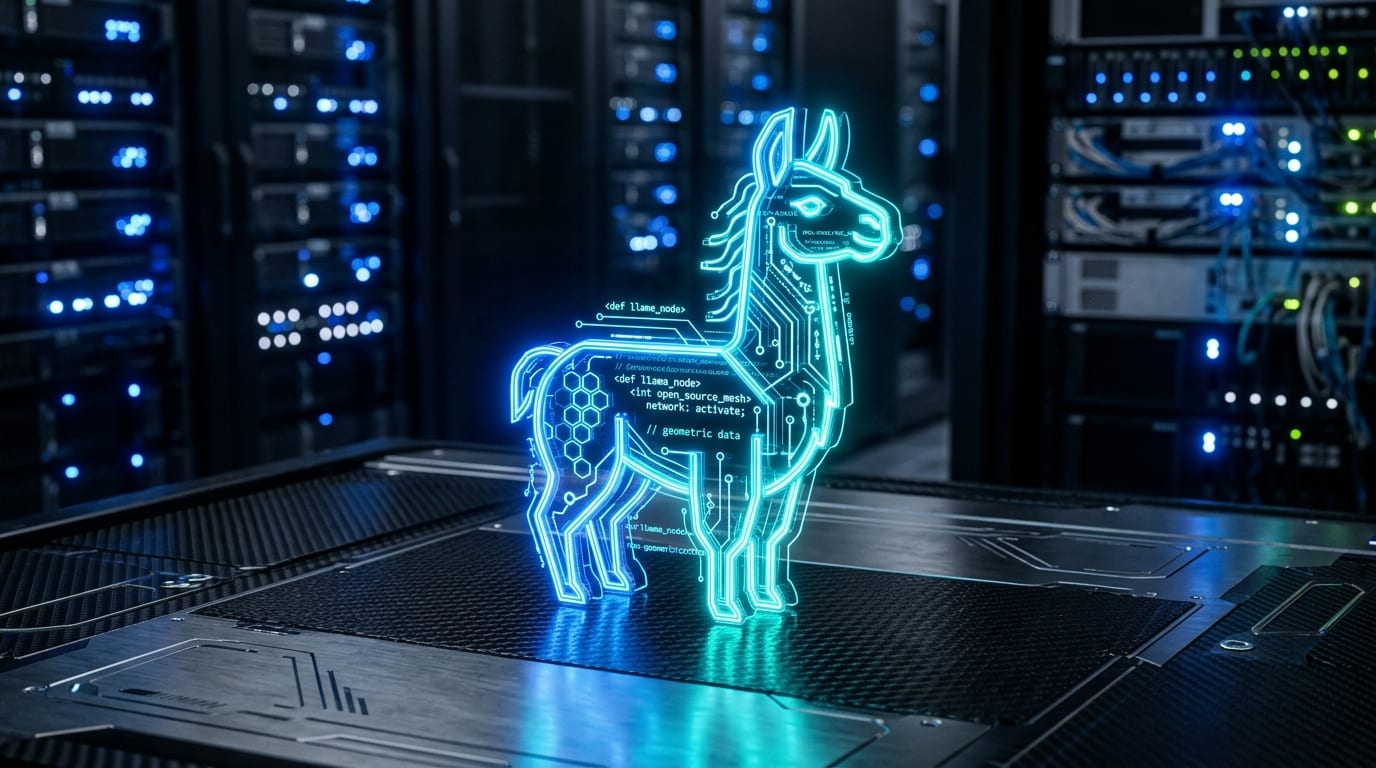
Throughout the generative artificial intelligence landscape, two distinct paradigms have fiercely competed: the “walled gardens” championed by OpenAI and Google—where users query black-box models exclusively through commercial cloud APIs—and the “open weights ecosystem” spearheaded by Meta, where developers can download, inspect, and deploy model weights on private infrastructure.
On April 18, 2024, Meta CEO Mark Zuckerberg delivered the open source community’s definitive triumph: the official release of the Llama 3 foundation model family, debuting with 8B (8 billion) and 70B (70 billion) parameter variants.
The release dismantled the prevailing assumption that open models would permanently lag proprietary alternatives by six to twelve months. Llama 3 established a new benchmark for open-weights performance and made running frontier-grade intelligence locally on consumer hardware an everyday reality.
1. Architectural Scaling: 15 Trillion Tokens and a Rebuilt Tokenizer
Rather than merely scaling parameter counts, Meta focused on pushing data volume and training compute efficiency to unprecedented heights:
- A Massive 15-Trillion-Token Corpus:
- Up from Llama 2’s 2 trillion tokens, Llama 3 underwent pre-training on 15T tokens—a sevenfold expansion—incorporating 4x more programming code and over thirty non-English languages.
- Meta deployed multi-stage heuristic classifiers and synthetic quality filters to ensure exceptional data cleanliness.
- A 128K Tokenizer:
- The upgraded 128,000-token dictionary boosted encoding compression efficiency by roughly 15%, reducing inference latency across multi-lingual and programming workloads.
- Grouped Query Attention (GQA) Standardized Across All Tiers:
- Both the 8B and 70B models adopt GQA, significantly lowering memory footprints during long-context generation and allowing modern consumer graphics cards (like an RTX 4060) to run models fluidly.
2. Benchmark Domination: 8B Outperforming Prior Giants
In rigorous standard academic evaluations, Llama 3 delivered extraordinary numbers:
- Llama 3 8B: Reached 68.4% on MMLU, 79.6% on GSM8K math reasoning, and 62.2% on HumanEval coding. A compact model requiring only a few gigabytes of VRAM surpassed the performance of previous generation server-grade models.
- Llama 3 70B: Scored 82.0% on MMLU, 93.0% on GSM8K, and 81.7% on HumanEval, matching or exceeding closed-source models like Claude 3 Sonnet and closely rivaling original GPT-4 baselines.
In blinded human preference evaluations, evaluators consistently favored Llama 3 70B for creative writing, code debugging, and complex instruction following.
3. Mark Zuckerberg’s Grand Strategy: Why Open Weights?
Training state-of-the-art models costs hundreds of millions of dollars in compute clusters and electricity. Why does Meta give its crown jewels away for free?
- Commoditizing the Complement: By offering free, high-performance weights, Meta erodes the high margin pricing power of cloud competitors like OpenAI and Microsoft.
- Harnessing Global Developer Innovation: Millions of software engineers build fine-tuning tools (LoRA), quantization formats, and low-latency runtimes around Llama architecture, saving Meta immense R&D expenditure.
- Fueling Hardware and Edge Ambitions: Llama 3 serves as the cognitive foundation for Meta’s Ray-Ban smart glasses, Quest spatial headsets, and global advertising recommendation engines.
Llama 3 demonstrated that open-source AI is not a second-rate substitute, but a dynamic, indispensable counterweight preserving technological independence and decentralized innovation worldwide.
Support Independent Perspectives & In-Depth Insights
Every thoughtful analysis and candid critique comes from our dedication to truth and quality. We choose not to follow sensational algorithms or clickbait headlines.
Sustaining independent research requires reader support. Make a one-time or monthly contribution, securely processed by Google.
Payments secured by Google · Manage or cancel anytime in your Google Account


Comments