
South Korea is an intriguing country that many people dislike for myriad reasons—whether sparked by heated sporting clashes (such as the FIFA World Cup, the Yang Shu-chun taekwondo controversy, e-sports rivalries, or international baseball tournaments), dog meat consumption, xenophobia mixed with foreign dependency, perceived bad faith in business, or simply being the travelers one least wishes to run into on journeys abroad.
To repeat an old point (even if tangential): strictly speaking, there is no generic “Korea” on the map, only South Korea (Republic of Korea) and North Korea (DPRK).
Personally, I dislike South Korea quite a bit as well. But as the saying goes, “know yourself and know your enemy.” The chart below is something everyone should inspect closely: a market capitalization comparison between the top 10 listed corporate groups in Taiwan and South Korea.
From this comparison, a startling reality emerges: just two Samsung Electronics conglomerates would be enough to buy out all ten of Taiwan’s premier flagship enterprises combined.
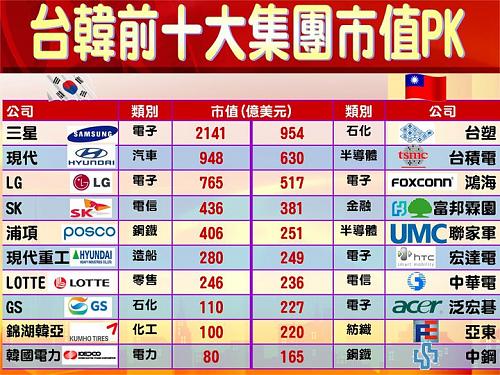 Market Cap Showdown: Top 10 Corporate Groups in Taiwan vs. South Korea
This chart reveals another critical takeaway: South Korean corporate market caps suffer a steep, cliff-like drop starting from the fourth spot. In contrast, Taiwan’s leading enterprises exhibit a healthier, more balanced spread, showing a smooth linear gradient across rankings. Furthermore, let us not forget that South Korea not only boasts a larger domestic consumer market than Taiwan, but its external trade has historically expanded even more aggressively.
This disparity is fundamentally the result of the South Korean state stepping in as the heavy-handed backer behind mega-conglomerates (chaebols), which has fueled soaring consumer prices and mounting household debt (in August 2014, the South Korean government even cut benchmark interest rates by a quarter-point to stimulate domestic spending…), all to forge an international giant like Samsung. As shown in the chart above, the total market valuation of the Samsung Group alone exceeds the sum of Taiwan’s top three corporations by over US$4 billion, while South Korea’s top ten enterprises surpass Taiwan’s top ten by a staggering US$168.2 billion in combined market value.
Looking at this from another global perspective: in 2011, Apple reigned supreme worldwide with a total market capitalization of US$337.2 billion, while ExxonMobil, which held the top crown for many years, took second place at US$330.8 billion. While Samsung was “only” valued at US$214.1 billion at the time, the gap between Samsung and Apple was roughly equivalent to the vast gulf between Formosa Plastics and Samsung—a seemingly insurmountable summit.
Even so, Samsung remains a deeply controversial enterprise. Comparing it directly to Apple evokes a headline once run by the Awakening News Networks: “Both Are Celebrities, but Worlds Apart: Media Praises Fong Fei-fei, Laments Makiyo Gang”—an utterly mismatched comparison of apples and oranges.
Lastly, as mentioned earlier regarding domestic market size, we can examine population figures: South Korea has roughly 50 million residents, whereas Taiwan has less than half of that at 23 million. Yet South Korea’s telecom giant SK Telecom held a market valuation of US$43.6 billion, while Taiwan’s Chunghwa Telecom stood at US$23.6 billion. Looking strictly at per-capita contribution ratios, Chunghwa Telecom’s revenue per user is substantially higher—which begs the obvious question: when will broadband and mobile fees finally come down?
(Originally written on February 15, 2012; expanded and updated on September 4, 2014.)
Support Independent Perspectives & In-Depth Insights
Every thoughtful analysis and candid critique comes from our dedication to truth and quality. We choose not to follow sensational algorithms or clickbait headlines.
Sustaining independent research requires reader support. Make a one-time or monthly contribution, securely processed by Google.
Payments secured by Google · Manage or cancel anytime in your Google Account


Comments