
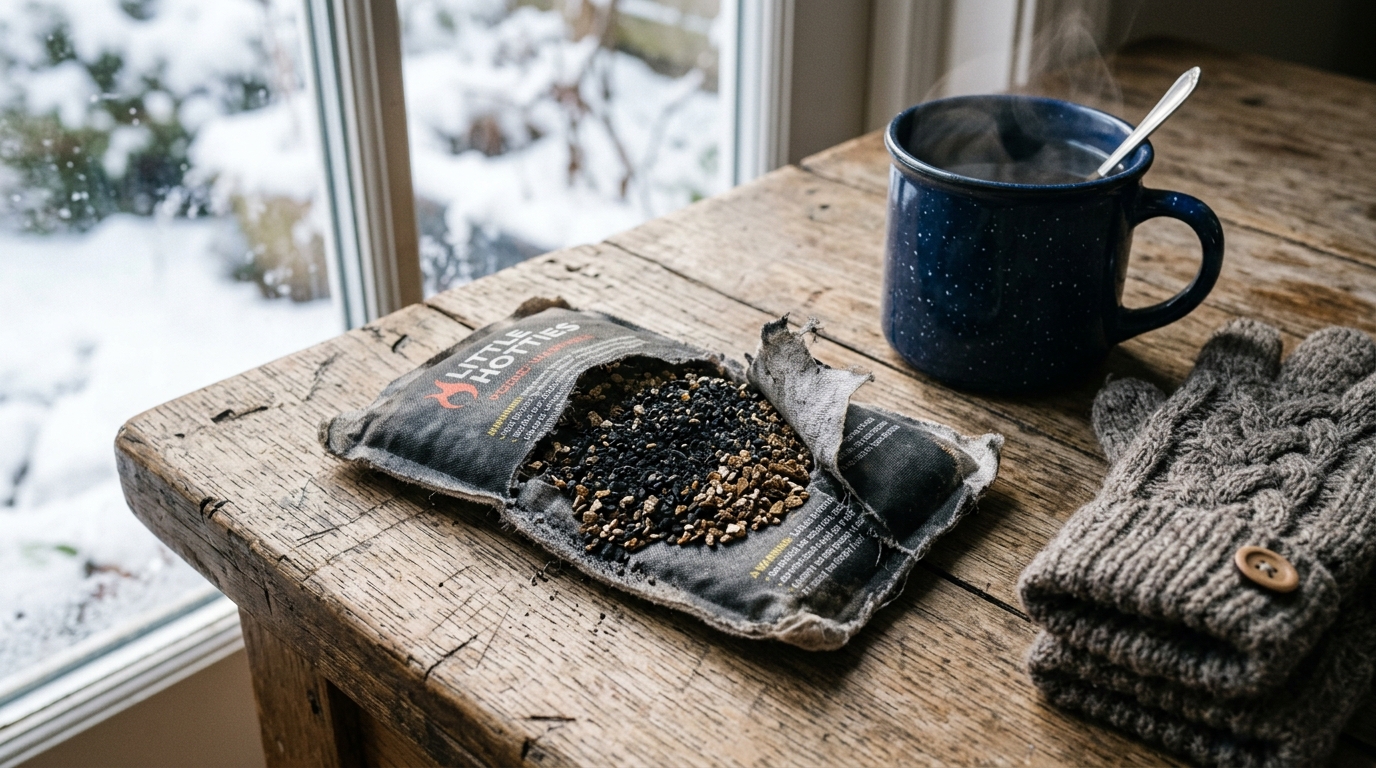
Whenever a cold snap arrives in winter, many households keep several large packs of “White Rabbit hand warmers” or various disposable pocket warmers in the living room coffee table or entryway drawer. Grab one and put it in your pocket or stick it on your waist before heading out, and within a few minutes you can feel an endless supply of warmth.
But have you ever wondered: what kind of magic is packed inside this thin, seemingly unremarkable little non-woven pouch? Why can it generate heat on its own for more than ten hours just by tearing open the transparent outer plastic bag, without even needing to be plugged in or lit?
Before unveiling this little life magic, a shocking accident occurred in the central region a few years ago: an elderly woman with dementia, while preparing breakfast in the early morning, mistook a hand warmer her family had left on the dining table for an instant black sesame paste packet. She cut it open, poured it into a bowl, added hot water, and drank a large bowl of scalding “iron sand paste” on the spot, causing extensive chemical and thermal burns to her esophagus and stomach wall, and she was rushed to the hospital for gastric lavage and emergency treatment.
This unfortunate incident shocked many families. Today, let us completely break down the five core “fillings” inside a hand warmer from the perspective of chemical engineering and materials science, and take a deep look at the safety precautions and eco-friendly disposal rules that must be kept in mind for daily use.
A Complete Analysis of the Five Core Chemical “Fillings” of a Hand Warmer
The heat-generating principle of a disposable pocket hand warmer is essentially a precisely controlled “accelerated iron rusting (oxidation heat release) reaction.”
In a natural environment, an iron block exposed to air slowly oxidizes and rusts while releasing weak heat, but because the reaction is too slow, we cannot feel any temperature change at all. The brilliance of the hand warmer lies in grinding iron into extremely fine micron-level powder, greatly increasing the surface area in contact with oxygen, and using auxiliary media in the formula to compress a rusting process that would take years into a violent release within just over ten hours:
| Material Ingredient Name | English Scientific Name and Material Characteristics | Key Role in the Hand Warmer |
|---|---|---|
| Iron Powder | High-purity micron-level reduced iron powder | Main fuel and heat source. Combines with oxygen in the air to form iron oxide (rust) and releases a large amount of reaction heat. |
| Microporous Pouch | Special high-density polyethylene/polypropylene microporous non-woven fabric | Heat valve and oxygen regulator. Controls the rate of air infiltration through precise micropores, determining the hand warmer’s heating speed and peak temperature. |
| Activated Charcoal | High specific surface area porous carbon material | Water reservoir and heat conduction medium. Absorbs the water needed for oxidation and uses its microporous structure to spread heat evenly within the pouch. |
| Sodium Chloride (table salt) | Industrial/food-grade sodium chloride salt crystals | Electrocatalyst. Dissolves in water to form an electrolyte solution, rapidly catalyzing the electrochemical redox reaction between iron and oxygen. |
| Vermiculite | Hydrated magnesium aluminum silicate mineral (expanded mica) | Buffer insulation agent and anti-burn protective layer. Highly water-absorbent, chemically inert, and fire-resistant, evenly dispersing the iron powder to prevent localized violent clumping that could burn the skin. |
1. Iron Powder: The Most Natural Chemical Fuel
Iron powder is the protagonist of the entire heat-generating reaction. Once the outer envelope that blocks air is torn open, the oxygen in the air contacts the iron powder inside the microporous pouch and rapidly undergoes a chemical reaction to form iron oxide ($4Fe + 3O_2 \rightarrow 2Fe_2O_3$). For every mole of iron oxide formed, as much as 824 kilojoules (kJ) of heat is released!
The average maximum temperature of a civilian handheld hand warmer is roughly 60°C to 68°C (about 140°F to 155°F); while military-grade self-heating packs used by US soldiers to heat flameless rations (MRE) in the field can reach maximum temperatures exceeding 93°C (200°F).
Factories usually manufacture this fine iron powder by atomizing and spraying molten steel with high-pressure water mist, or by mechanical high-pressure crushing. An interesting piece of trivia: to supplement trace minerals, humans eat more than 2 million pounds of the same grade of edible fine iron powder each year in nutritionally fortified breakfast oatmeal!
2. Microporous Pouch: The Precise Throttle Valve for Oxygen
The reason a hand warmer does not instantly flare up and burn like a match lies in that seemingly ordinary white non-woven pouch on the outside. The surface of this pouch is covered with micron-level breathable pores invisible to the naked eye, acting like an engine’s intake manifold, precisely limiting the total amount of oxygen that can permeate through per unit of time.
This also explains why hand warmers for different body parts on the market have different structures: for example, the “toe-specific hand warmer” designed to be tucked into the toe of a shoe often has a higher density of pores on its non-woven fabric than the general handheld type. Because the air circulation inside thick snow boots is extremely poor and the oxygen content is very low, it must rely on larger intake pores to maintain the basic oxidation reaction.
3. Activated Charcoal: The Divine Tool for Water Storage and Even Heating
In addition to oxygen, a trace amount of water is an indispensable medium for the chemical oxidation reaction. Activated charcoal is activated in an oxygen-free high-temperature environment, and its internal carbon atoms crack apart to create hundreds of millions of micropores. The specific surface area of one gram of activated charcoal reaches as much as 2,000 square meters (the total internal surface area of one pound of activated charcoal is equivalent to six full American football fields!).
These tiny capillaries can firmly lock in the trace liquid water needed for the reaction, and by virtue of excellent thermal conductivity, spread the heat generated by the iron powder reaction evenly throughout the entire pouch, preventing uneven localized heating.
4. Sodium Chloride: The Accelerator That Catalyzes Rusting
Just as spreading salt on roads to melt snow in winter causes severe corrosion of the undercarriages of passing cars, sodium chloride is a super catalyst for the iron rusting reaction. Once table salt dissolves in the trace water carried by the activated charcoal, it forms an electrolyte solution with excellent conductivity, increasing the electron transfer rate of iron atoms by thousands of times, allowing the hand warmer to heat up rapidly within just a few minutes of contact with air.
5. Vermiculite: The Safety Buffer Layer That Prevents Burns
The Latin origin of vermiculite means “little worm (Vermiculus),” because when this natural hydrated magnesium aluminum silicate ore is heated to a high temperature, the interlayer water violently vaporizes and expands, making it look like wriggling little worms.
Expanded vermiculite is extremely lightweight and possesses excellent chemical inertness and fire-resistant insulation properties. In a hand warmer, it acts like countless tiny sponge particles evenly separating the iron powder, preventing the iron powder from accumulating and clumping into deadly high-temperature hot spots that burn the skin. Because it is non-toxic and has excellent moisture retention and constant-temperature properties, in the reptile-keeping world professional hobbyists also commonly use vermiculite as a bedding medium for incubating snake and lizard eggs.
Three Major Safety Self-Protection Rules for Hand Warmers
Now that you understand the composition of a hand warmer, you must establish correct safety awareness in daily use to avoid turning a cold-fighting tool into a deadly trap:
1. Keep Away from Dining and Kitchen Tables, Beware of Accidental Ingestion by the Elderly and Young Children
The contents of a hand warmer look like fine gray-black powder, extremely similar to commercially available three-in-one black sesame paste, almond tea powder, or instant coffee.
- Zoned storage: Hand warmers must never be placed in the same drawer or on the same table as instant drinks or snacks. They should be kept in a dedicated medicine cabinet or a moisture-proof wardrobe cabinet.
- Emergency handling of ingestion: If an elderly family member or young child accidentally ingests hand warmer powder, do not induce vomiting (induced vomiting may cause the iron sand to burn the esophagus a second time or be inhaled into the trachea causing suffocation). Immediately give a small amount of cold water or milk to protect the digestive tract mucosa, and quickly bring the packaging to the hospital emergency room for gastric lavage.
2. Guard Against “Low-Temperature Burns”: Never Sleep with One Pressed Directly Against the Skin
When human skin contacts a heat source of 44°C to 50°C, it does not initially feel severe pain, but if the contact lasts for tens of minutes to several hours, the heat gradually penetrates the dermis, causing protein denaturation and necrosis of the subcutaneous tissue, forming a red, swollen, blistered “third-degree low-temperature burn.”
- Adhesive hand warmers must be attached to the outer layer of close-fitting clothing, and must never be attached directly to bare skin.
- Be sure to remove the hand warmer from the bedding before sleeping. During sleep, the body’s pain response is dull, and combined with the heat-trapping quilt, it is very easy to cause serious burns unconsciously.
3. Can a Used Hand Warmer Be Reused?
A hand warmer that has finished generating heat has essentially transformed into heatless iron oxide (rust) mixed with activated charcoal and vermiculite.
- Household dehumidification and deodorization: Since there is still a large amount of activated charcoal and vermiculite in the pouch, a fully cooled old hand warmer can be stuffed into a shoe cabinet, inside shoes, or a corner of a wardrobe to serve as a natural moisture-proof and odor-absorbing pack.
- Never casually pour it into potted plants or the garden: There are often folk remedies online claiming that the iron and vermiculite in a hand warmer can serve as flower fertilizer, but a hand warmer contains a high concentration of table salt (sodium chloride). If poured into a pot at will, it will cause soil salinization, directly draining the water from the plant’s roots and causing the plant to wither and die!
Support Independent Perspectives & In-Depth Insights
Every thoughtful analysis and candid critique comes from our dedication to truth and quality. We choose not to follow sensational algorithms or clickbait headlines.
Sustaining independent research requires reader support. Make a one-time or monthly contribution, securely processed by Google.
Payments secured by Google · Manage or cancel anytime in your Google Account



Comments