
Google officially announced an evolved verification technology, “reCAPTCHA”, promising a much more user-friendly and robust solution for countering spam comments and automated web bots.
The defining characteristic of this new approach is that a single simple click replaces the tedious chore of typing long, distorted verification codes (which frequently resulted in mistyped inputs). Google’s backend behavioral heuristics achieve the same—yet vastly more convenient—verification goal of distinguishing humans from automated scripts.
At present, the inner workings of this intelligent verification mechanism remain under wraps. If it withstands automated probing over the next few months, it will have proved its mettle against internet hackers. Seeing this launch brought back memories of my own past experiments, where I explored combining cursor trajectory randomness with IP blacklists to detect automation.
Take a look at the animation of Google reCAPTCHA in Figure 1. This iteration presents an ultra-minimalist widget containing merely a single checkbox.
The verification process is remarkably simple and natural: users merely guide their mouse cursor to click the checkbox. Google’s newly developed risk analysis engine automatically determines whether the interaction was performed organically by a human or scripted by a bot.
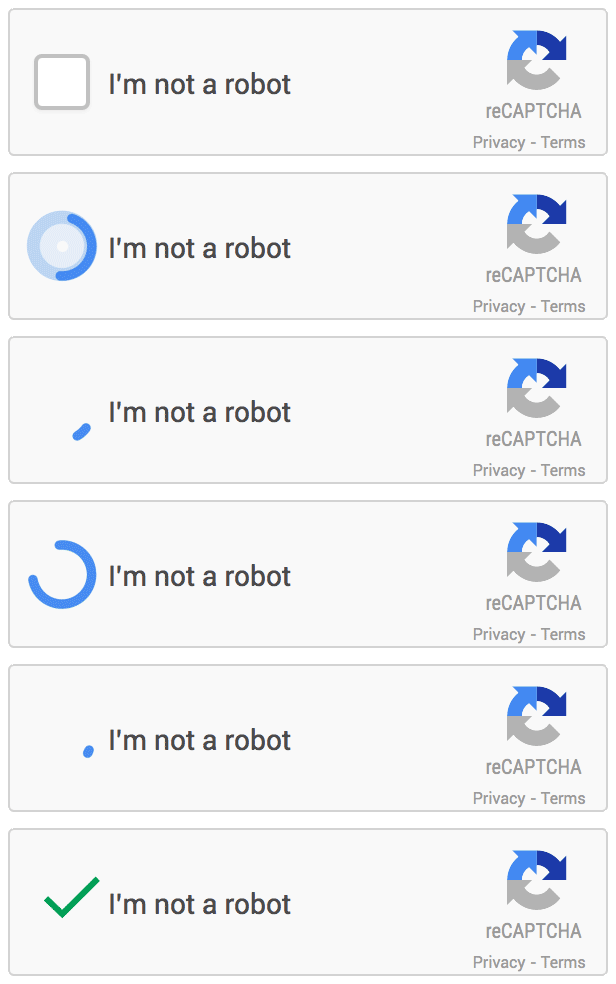 Figure 1: Google’s streamlined verification widget.
CAPTCHA stands for “Completely Automated Public Turing test to tell Computers and Humans Apart”, originally intended as an automated challenge to determine human presence versus machine emulation.
As an aside, the AI Matrix in The Matrix trilogy could be said to have thoroughly surpassed the Turing Test. In the second installment, The Matrix Reloaded, the philosophical dialogue between Neo and the Architect within the Source regarding choice remains a cinema classic, precisely because Neo arrived at an answer distinct from his five predecessor anomalies.
The Turing Test was proposed by Alan Turing in 1950 as a benchmark experiment to determine whether a machine can exhibit intelligent behavior indistinguishable from that of a human. The exchange is confined to purely text-based channels, such as a keyboard and display terminal, ensuring results do not hinge on audio synthesis or visual rendering.
Traditional CAPTCHA mechanisms rely on reverse Turing tests, typically using “distorted character puzzles” or “knowledge queries” that presumably only humans can solve.
Figure 2 illustrates the traditional distorted text challenge long employed by Google’s older reCAPTCHA (which I frequently misread and failed).
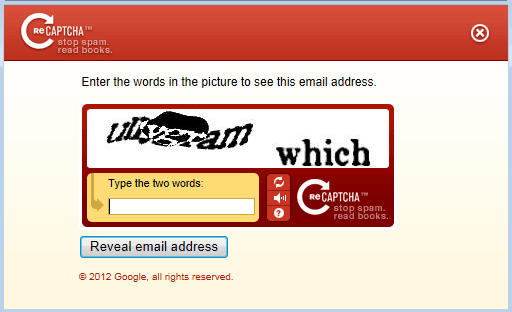 Figure 2: Traditional Google CAPTCHA verification.
Classic text CAPTCHAs have largely been cracked. The most common bypass involves Optical Character Recognition (OCR) engines scanning characters and decoding them into machine-readable text. This triggered an arms race where characters grew progressively distorted. The first captcha on the left of Figure 2 was deliberately designed to defeat OCR engines, requiring human cognitive synthesis to reconstruct the word from ambiguous glyphs.
Google’s new approach replaces character distortion with a novel risk engine. However, the system is not without fallback challenges, as the simple click is not the sole line of defense.
Whenever reCAPTCHA lacks sufficient behavioral confidence, it presents a fallback image selection challenge, as shown in Figure 3. Moreover, the simple checkbox click is not yet optimized for smartphones and tablets; mobile touch displays frequently fall back directly to this image challenge.
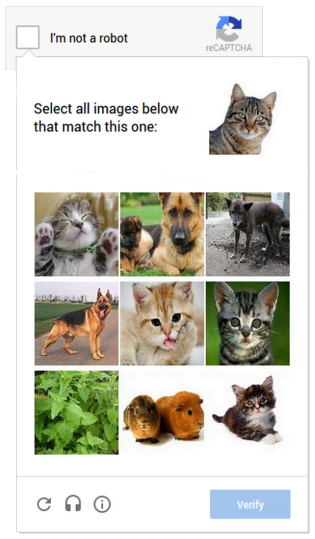 Figure 3: Image selection verification challenge.
Users of Plurk will likely find image-based verification familiar.
While Plurk asks users to identify a feline among six animals, Google’s image challenge goes further, asking users to multi-select all matching images across variations in breed, markings, or camera angles. Given the current state of computer vision, defeating such multi-image classification at scale remains challenging, providing dependable front-line protection for the time being.
Of course, as the old saying goes: “as virtue rises one foot, vice rises ten.” This technology is brand new, and attackers are only beginning to analyze its vectors. Historically, nearly every mainstream CAPTCHA system has eventually been bypassed. So grab some popcorn and observe how this cat-and-mouse game unfolds (one can already imagine bot developers refining their tooling, while human CAPTCHA-solving farms click away).
Further Reading
- Wired: Google Can Now Tell You’re Not a Robot With Just One Click.
Support Independent Perspectives & In-Depth Insights
Every thoughtful analysis and candid critique comes from our dedication to truth and quality. We choose not to follow sensational algorithms or clickbait headlines.
Sustaining independent research requires reader support. Make a one-time or monthly contribution, securely processed by Google.
Payments secured by Google · Manage or cancel anytime in your Google Account



Comments