
This morning while making breakfast for myself, I was stunned. (I hear headlines have to be written this way to get views.)
I originally wanted to crack an egg and cook Liang-Liang Kitchen’s exclusive bacon and fried egg to enjoy a delicious early-morning meal. (I hear some people are on team soy sauce for fried eggs? I am a true “salt-flake faction.”)
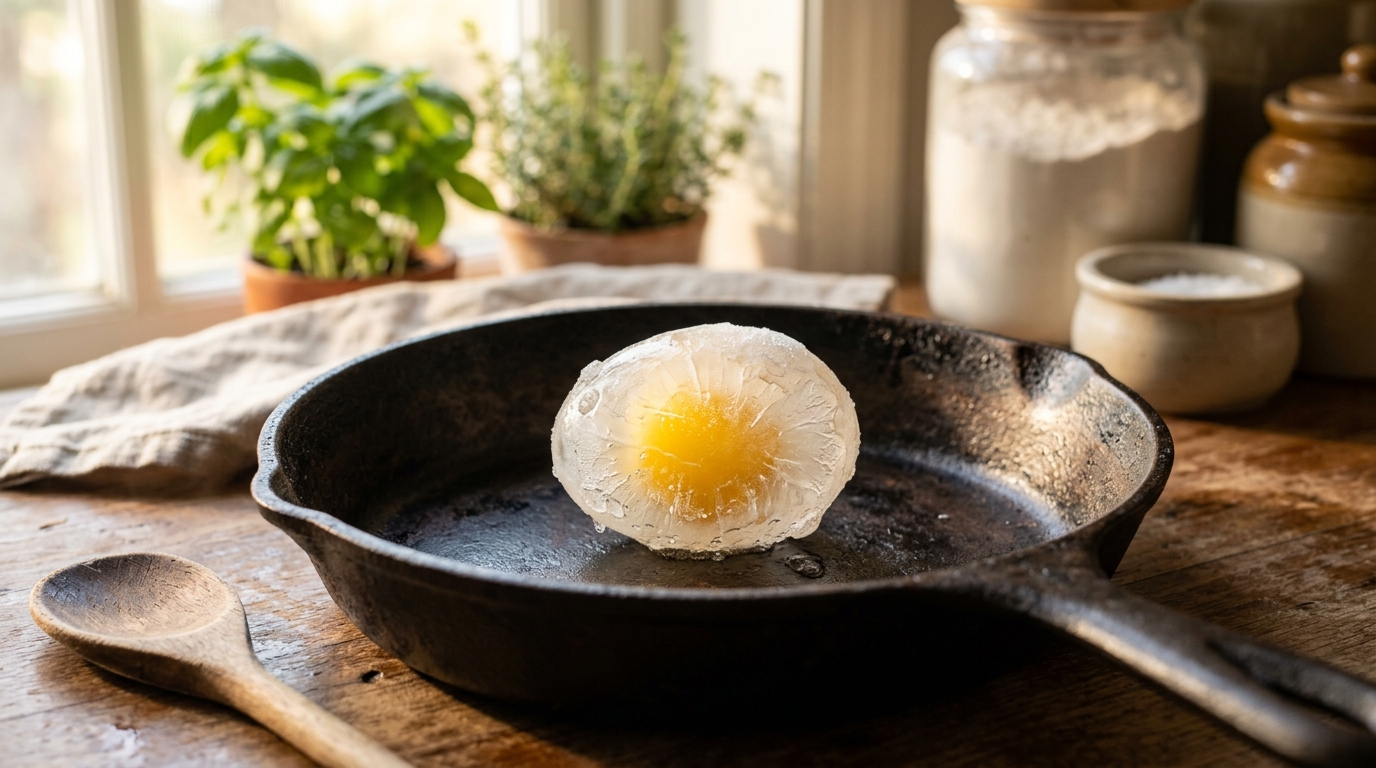
But after I cracked that egg’s shell, it dropped into the hot pan as a whole intact ball, and even bounced once on the sizzling frying pan. At that moment I stood frozen in front of the stove, and at first I even thought some guy had steamed an egg but did not eat it, so he put it back in the egg carton.
But on closer inspection, I found that this “egg” was watery, slightly transparent in color, a bit like the Slime King defeated by a hero. But why was a slime lying on my beloved cast-iron pan, and still wobbling back and forth?
(It actually also looked a bit like a 3D version of Egg-kun.)
Oh my, the egg had actually frozen! This was the first time I discovered that eggs can actually freeze — and it was actually quite beautiful, much like the beauty of bright yellow life within a crystal-clear crystal ball.
Come to think of it, I seemed to have adjusted the knob in the refrigerator last night, so I went pattering over to open the fridge door. It turned out that even the milk kept in the side door, used specifically for making coffee, had frozen into crushed ice. Fortunately, I have been making iced coffee lately, so it did not have much of an impact.
(I completely do not want to check the vegetable and fruit compartment…)
Why Did the Egg Freeze in the Refrigerator?
The suitable temperature for a typical household refrigerator is usually set between 3°C and 5°C. The freezing point of an egg is slightly lower than that of pure water (around -0.5°C to -1.5°C), so under normal circumstances it will not freeze in the refrigerator compartment.
There are two main reasons for this “frozen egg”:
- The knob was set too low or the air outlet blew directly on it: Last night when adjusting the refrigerator knob, I accidentally set it too cold (close to or below 0°C), or placed the egg carton on the innermost side near the cold air outlet, causing the local area temperature to be too low.
- The effect of seasonal and environmental temperature differences: When the weather turns cold, if the refrigerator’s cooling, which was turned up in summer, is not adjusted back appropriately, the actual temperature inside the refrigerator compartment can easily drop too much.
Can a Frozen Egg Still Be Eaten? Safety and Texture Analysis
After accidentally freezing an egg, I believe many people’s first question is: “Can this egg still be cooked and eaten?“
1. Check Whether the Eggshell Has Cracks
An egg contains a large amount of water, and its volume expands when it freezes. If the eggshell is squeezed and cracked during freezing, bacteria in the environment (such as Salmonella) may invade through the cracks. Therefore, if the eggshell is clearly broken, for food safety reasons, it is recommended to discard it rather than eat it.
2. It Must Be Thoroughly Heated and Cooked Through
If the eggshell is intact and unbroken, a frozen egg can be eaten, but be sure to cook it thoroughly (for example, frying it into a fully cooked fried egg or making a boiled egg). It is not recommended to make it into a soft-boiled egg or raw egg yolk dipping sauce.
3. The Wondrous Changes in Texture and Mouthfeel
After an egg freezes, the structure of its proteins and lipids changes. After thawing, the egg white becomes thinner and releases water, while the yolk, due to “freeze gelation,” becomes thick, firm, and elastic like gummy candy.
In Japan, a “frozen egg cuisine” of specifically putting eggs in the freezer was even once popular. Taking advantage of the fact that the yolk does not spread after freezing, you can cut a frozen egg in half and then fry it, frying two cute miniature fried eggs from one egg!
Refrigerator Temperature Control Tips to Avoid Freezer Burn on Ingredients
Although this time I unexpectedly gained a frozen egg as beautiful as a crystal ball, it also serves as a warning about the importance of refrigerator temperature control:
- Check the refrigeration temperature regularly: Keeping it at 3°C ~ 5°C is most suitable.
- Avoid the cold air outlet: Try not to place eggs, leafy vegetables, and fresh milk directly against the cold air outlet.
- Observe the state of drinks in the side door: If even the drinks in the side door show crushed ice, it means the refrigeration temperature is already too low, and the adjustment knob should be turned slightly toward a milder setting as soon as possible.
Support Independent Perspectives & In-Depth Insights
Every thoughtful analysis and candid critique comes from our dedication to truth and quality. We choose not to follow sensational algorithms or clickbait headlines.
Sustaining independent research requires reader support. Make a one-time or monthly contribution, securely processed by Google.
Payments secured by Google · Manage or cancel anytime in your Google Account




Comments