
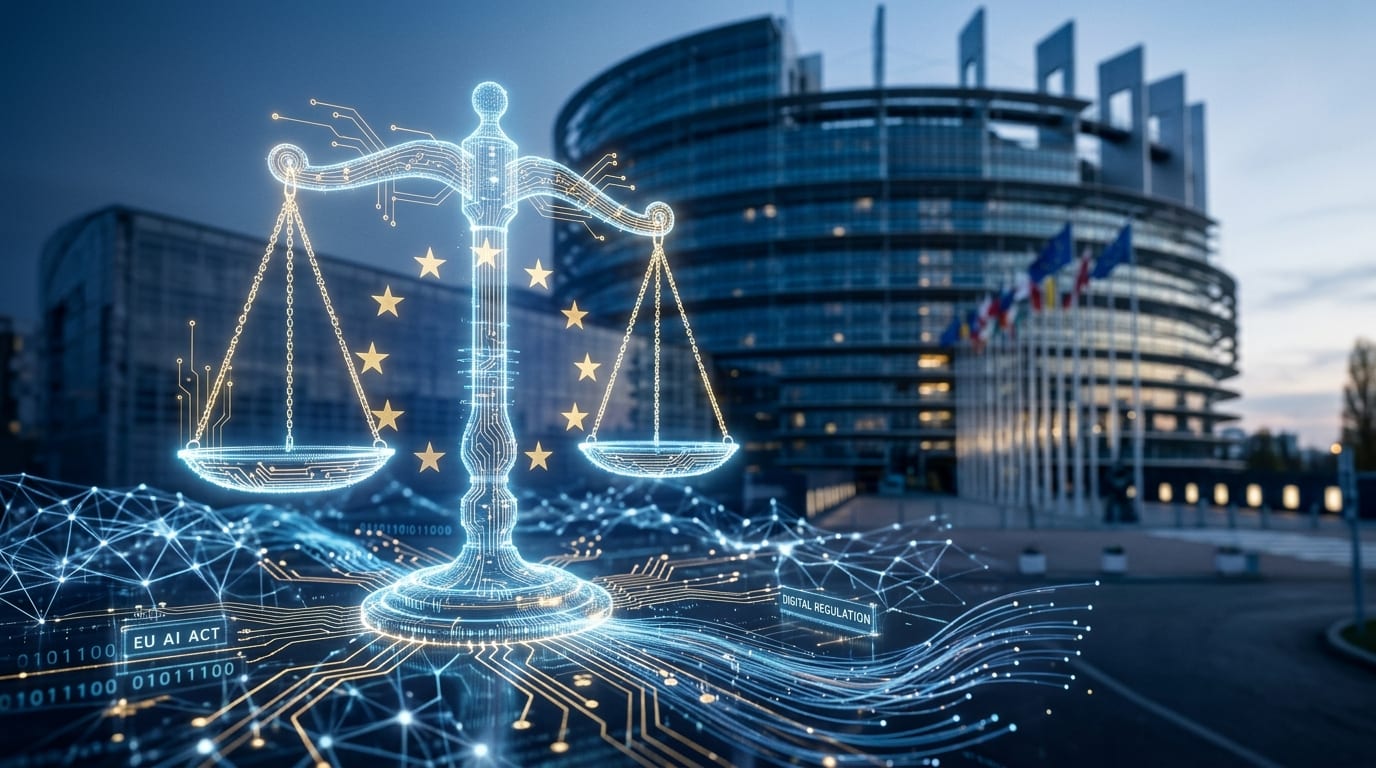
On March 13, 2024, resonant applause filled the European Parliament in Strasbourg as lawmakers voted overwhelmingly—523 in favor, 46 against—to pass the world’s first comprehensive, legally binding horizontal regime for artificial intelligence: The European Union Artificial Intelligence Act (EU AI Act).
Negotiated over years and rapidly rewritten following the breakout of generative AI, this historic legislation signifies artificial intelligence’s formal departure from the “Wild West” of unregulated deployment into the domain of institutional rule-of-law.
Just as the General Data Protection Regulation (GDPR) reshaped worldwide privacy standards, the AI Act leverages the formidable “Brussels Effect” to establish non-negotiable legal baselines for multinational technology conglomerates globally.
1. A Risk-Based Pyramid Architecture
The fundamental philosophy of the EU AI Act avoids stifling technological innovation by classifying AI systems according to the societal harm they pose across a four-tiered risk pyramid:
- Unacceptable Risk (Prohibited Entirely):
- Government-administered social scoring regimes.
- Real-time biometric surveillance in publicly accessible spaces (narrow exceptions strictly reserved for counter-terrorism or hostage rescue under judicial authorization).
- Emotion recognition systems deployed within workplaces and educational institutions.
- Cognitive behavioral manipulation targeting vulnerable demographics (children or persons with disabilities).
- High Risk (Strict Conformity and Audits):
- Encompasses critical infrastructure, medical device firmware, autonomous driving algorithms, CV-screening recruitment tools, and judicial risk assessment software.
- Mandates continuous risk management, bias-tested training data, comprehensive technical logging, and mandatory “human-in-the-loop” operational oversight.
- Specific Transparency Risk (Mandatory Disclosure):
- Conversational chatbots, synthetic voices, and deepfakes must embed indelible, machine-readable digital provenance watermarks informing users of synthetic origin.
- Minimal Risk (Unregulated):
- Everyday spam filters, recommendation engines, and video game AI remain unhindered by bureaucratic licensing.
2. Specialized Governance for General-Purpose AI (GPAI)
The rapid explosion of foundation models forced EU regulators to establish distinct obligations for General-Purpose AI (GPAI):
- Foundational Transparency: Providers placing models on the European market must publish technical summaries of copyright-protected training materials and respect EU intellectual property directives.
- Models with Systemic Risk: Models trained using cumulative computational capability exceeding $10^{25}$ FLOPs face rigorous oversight by the newly established EU AI Office, mandatory adversarial red-teaming, incident reporting, and energy efficiency profiling.
3. The Brussels Effect and the Future of Tech Innovation
While certain European startup founders raised concerns regarding international competitiveness, the global externalities of the legislation are irreversible:
- De Facto International Standards: Global cloud providers cannot economically maintain bifurcated architectures across geographical regions; hence, European compliance standards naturally become default engineering blueprints.
- Rise of Algorithmic Auditing: A vibrant market for third-party bias evaluation, model watermarking, and continuous safety verification has instantly emerged.
The enactment of the EU AI Act marks a permanent watershed in digital governance, illustrating that the future of advanced computation will be inextricably bound to human rights, safety, and legislative accountability.
Support Independent Perspectives & In-Depth Insights
Every thoughtful analysis and candid critique comes from our dedication to truth and quality. We choose not to follow sensational algorithms or clickbait headlines.
Sustaining independent research requires reader support. Make a one-time or monthly contribution, securely processed by Google.
Payments secured by Google · Manage or cancel anytime in your Google Account




Comments