
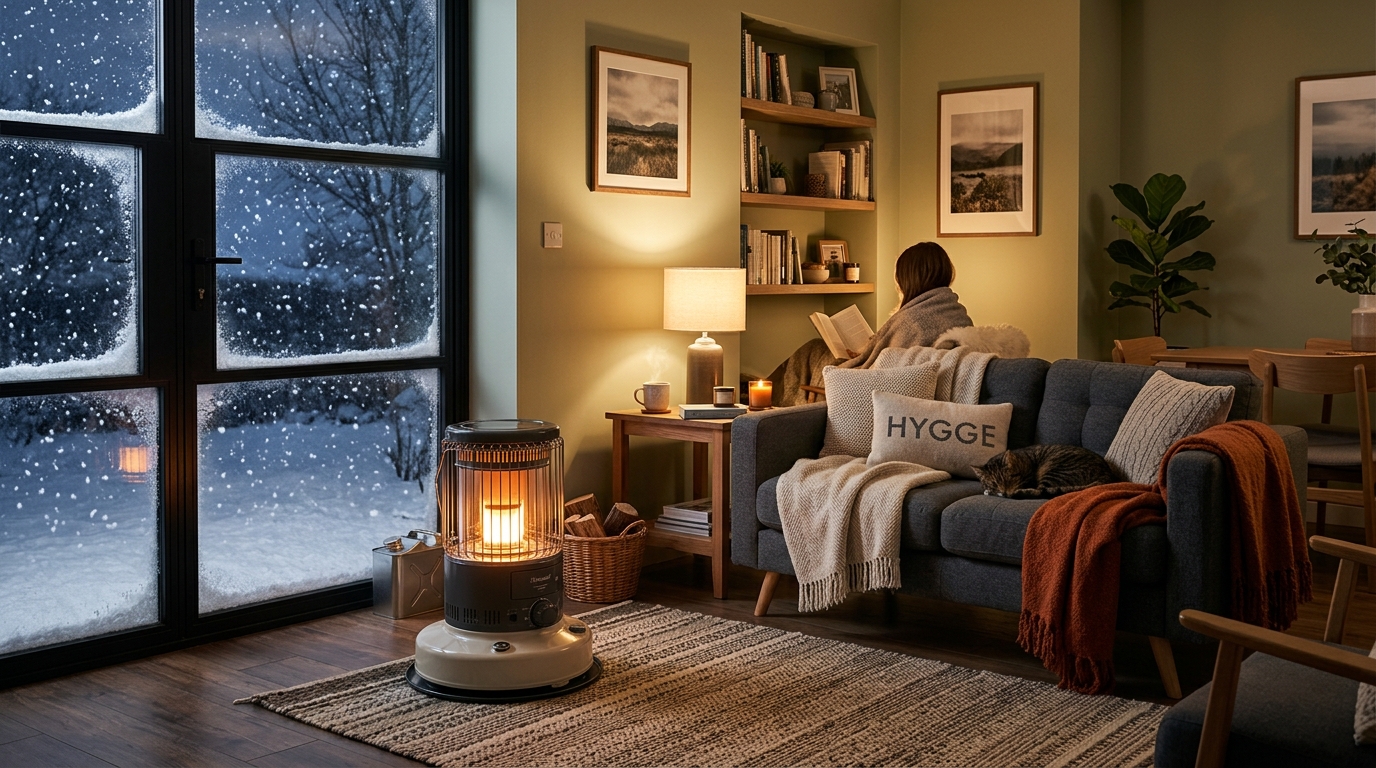
After experiencing the island-wide freeze of a once-in-a-generation cold snap, I believe everyone was stunned by the abnormally extreme global climate. From north to south, rare snowfall was reported across the high mountains. While the abnormal weather brought enormous crises and challenges to agriculture and fisheries, it also instantly created a whole new wave of cold-weather business opportunities — shopping malls and e-commerce stores alike reported heaters and space heaters selling out, even going out of stock.
However, before you step into the store and pull out your wallet, have you really chosen the right heating equipment?
I want to earnestly recommend to everyone: rather than spending big money on oil-filled or convection electric heater products like DBK or Northern, when facing extreme cold, kerosene heaters are the true king!
1. The Cold-Weather Wisdom of Japan’s Snow Country: The Truth Told by Store Shelves
When I visited many places in Japan recently, I found through close observation that the Japanese rely first and foremost on inverter heat pumps to fend off the severe winter cold, followed by the ever-present kerosene heater.
Kerosene heaters possess many advantages that electric heating devices cannot match: they consume almost no electricity (extremely eco-friendly and energy-saving), heat up extremely fast, and have a simple mechanical structure that is easy to maintain, and they even carry a unique nostalgic atmosphere when igniting. When I returned from my trip to Japan last month, looking at the affordable prices and exquisite industrial design in the stores, I almost brought one straight back to Taiwan!
The only troublesome part of using a kerosene heater in Taiwan is probably that, unlike in Japan or high-latitude regions of Europe, you cannot prepare a large household oil storage tank in your backyard or basement — you can only drive with an oil can to a CPC (Taiwan’s state oil company) gas station and haul it back bucket by bucket.
2. A Full Analysis of the Pros and Cons of Four Major Heating Appliances and Tested Ranking
For the four common heating mainstays on the market — kerosene heaters, inverter heat pumps, oil-filled heaters, and convection heaters — we rank them by heating principle, heating speed, energy cost, and usage scenario, giving you the most valuable order of priority:
【Ultimate Heating Power Ranking】
No. 1: Kerosene heater (explosive power, rapid whole-room rewarming)
No. 2: Inverter heat pump (top-tier efficiency, year-round use, no floor space)
No. 3: Oil-filled heater (gentle constant temperature, quiet, no oxygen consumption, but slow and heavy)
No. 4: Convection heater (looks slim, but heats at a snail's pace, weakest feel)
🥇 No. 1: Kerosene Heater — The Heating Beast of the Cold Winter
The kerosene heater is the overlord born for large areas and extreme cold. It burns deodorized kerosene to produce powerful heat, and uses a tiny amount of electricity to drive a fan (electronic type) or natural convection heat radiation (traditional mechanical cylinder type) to rapidly spread warm air throughout the room.
Core Advantages:
- Devastating burst heat and heating speed: The heat output of an electronic kerosene heater often reaches 3.0 kW to 5.0 kW or more (equivalent to the astonishing heat output of a 3000W to 5000W electric heater). Within tens of seconds of ignition, rolling heat waves pour out, able to bake a cold living room of over 10 ping (about 33 m²) to spring-like warmth within 3 to 5 minutes.
- Extremely power-saving and energy-efficient: An electronic heater consumes only 20W to 40W of weak electricity while running (mainly for the fan and mainboard); a traditional mechanical convection heater can even be ignited with just two dry batteries, still providing powerful heat during winter wind-induced power outages or outdoor camping.
- Moist, non-drying air: The byproducts of complete kerosene combustion are carbon dioxide and water vapor, which naturally raise the relative humidity of a dry winter room, so your skin won’t feel tight and itchy the way it does with ordinary resistance-type fan heaters.
Main Pain Points and Cautions:
- Regular oil hauling and refueling: You need to drive or ride to a designated CPC gas station to buy 20-liter canned kerosene or bring your own can for bulk fueling.
- Must open a window for slight ventilation: The combustion process consumes indoor oxygen, so you must open a window 1 to 2 cm as a safety gap when using it, ensuring air convection and eliminating any carbon monoxide risk.
- Ignition and extinguishing odor: Although modern high-end models have deodorizing combustion mechanisms, there is still a slight kerosene combustion odor at the moment of ignition and extinguishing.
🥈 No. 2: Inverter Heat Pump — The Efficiency King of Everyday Homes
If you look at year-round usage benefits, space integration, and electricity costs, the inverter heat pump is the most indispensable cornerstone of a modern home.
Core Advantages:
- Ultimate energy efficiency (most power-saving): An inverter heat pump does not “burn” electricity through a heating element to produce heat, but uses the reverse heat pump principle to “carry” ambient heat from outdoors into the room. Its energy efficiency ratio (CSPF) is extremely high — every 1 kWh of electricity consumed can produce heat equivalent to 3 to 4 kWh or more, with running electricity costs only one-third to one-quarter of a traditional resistance heater.
- Takes up no floor space indoors: Mounted below the ceiling, it does not affect furniture or walkway flow at all. It blows warm air in winter and cool air in summer, with no need to haul a heavy heater in and out of storage when the seasons change.
- Safe, no flame, no oxygen consumption risk: It operates with no open flame and does not burn oxygen, so you can safely enjoy a constant temperature even with doors and windows closed.
Main Pain Points and Cautions:
- High initial installation threshold: It requires coordinating the outdoor unit location and refrigerant piping construction, making it harder for renters or old houses with limited piping to add freely.
- Hot air floating to the ceiling: Hot air is inherently lighter, so if the heat pump’s air deflector is not set to “blow vertically downward,” heat tends to accumulate at the ceiling, leaving your feet still feeling cold.
🥉 No. 3: Oil-Filled Heater — The Gentle, Quiet but Heavy and Slow Traditional Choice
The oil-filled heater is a veteran model commonly found in Taiwanese homes during cold winters. The body is filled with sealed heat-transfer oil, which is heated by an electric heating tube, and the heat is then gently radiated into the surrounding air through multiple metal fins.
Core Advantages:
- No oxygen consumption, silent operation: Relying purely on natural heat radiation and oil convection, it runs with no fan noise and produces no odor, making it less likely to cause respiratory discomfort during long sleep use.
- Good heat retention after power-off: Because the metal fins and internal oil have a large heat storage capacity, it continues to release warmth for a while after being switched off.
- Built-in clothes-drying function: Most models come with a dedicated drying rack, handy for drying towels or undergarments during the damp cold winter.
Main Pain Points:
- Extremely slow warm-up: From power-on to the whole machine heating up often takes over 30 minutes; to make a 5-ping (about 16.5 m²) room feel noticeably warmer, it often needs to run continuously for 1 to 2 hours or more.
- Astonishing power consumption at full speed: Full power often reaches 1500W, and running it continuously for long periods makes next month’s electricity bill alarming.
- Extremely heavy body: The whole machine often weighs 15 to 20 kg, making it very laborious to move and store between seasons.
🎖️ No. 4: Convection Heater — Looks Slim, but Better Remembered Than Seen
Convection heaters usually have a flat, slim appearance, featuring aluminum fin heating elements, using thermal buoyancy to create a chimney effect where cold air enters from below and hot air exits from above. Although often marketed as splash-proof and suitable for both living room and bathroom, they often rank last in actual whole-room heating performance.
Core Advantages:
- Lightweight body, can be wall-mounted or moved: Compared with the bulky oil-filled type, convection machines are extremely light and can even be installed on a wall.
- Completely silent operation: No fan mechanical structure, so no annoying airflow noise.
- Basic splash-proof design: Common models like Northern or various living-room/bathroom dual-use types mostly have IP24 splash-proof protection on the casing.
Main Pain Points:
- Heating at a snail’s pace, extremely weak floor-level feel: Because there is no forced-air fan at all, once heated, the hot air drifts straight up to the ceiling. In a room with cold tiles, you often get the extremely awkward situation of slightly warm head, feet frozen like ice.
- Strict safety clearance requirements for installation: If claimed for bathroom use, the manual often specifies “must be more than 1 meter from a water source, more than 15 cm off the ground, and with more than 50 cm of clearance in front,” which is extremely hard to place legally and compliantly in a small, space-precious bathroom.
- High power consumption with limited payoff: It likewise consumes a high 1000W to 1500W, but the warmth you get in return is negligible.
3. Comprehensive Comparison Table of the Four Major Heating Appliances
| Comparison Item | 🥇 Kerosene Heater | 🥈 Inverter Heat Pump | 🥉 Oil-Filled Heater | 🎖️ Convection Heater |
|---|---|---|---|---|
| Representative Brands | DAINICHI, TOYOTOMI, CORONA | Daikin, Hitachi, Panasonic, Mitsubishi Heavy | Germany HELLER, De’Longhi, DBK | Northern, AIRMATE |
| Main Heating Principle | Kerosene combustion jet / radiant heating | Reverse heat pump cycle | Sealed oil resistance heating | Aluminum fin element natural convection |
| Heating Speed | Ultra-fast (3 - 5 min) | Fast (5 - 10 min) | Extremely slow (1 - 2 hr) | Slow (30 - 60 min) |
| Power Consumption & Efficiency | Extremely low power (20W-40W, fuel separate) | Highest efficiency (1 kWh in, 3+ kWh heat out) | Extremely high power (1500W at full speed) | High power (1000W - 1500W) |
| Suitable Space | Large living rooms 8-20+ ping, townhouses | Bedrooms and living rooms of all sizes (whole-room) | Enclosed bedrooms 4-8 ping | Local spaces 3-6 ping |
| Quietness | Very low (slight fan sound) | Extremely quiet (low indoor decibels) | Absolutely silent (no mechanical sound) | Absolutely silent (no mechanical sound) |
| Main Advantages | Lightning-fast heating, huge burst heat, usable in outages, non-drying air | Power-saving, year-round use, no floor space, precise temperature control | Comfortable constant temperature, no oxygen consumption, doubles as clothes dryer, no open flame | Slim body, wall-mountable, no noise |
| Main Disadvantages | Need to refuel at gas station, need regular slight window ventilation | Need outdoor unit space and installation, hot air floats to ceiling | Extremely heavy body (15-20kg), slow warm-up, high electricity bill | Weak feel without fan airflow, strict safety distance limits |
| Overall Recommendation Index | ⭐⭐⭐⭐⭐ (Top choice for extreme cold snaps) | ⭐⭐⭐⭐⭐ (All-round home essential) | ⭐⭐⭐ (For light-sleepers in enclosed rooms) | ⭐⭐ (Limited effect, choose with care) |
4. The Ultimate Buying Conclusion: How to Spend Your Money Wisely?
Facing increasingly extreme and changeable winter weather, keep the following rules in mind when buying heating appliances:
- If you seek the most worry-free, year-round long-term investment for the whole family: When renovating a new home or replacing an old air conditioner, be sure to go straight for an inverter heat pump — it is the basic equipment with the lowest daily running cost and the most balanced temperature control.
- If you live on a damp, windward side, in a large townhouse, or urgently need warmth during a cold snap: Stop fantasizing about resistance-wire heaters. Adding a Japanese kerosene heater can bring you unprecedented blissful high heat — as long as you follow the window-ventilation rules, it is an invincible weapon on the cold-defense line.
- If you have elderly or infants at home and value quiet, light-free sleep: If you don’t want the hassle of kerosene and air conditioning, choose an oil-filled heater from Germany HELLER or De’Longhi that boasts eco-friendly coating, and turn it on half an hour before bed to preheat — you can still enjoy a warm, peaceful night’s sleep.
Support Independent Perspectives & In-Depth Insights
Every thoughtful analysis and candid critique comes from our dedication to truth and quality. We choose not to follow sensational algorithms or clickbait headlines.
Sustaining independent research requires reader support. Make a one-time or monthly contribution, securely processed by Google.
Payments secured by Google · Manage or cancel anytime in your Google Account



Comments