
Before writing this piece, my initial thought was not how to structure it, but rather wondering how Mr. L—living in his elite capital bubble—would critique it [1]. Enough venting, though; let’s get to the main topic. With the ongoing controversies over nuclear power and energy policy, people constantly complain about power shortages, yet electricity continues to be squandered everywhere.
Those who have known me long enough know I have a particular knack. Ever since childhood, I haven’t enjoyed chatting with strangers [2], relying instead on sharp, meticulous observation to discern the true essence of things.
For instance, the head of a biomedical company once had her internal team produce a promotional video for a new product. When she asked for my private feedback, I immediately pointed out a small device in the footage—the numbers flashing briefly across its screen were unmistakably fabricated. Beyond being surprised, she admitted the data was indeed faked, though she explained it was done simply for convenience during filming; the equipment itself was fine and served as their flagship product for an upcoming IPO.
Furthermore, ever since I was young, I loved observing life’s spectrum in hospitals (everyone probably knows what’s right next to Nanyang Street, right?). Back when I worked as a biomedical engineer, I frequently visited numerous major medical centers across Taipei. My favorite pastime wasn’t stealing glances at nurses, but sitting on a bench watching the passing doctors, nurses, and patients, while analyzing hospital infrastructure and environmental hygiene—which, truthfully, fell far short of what they should be. [3][4]
In short, the physical world appears to me as a continuous stream of visual attributes and analytical research (a photographer’s eye, if you will), and anomalies invariably catch my attention.
This time, while strolling through Prosperity Plaza Taiwan (formerly Carrefour) in Tamsui, I happened to pass by an aisle. A scene inside caught my eye in an instant, drawing me in to stop and stare. Below is a snapshot of that aisle. Can you tell what stood out amidst this neat, brightly lit space to grab my attention?
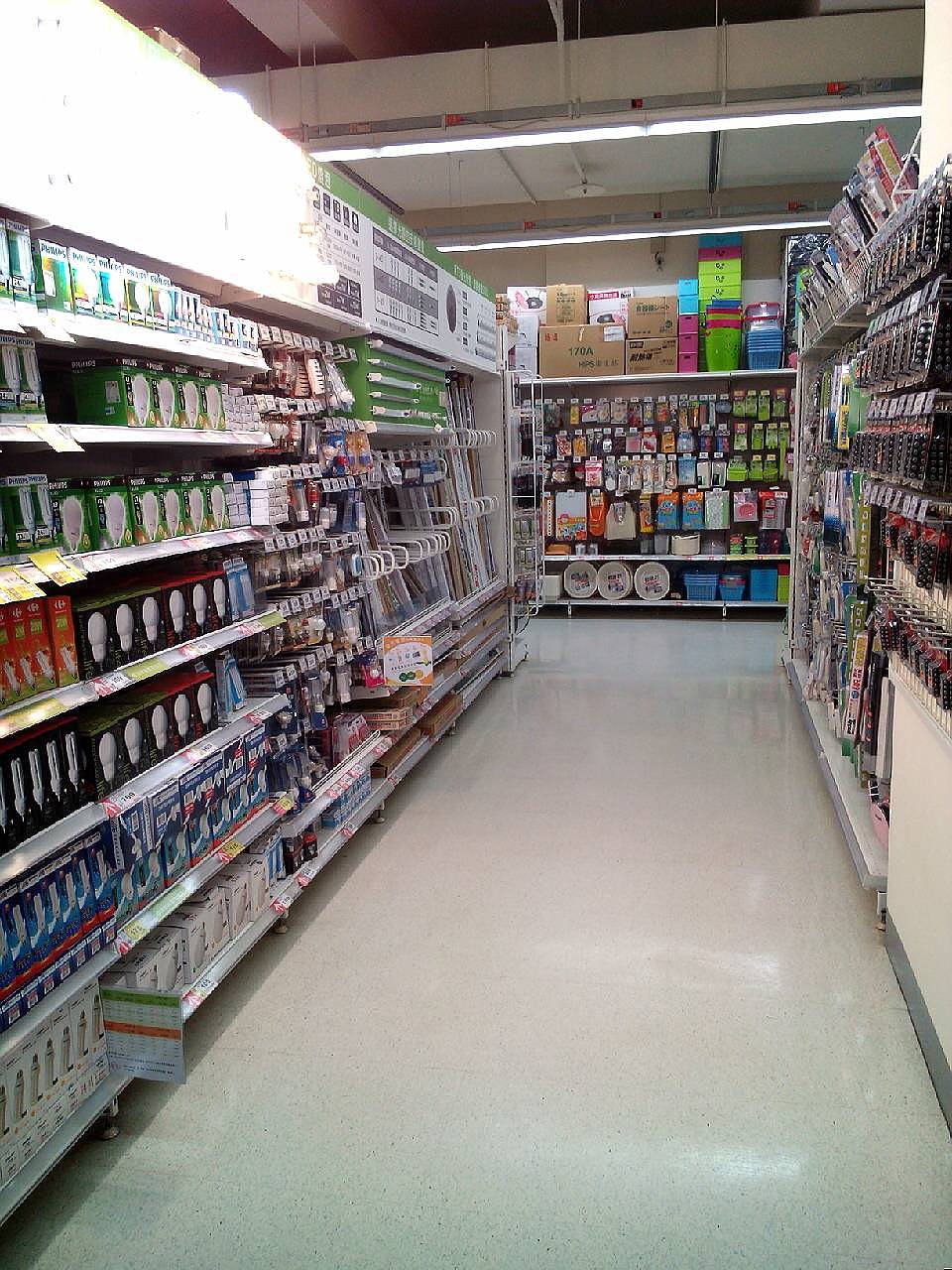 Prosperity Plaza Taiwan (formerly Carrefour) Aisle
You’ve probably spotted it by now: the upper-left corner of the photo shows a massive “wall of lights” completely blowing out my phone’s camera exposure—and the photo captures only half of it.
I stood in that aisle for nearly five minutes, and not a single soul walked through. (Don’t you dare joke that nobody could squeeze through—step forward if you dare!)
Doing some quick math, there were easily 30 to 40 different light bulbs turned on along that wall. Assuming each was a 17-watt energy-saving bulb, just 20 active bulbs consume 340 watts—nearly 0.4 kW. And that does not even account for the desk lamp section or the running fans in the home appliance aisle [5]. For a hypermarket giant like Prosperity Plaza Taiwan (formerly Carrefour), 0.4 kW might be negligible in terms of cost and metrics, but leaving them constantly on serves no real purpose—and directly contradicts the goal of energy conservation.
I always evaluate things based on whether something is truly necessary, and then brainstorm practical solutions. The illuminated display wall above is a prime example of a poor design: having a testing display meets consumer demand, but keeping it constantly lit is completely unnecessary.
Perhaps Prosperity Plaza Taiwan (formerly Carrefour) [6] never intended to keep the bulbs lit at all times. Yet whether by design or because shoppers forget to turn them off, the outcome is identical. Factoring in human nature, they should install a simple countdown timer circuit or a motion-sensor bypass on the display wall. Once shoppers finish checking the brightness levels, the lights should shut off automatically—such circuits are remarkably simple and inexpensive. Alternatively, they could at least use illuminated switches to prompt shoppers to turn them off after use.
After snapping the photo, I reached out and switched off the entire wall of lights, discreetly glancing around to see if any security cameras or store associates were watching me.
Further Reading:
- A portion of the complaints in this section was too dark, too cynical, and far too verbose (accounting for 99.9%), so I split it into a separate article: Facebook Drama: Mr. L, Are You Okay? Stop Being So Paranoid in Discussions.
- Not chatting with strangers is purely about avoiding hassle. If you don’t believe me, ask Ms. Miaobai just how much of a chatterbox I can really be. :lol:
- Recently, a male nurse launched a Facebook campaign calling to lift the “shoe ban” in hospitals. However, I believe strict hygiene and infection control in hospitals are essential; under that premise, professional nursing footwear remains necessary. While materials and ergonomics can certainly be redesigned, shoe color and minimal tread patterns on the upper and sole are preferable for easy sanitization.
- During graduate school, I took an evidence-based hospital design course. After examining many case studies, I realized that many major domestic hospitals have numerous architectural flaws and room for improvement, often due to aging facilities.
- I am more forgiving of television walls and computer displays remaining on, as frequent power cycling can wear out electronics, and booting up takes time, which dampens purchasing interest (though computers could easily be set to sleep mode). But small consumer appliances like light bulbs or electric fans should only be turned on when a customer wants to test them—there is no reason for them to run continuously.
- Prosperity Plaza Taiwan (formerly Carrefour) was specifically highlighted here simply because that’s where I took the photo, but major retail chains like B&Q, RT-Mart, and Far Eastern A.Mart often suffer from the exact same issue.
Official Website: Prosperity Plaza Taiwan (formerly Carrefour) Online Shopping.
Support Independent Perspectives & In-Depth Insights
Every thoughtful analysis and candid critique comes from our dedication to truth and quality. We choose not to follow sensational algorithms or clickbait headlines.
Sustaining independent research requires reader support. Make a one-time or monthly contribution, securely processed by Google.
Payments secured by Google · Manage or cancel anytime in your Google Account




Comments