
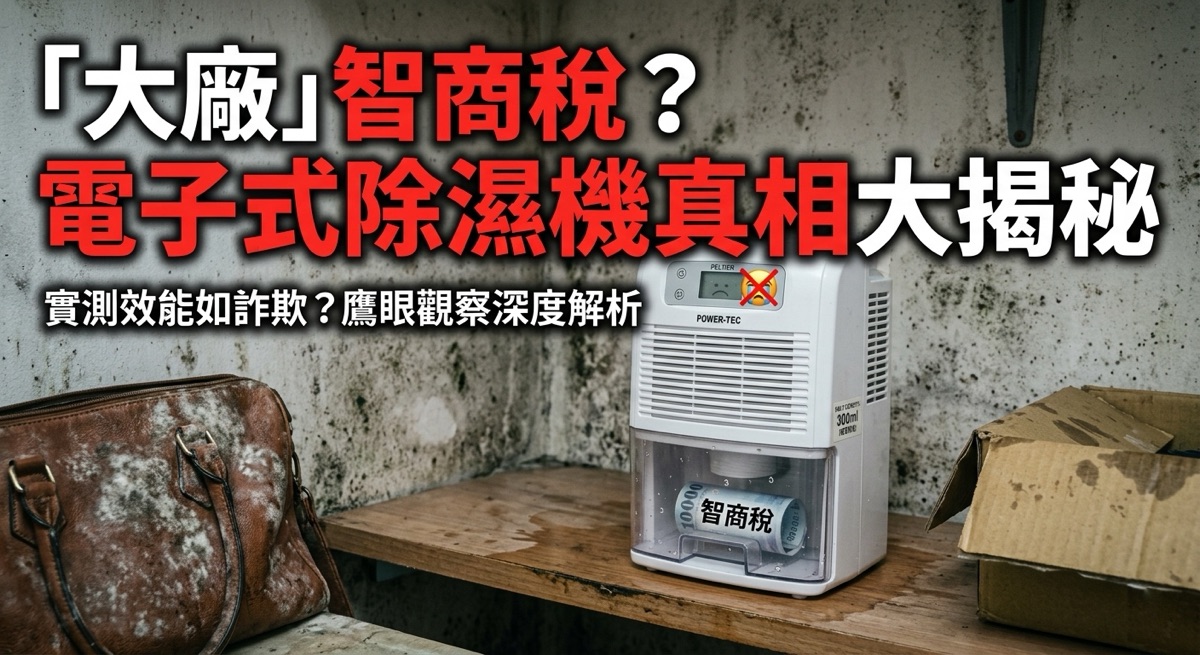
As the spring rainy season approaches, oppressive humidity permeates every corner of the house, leaving people sluggish and causing joint discomfort.
Naturally, many consumers consider buying a dehumidifier. But browsing online stores reveals a stark price divergence: miniature electronic (semiconductor) dehumidifiers selling for barely $30 to $50, contrasted against traditional compressor-driven units ranging anywhere from $200 to over $800.
In reality, putting a semiconductor dehumidifier in your room is little more than a psychological placebo combined with a waste of living space. Historically, these underpowered gadgets were marketed almost exclusively by obscure, white-label manufacturers.
However, when established legacy appliance brands also begin licensing their logos on these rock-bottom, near-zero-efficiency thermoelectric dehumidifiers, it represents more than just a regression in technical integrity—it is an overdraft of consumer brand trust.
Packaged under alluring slogans like “ultra-quiet,” “ultra-low power,” and “compact design,” they target budget-conscious renters and studio dwellers. Yet evaluated against physical laws and measurable moisture output, these devices are less home appliances and more a precision harvest of consumer misunderstanding—commonly known as an “IQ tax.”
The core mechanism of these electronic dehumidifiers is the Peltier Effect, which uses a semiconductor thermoelectric cooler (TEC) to generate a temperature differential, condensing airborne moisture on the chilled side.
While it sounds high-tech, in real-world subtropical maritime climates, the thermodynamic efficiency of this process is hopelessly inadequate.
Under identical ambient conditions, a standard compressor dehumidifier extracts dozens of times more water per kilowatt-hour of electricity than a Peltier unit.
When you see a spec sheet boasting “daily dehumidification capacity: 300 ml,” you must understand this is an idealized figure achieved under extreme laboratory conditions (e.g., 30°C and 80% relative humidity).
In everyday living environments where relative humidity hovers around 65% to 75%—making everything feel damp and sticky—a semiconductor dehumidifier running continuously for an entire week might not even collect half a bottle of water. Rather than a functional dehumidifier, it acts as a physical classroom demonstrator illustrating that “the laws of thermodynamics cannot be cheated.”
Many buyers are seduced by the cheap price tag, overlooking the essential economic calculus: the primary purpose of dehumidification is to prevent leather, electronics, and walls from molding, and to safeguard respiratory comfort.
If a machine cannot suppress indoor relative humidity below the critical 55% threshold, every single kilowatt-hour of electricity it consumes is pure waste.
The Energy Factor (EF) of semiconductor cooling plates is dismal. They convert the vast majority of electrical power into wasted heat, with only a tiny fraction contributing to condensation. In other words, you have purchased an extremely inefficient mini-space-heater that produces an insignificant trickle of water on the side.
If your leather bags are growing mold and your camera sensors are suffering fungus, this tiny machine humming faintly in the corner can do nothing to prevent asset depreciation. The apparent “affordability” is an illusion concealing cumulative hidden economic losses.
The situation is exacerbated when reputable brands join the fray, lending unwarranted legitimacy to the product category.
Shoppers naturally trust historic brands, assuming that if a heritage manufacturer puts its badge on the box, the quality and effectiveness must be vetted.
Yet most of these offerings are merely rebranded OEM products. The brand licenses its name, taking no responsibility for the inherent physical limitations of the technology. Until energy-efficiency labeling standards mandate strict disclosures on such miniature units, vendors will continue exploiting consumer knowledge gaps.
They emphasize “whisper-quiet” operation simply because there is no compressor vibrating inside. But this also means the device lacks powerful airflow circulation. It cannot cycle room air, restricting its moisture extraction radius to merely a few inches around the chassis—insufficient even for a small powder room.
In humid island climates, dehumidification is a genuine necessity, but semiconductor dehumidifiers are an insult to that necessity.
For anyone who values life quality and engineering rigor, these gadgets should never be on your shopping list. If your budget is limited, you are far better off buying chemical moisture-absorbing desiccant tubs or high-velocity circulator fans than throwing hard-earned money at plastic e-waste.
Genuine dehumidification solutions must respect thermodynamics and mechanical engineering. Hoping that a few-dollar semiconductor plate can conquer seasonal moisture is wishful thinking. Rejecting these low-efficiency gimmicks is the first step in protecting your living comfort and personal finances.
Support Independent Perspectives & In-Depth Insights
Every thoughtful analysis and candid critique comes from our dedication to truth and quality. We choose not to follow sensational algorithms or clickbait headlines.
Sustaining independent research requires reader support. Make a one-time or monthly contribution, securely processed by Google.
Payments secured by Google · Manage or cancel anytime in your Google Account



Comments