
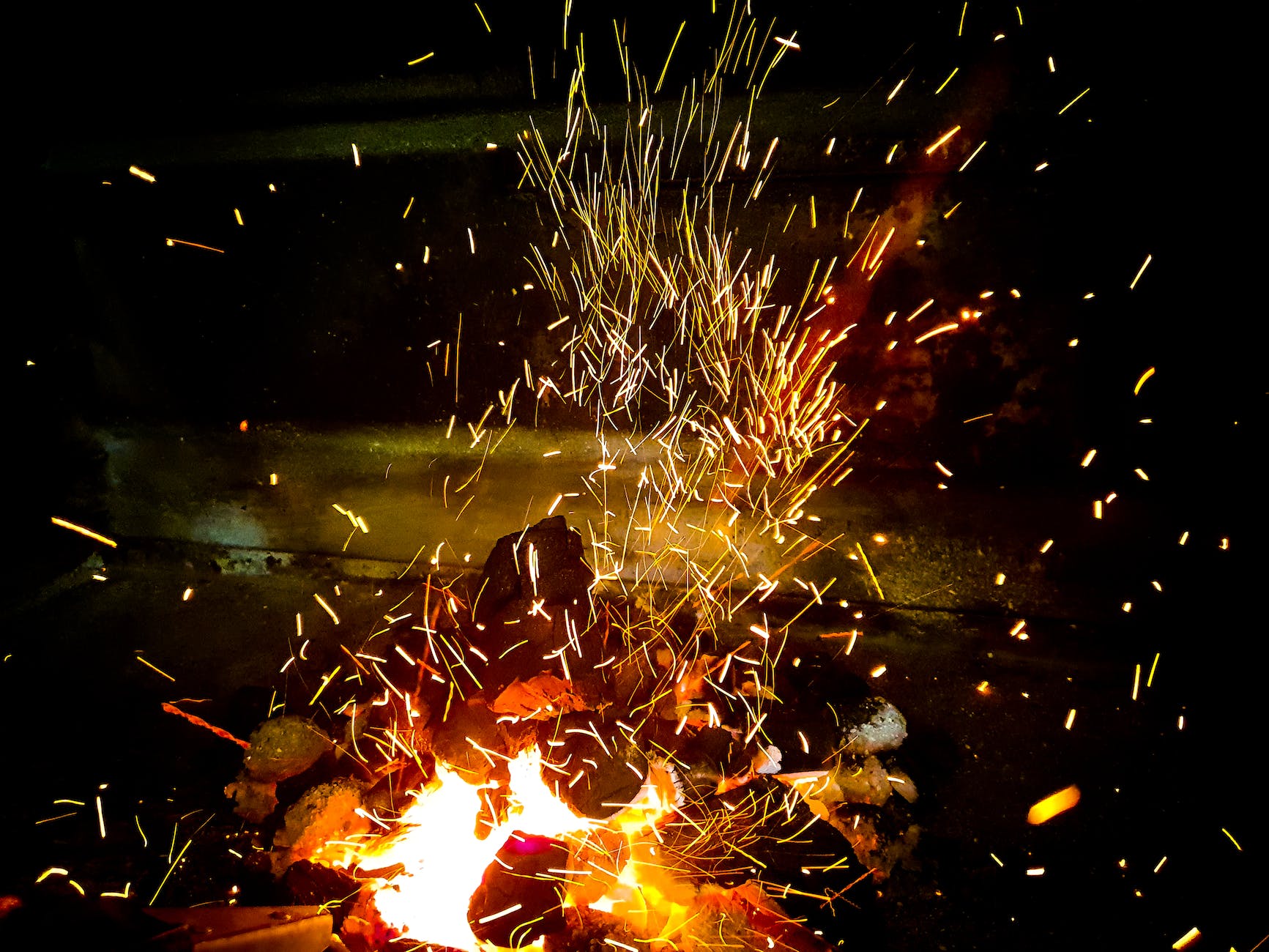
Right now, I feel as if I were standing in a warzone. Crackling sounds erupt continuously from beside my feet, accompanied by billows of white smoke and an overwhelming stench, submerging me entirely in this freezing, dark night.
I never really intended to play the role of an embattled war correspondent roughing it in the wilderness. Yet the brazier next to my legs behaves as if an ammunition depot had caught fire, blasting sparks in all directions. While installing a fireplace with a chimney (one of my dreams) isn’t feasible in my old family home, setting up a charcoal brazier at least satisfies the craving. Some modern charcoal brazier designs are quite well thought-out. For example, the portable fire pits favored by hikers have great functionality: their modular structure is easy to carry, and they come with covers for cooking ─── truly an essential camping companion for the wild back country during cold seasons.
Every time I warm myself before a charcoal fire, it recalls memories of living in a log cabin in polar regions years ago, sipping whisky with friends, smelling the savory aroma of potato beef stew wafting from the pot on the stove while adding firewood to the hearth. How carefree and joyous that was.
That is why every winter, as a seasonal ritual, I visit a traditional charcoal shop in Tamsui to purchase what I convince myself is premium-grade longan wood charcoal.
Lighting a brazier of charcoal in the living room fills the space with a delicate sweet aroma and gentle warmth. It feels far cozier than an oil-filled electric radiator and doesn’t dry out indoor air excessively, which can dehydrate the skin or trigger asthma and bronchitis.
Studies have shown that burning charcoal can also clear toxic airborne bacteria indoors ─── you’ve eaten smoked ham before, haven’t you?
I once wrote a feature article praising this charcoal shop, reflecting my confidence in its quality. It was my go-to choice after trying out all sorts of charcoal sold in supermarkets and traditional grocery stores. If you ever visit me in Tamsui for a barbecue, I would still take you there to buy grilling fuel.
This year, however, things took a turn.
This kind of shift is familiar to all of us; we see similar occurrences reported constantly in the news. When chefs or restaurateurs cut costs by opting for unfamiliar yet cheaper ingredients, food safety scandals inevitably follow one after another.
Change in itself holds no inherent value; whether it brings progress is what truly matters, otherwise one is better off leaving things unchanged.
Around early December, having exhausted the charcoal purchased at the start of the year, I returned to that old charcoal shop. The price was calculated as usual: one bag for exactly one hundred dollars. However, the charcoal I brought home this time was distinctly different from what I remembered.
In the past, every piece looked carefully selected, measuring three to five centimeters in diameter and about fifteen centimeters in length. They were pitch black, solid, and had a light powdery dusting on the surface.
This time, the bag contained two or three large logs about ten centimeters in diameter that required manual chopping. Looking at the cross-section, the outer ring was about two centimeters thick, solid, jet black, and dense with few fissures. Yet the core, nearly eight centimeters in diameter, resembled layered flakes with a glossy sheen. The actual burn test turned out to be the worst experience I have ever had. Even when ignited to a glowing red, unless multiple pieces were stacked together to sustain combustion, the fire would fade out within moments.
Furthermore, during the lighting process, the charcoal behaved as if it had swallowed a grenade, continuously spitting out surface embers. The sparks flew as if fueled by oil, flashing and popping erratically. Several pieces refused to burn cleanly at all, belching suffocating white smoke the moment they caught fire. Even those that didn’t emit white smoke gave off an overpowering, harsh smell that could not compare to genuine longan charcoal.
When I later inquired at the shop, I learned that a supplier had pitched this batch to them, claiming it was charcoal made from Acacia confusa (Taiwan acacia). This matched the descriptions I found online: cross-sections with longitudinal fractures and a shiny black luster. Yet I strongly suspect these were simply inferior imported charcoals from Vietnam or the Philippines.
In the end, I had to dig through the shop’s warehouse to salvage some remaining longan charcoal from earlier stock, finally regaining a sliver of genuine warmth on these frigid winter nights. I suppose I will hold off on visiting this rare surviving heritage shop for a while, at least until that questionable inventory is thoroughly cleared out.
Recommended Products
- Tamsui Charcoal (Extruded Charcoal) Small Packs (Repacked for local residents in Tamsui).
Support Independent Perspectives & In-Depth Insights
Every thoughtful analysis and candid critique comes from our dedication to truth and quality. We choose not to follow sensational algorithms or clickbait headlines.
Sustaining independent research requires reader support. Make a one-time or monthly contribution, securely processed by Google.
Payments secured by Google · Manage or cancel anytime in your Google Account




Comments