
Whether using classic single-lens reflex (SLR) cameras loaded with silver-halide film or today’s ubiquitous digital SLRs (DSLRs), their most critical advantage over point-and-shoot cameras—aside from inherent hardware prowess—is how much operational control they grant the photographer.
Image quality naturally reflects price; you get what you pay for. But control is another matter entirely.
Many photographers find that after owning an SLR for a while, the standard “AUTO” mode inherited from point-and-shoot cameras simply fails to satisfy their creative aspirations.
Naturally, the next step is dialing in preset scene modes: Macro (the little flower), Landscape, Portrait, Sports, and Night Scene (features that pro and semi-pro bodies might not even bother to include).
Before long, that familiar sense of creative constraint returns—a persistent feeling that something is still missing.
The 4 Primary Camera Exposure Modes
This is when exposure modes like P, S (Tv), and A (Av) appear in your viewfinder and LCD menus. Suddenly you are introduced to an array of terminology: “Program (P)”, “Shutter Priority (S/Tv)”, and “Aperture Priority (A/Av)”. What do these modes actually do?
- Program Mode (P): The camera assesses ambient light and automatically pairs an aperture with a shutter speed to achieve optimal exposure. On many cameras, photographers can shift this program to prioritize faster shutter speeds or larger apertures according to their shooting goals.
- Shutter Priority Mode (S / Tv): You manually set the shutter speed, and the camera automatically calculates and selects the corresponding aperture for optimal exposure.
- Aperture Priority Mode (A / Av): You manually choose the aperture size (f-number), and the camera automatically selects the matching shutter speed.
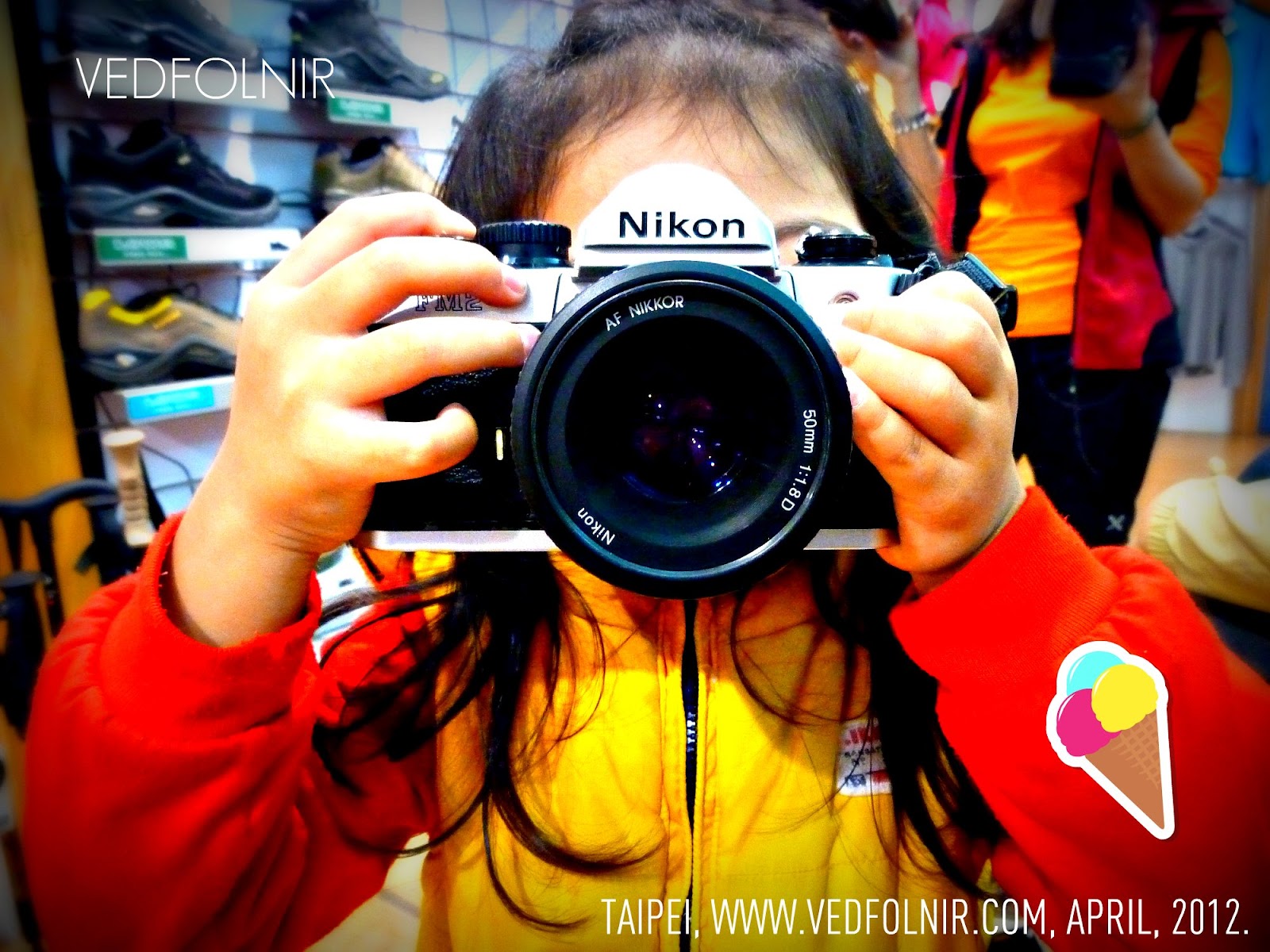 My niece looking like a seasoned pro handling a Nikon FM2.
Whether using full AUTO, scene modes (macro, portrait), or the three semi-automatic exposure modes (P, S, A), the common thread is that the camera’s internal meter ultimately determines the target exposure value.
The distinction is simply that AUTO and scene presets leave all computational decisions entirely to the camera’s processor, whereas semi-automatic exposure modes allow the photographer to fix one parameter first before the camera calculates the rest.
What Is Aperture?
The aperture refers to an adjustable diaphragm inside the lens. By altering the diameter of this opening, you determine how much light passes through the lens to hit the sensor or film. A wider opening corresponds to a smaller f-number (e.g., f/1.8), allowing more light to enter and producing a shallower depth of field.
What Is Shutter Speed?
The shutter speed refers to the duration the camera shutter curtains remain open, dictating how long incoming light is allowed to strike the sensor or film plane.
Through countless combinations of aperture and shutter speed, you regulate the total volume of light reaching the sensor—the exposure level of your final image.
Manual Exposure Mode (M)
Regardless of whether you shoot on an entry-level camera or a flagship professional body, there is only one mode where exposure is governed entirely by human judgment: Manual Mode (M).
In Manual mode, the photographer must independently set both the aperture and shutter speed. This gives you absolute creative authority. Shots taken in M mode might easily turn out overexposed or underexposed if misjudged, but this freedom to shape the mood and tonality makes Manual mode the true gateway to fine-art photography.
While automated modes ensure a technically correct exposure, Manual mode empowers you to craft an image with distinct personality.
It is worth noting that you can achieve similar brightness adjustments in P, S, or A modes by adjusting Exposure Compensation (EV value). However, relying constantly on EV compensation adds an extra layer of dial adjustments that can dull your intuitive grasp of exposure fundamentals.
Some argue that shooting in Manual mode is overly complicated and slow. Yet many professional wedding photographers shoot exclusively in M mode indoors. Once ambient lighting is mapped out during prep, Manual mode ensures rock-solid consistency across every shot without being tricked by varying backgrounds or bridal gowns.
At the end of the day, all exposure modes revolve around balancing aperture and shutter speed, combined with the camera’s sensitivity (ISO). In film photography, ISO was determined by your chosen film roll; in modern digital cameras, it is governed by sensor gain. Together, these three comprise photography’s timeless “Exposure Triangle.”
Even the oldest pinhole cameras operated on these exact principles: a fixed aperture (the pinhole) and a fixed medium sensitivity, with exposure sculpted purely by the duration of the shutter opening.
Support Independent Perspectives & In-Depth Insights
Every thoughtful analysis and candid critique comes from our dedication to truth and quality. We choose not to follow sensational algorithms or clickbait headlines.
Sustaining independent research requires reader support. Make a one-time or monthly contribution, securely processed by Google.
Payments secured by Google · Manage or cancel anytime in your Google Account

Comments