
Ever since British brand Dyson introduced its bladeless turbine airflow multiplier fans, a wave of aerodynamic innovations has sought to fix flaws in traditional everyday products. The Air Umbrella featured here is one such invention. But as my title suggests, this device—crowdfunded on Kickstarter—is a clever concept coupled with an utterly flawed execution, whose fundamental physical viability raises serious doubts.
To avoid interfering with their fundraising campaign or refund requests, I deliberately delayed publishing this critique until today.
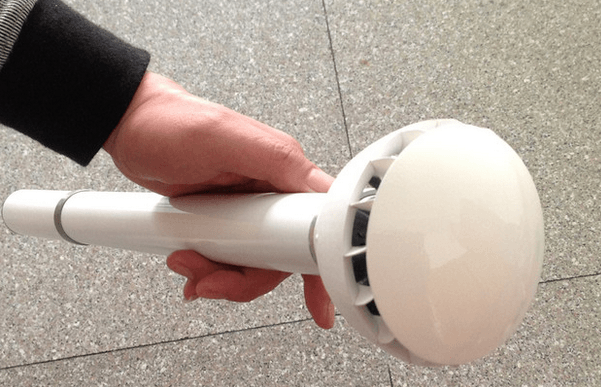
The Air Umbrella’s premise is straightforward: perched atop a handheld wand is a high-speed fan module that discharges horizontal air curtains in all directions. This creates an invisible aerodynamic canopy that deflects vertically falling raindrops outward, shielding the pedestrian beneath.
While intuitive in theory, effectively repelling rain under real-world conditions demands rigorous hardware engineering, high energy density, and delicate geometric aerodynamics. Get it wrong, and it will leak worse than a torn umbrella—or run out of battery mid-commute, instantly leaving you holding an expensive, useless stick. The Air Umbrella team touted an operating time of a mere 30 minutes.
Similar airflow principles are commonplace in industrial air curtains, but the central question remains: can this handheld wand truly deliver enough static pressure and airflow volume to reliably deflect torrential rainfall? And how long can a compact lithium battery sustain such a high-draw motor?
As shown in Figure 1 below, this Air Umbrella campaign ran on Kickstarter, drawing 852 backers and raising $102,240 USD before closing.
 Air Umbrella (Screenshot via Kickstarter)
Applying aerodynamic repulsion to an umbrella feels agonizingly ill-conceived. I would much rather see this motor repurposed elsewhere—perhaps with rotational torque as a culinary immersion blender.
As clearly demonstrated in Figure 2, the Air Umbrella’s design completely disregards the surrounding environment—a monumentally self-centered design concept. By blowing raindrops outward at nearly horizontal angles, it directly sprays high-velocity rainwater into the faces of nearby pedestrians. Factoring in varying user heights, an Air Umbrella user meetup on a crowded sidewalk would look like an involuntary synchronized fountain display.
Add an LED ring around the nozzle, and you’d have quite the dazzling water fountain show.
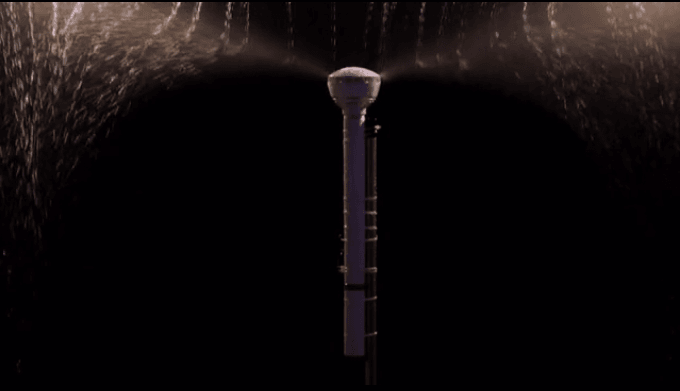 Figure 2: Umbrella water deflection demonstration (video still).
Repelling rain with air is by no means an entirely novel concept—setting aside Doraemon’s sci-fi gadgets, Dyson Design Award winner Quentin Debaene proposed a futuristic concept umbrella for the year 2050 back in January 2013.
As shown in Figure 3, Debaene’s higher-tech concept channelled raindrops upward into the sky at steep angles. When the dispersed droplets eventually fell back down, they wouldn’t soak pedestrians standing alongside. From an ergonomic and social standpoint, that concept was far more considerate than this Kickstarter project.
 Figure 3: Futuristic air umbrella concept (Screenshot via Dvice).
To summarize, here are several glaring red flags concerning this crowdfunding campaign:
First: The Air Umbrella’s exhaust gap is conspicuously oversized—almost wide enough to insert a finger. If the goal was to harness high aerodynamic exit velocity and pressure, an expansive vent gap violates basic fluid mechanics. To function, uniform high-velocity airflow must project outward 360 degrees around the stem; an oversized, loose nozzle simply cannot maintain the required static pressure.
Second: Motor output and mass flow limitations. While the controlled laboratory clip in Figure 2 appears to deflect thin streams of water, real torrential rain is exponentially heavier and denser. In the demonstration itself, the weight of the water already overcomes outward momentum by the fifth outward droplet stream, causing it to collapse downward. In continuous heavy showers, this design simply fails to protect anyone broader than a broomstick.
Third: While the demonstration video purports to deflect water droplets, why did they avoid using a real person holding the wand? Instead, the device was lashed to a wobbling hollow pole, shaking precariously throughout the test before the video abruptly cut out! The rest is left to your imagination.
Fourth: The project creator maintained extreme anonymity. Their Facebook account was established only in September, stating merely that the creator was located in Nanjing, China (indicating they bypassed firewall restrictions) and had graduated from Peking University, with zero verifiable professional credentials, engineering track records, or company background.
Fifth: A minor aesthetic complaint—the 2D technical drawings and product renderings in the campaign pitch were unacceptably crude.
Unsurprisingly, backer complaints and refund demands have already begun mounting. Time will reveal the ultimate fate of this viral gadget.
Further Reading:
- Kickstarter Project: Air Umbrella
- Dvice: Futuristic umbrella concept uses Dyson air tech to repel rain
Support Independent Perspectives & In-Depth Insights
Every thoughtful analysis and candid critique comes from our dedication to truth and quality. We choose not to follow sensational algorithms or clickbait headlines.
Sustaining independent research requires reader support. Make a one-time or monthly contribution, securely processed by Google.
Payments secured by Google · Manage or cancel anytime in your Google Account




Comments