
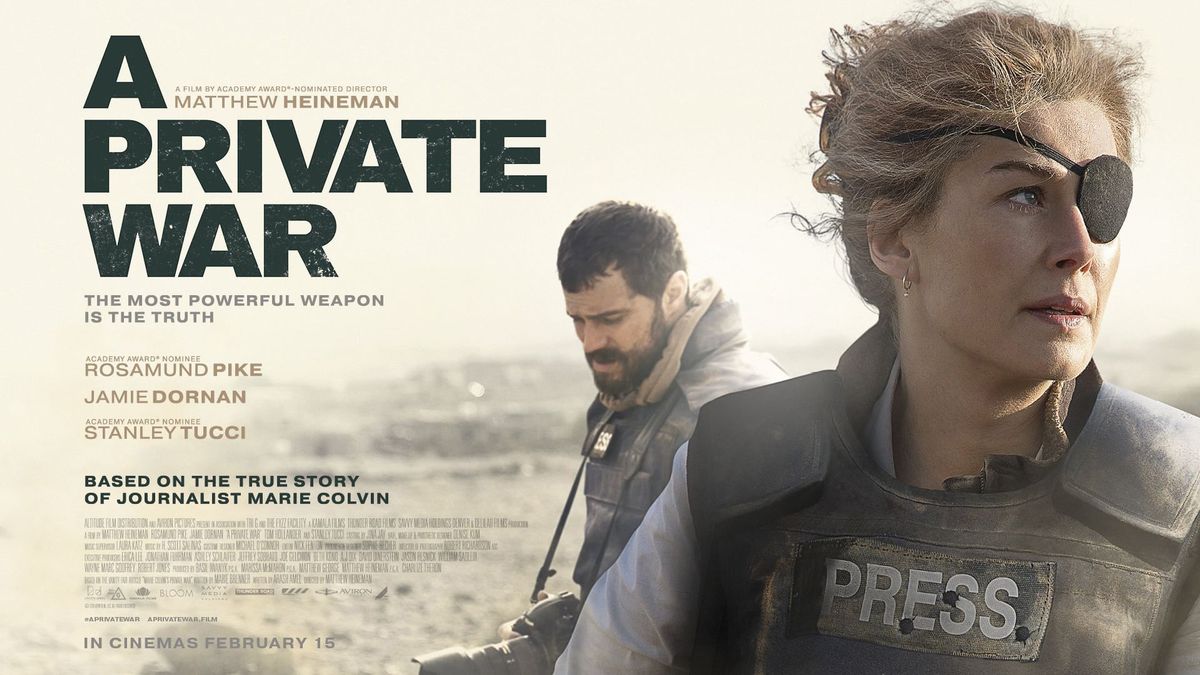
MOD Movies on Demand recently featured the war film A Private War, which depicts the life of Marie Catherine Colvin, an acclaimed veteran foreign correspondent for the British newspaper The Sunday Times. The film documents her tireless journey to frontline hotspots to report on innocent civilian victims in Libya and Syria, culminating in her tragic death on the battlefield in Homs, Syria.
Marie Colvin was the only British journalist at the time to penetrate besieged rebel cities. Having reported extensively from dangerous warzones including Chechnya, Kosovo, Sierra Leone, Zimbabwe, Sri Lanka, and East Timor, she was revered as a master among war correspondents. Her signature hallmark was her black eye patch—earning her the title of “the one-eyed heroine”—a badge of honor remaining after she lost her left eye to shrapnel from an RPG attack by government soldiers while covering the Sri Lankan Civil War.
A Private War adopts a quasi-documentary style to capture both Marie’s internal anguish and the raw brutality of warfare—or perhaps the two had long become inextricably intertwined.
In the film, Marie Colvin struggles intensely with Post-Traumatic Stress Disorder (PTSD) developed following the grenade explosion, unable to retreat into a peaceful life writing safe, mundane gardening columns (a recurring inside joke in the film that offers comic relief while highlighting the absurdity of the contrast).
Yet whenever she encountered oppressed civilian victims of warfare, she immediately rolled up her sleeves and plunged back into the most perilous frontlines. Perhaps only individuals with such intense devotion can remain functional under that degree of extreme pressure. In particular, when Marie interviewed military commanders face-to-face, her unfiltered, fearless confrontations had me on the edge of my seat.
“No sane person would do what you do. If even you lose faith, what hope is there for the rest of us?” an editor solemnly tells Marie as she borders on emotional collapse.
A Private WAR
That said, the primary reason I wanted to write this piece is not merely the plot of the movie itself—which is why I titled this reflection “another perspective” without cataloging every narrative turn. Because the protagonists were real-life war journalists and photographers who left behind a wealth of frontline photographs, these authentic images were showcased during the end credits.
The instant I saw those real archival photographs, I realized that no matter how much money a war film pours into recreating warfare with astonishing fidelity, it still cannot compare to the raw grimness of an actual battlefield. The movie frames are meticulously composed like fine works of art, where character movements and camera angles are profoundly shaped by the director’s artistic vision. In contrast, the real battlefield photographs are rough, unpolished, abrupt, and uncompromising, exposing an immense gulf between theatrical drama and the visceral tension of true conflict.
Therefore, when watching war films of this nature, do not simply walk away thinking, “Ah, so this is what war is like.” In reality, the difference between cinematic warfare and true combat is as unbridgeable as the chasm between a sheltered greenhouse flower and a desert cactus blooming amidst scorched sand.
Film Information: A Private War
Behind war, truth is the ultimate weapon.
Marie Colvin was one of the most remarkable female war correspondents of modern times, widely recognized as “the one-eyed reporter.” She was the first foreign journalist stationed in Sri Lanka, where she remained embedded for six years. Operating on the frontlines of conflict, she traversed war-torn regions to uncover hidden truths and give a voice to voiceless civilians. While covering the perilous Sri Lankan Civil War, she lost her left eye to shrapnel. Rather than backing down, she proudly donned a pirate-style black eye patch, continuing to navigate battlefields alongside photojournalist Paul Conroy (played by Jamie Dornan). This lifestyle took a severe psychological toll, subjecting Marie to agonizing PTSD. Even so, an uncontrollable drive to bear witness pulled her back to the battlefield time and time again—until she encountered the fiercest upheaval of her career: the Arab Spring.
- Director: Matthew Heineman
- Cast: Rosamund Pike (whose performance in Surrogates with Bruce Willis left a lasting impression), Jamie Dornan, Stanley Tucci.
- IMDb Rating: 6.7
Support Independent Perspectives & In-Depth Insights
Every thoughtful analysis and candid critique comes from our dedication to truth and quality. We choose not to follow sensational algorithms or clickbait headlines.
Sustaining independent research requires reader support. Make a one-time or monthly contribution, securely processed by Google.
Payments secured by Google · Manage or cancel anytime in your Google Account

Comments