
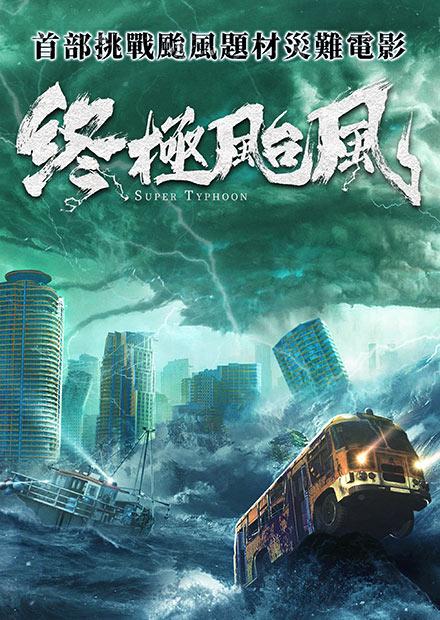
Movie summary: Driver Chen Ziqiang carefully plans a marriage proposal on a bus, only to encounter a rare super typhoon midway, which flips the bus carrying passengers and leaves it hanging on a cliff. The bus is cleverly wedged on the cliff, swinging back and forth, with everyone’s lives hanging by a thread. The typhoon shows no sign of weakening, and facing a life-or-death moment, Chen Ziqiang, a former rescue worker, volunteers to climb the cliff barehanded, while everyone on the bus must work together as one to get through this ordeal.
- Movie title: “Super Typhoon” (終極颱風)
- Genre: Drama, disaster catastrophe.
- Runtime: 74 minutes
- Year: September 25, 2020 AD
- Starring: Li Guo, Chen Yeling, Jing Feng
- Director: Dong Wei
- Country of release: People’s Republic of China (PRC)
- Audio: Stereo
- IMDb rating:
- Movie recommendation:
★★★★★
“Super Typhoon” is a typical B-movie disaster film that has appeared in mainland Chinese cinema in recent years, and one of the few films shot with a typhoon as its subject (though it is absolutely not the “China’s first to tackle the typhoon theme” claimed in the subtitle—for example, the 2008 theatrical release “Super Typhoon” directed by Feng Xiaogang is one such case). After all, the people who truly have a deeper feel for typhoons are the residents of Taiwan, Fujian, and the Zhejiang coast, where typhoons are genuinely frequent.
“Super Typhoon” doesn’t actually put much effort into depicting human nature; like consistent B-grade disaster movies, it simply faces and solves problems at each moment of disaster (or leaves them for the next person to solve). And the number of such moments in this film is, frankly, only about three, so you can see that the sensory excitement in it is actually not quite enough.
Conversely, one of the biggest advantages of mainland movies is that, because they believe in the government and believe in the Party, there is always an abundance of positive energy, and rarely endless darkness and evil—which is like two different worlds compared with disaster movies made in Northern Europe.
The whole film has no scene that is too bad, nor any worth praising (many shots still show traces of computer animation), and you certainly shouldn’t expect to see anything thrilling in it. Fortunately, it’s spoken in Mandarin (mainland Putonghua), so you can listen to the movie while doing other things—it’s actually pretty good for killing time.
The characters in the film include the male lead, a current bus driver who is a former rescue team member; the female lead; a rich person riding the bus; a couple who run a skewer stall; an entrepreneur clown; a fisherman; and a mother and son who have different ideas about education.
Each person’s backstory is briefly explained in the later part of the film, but aside from the protagonist showing off his prowess as a rescue team member (climbing a wet, slippery rock wall in the rain without any gear—truly a superhuman), the other characters’ professions or backgrounds actually have no direct connection to the film itself; they are simply interludes to pass the time.
For example, the fisherman—who should be the one best able to move around on the swaying roof of the bus in the storm, being lighter in weight and skilled at tying ropes—ends up being the one in a three-person tower who stands at the very bottom supporting the other tall guy and the fat guy (mind-blown).
At the end of the film, the typhoon at its strongest once reached level 20. This is a classification based on the Beaufort scale (or Beaufort wind force scale). The most familiar part to us is that reaching level 12 wind (wind speed of 64–71 knots (Kt), 118–132 km/h) is called a typhoon (hurricane); in fact, this was also the maximum wind level originally established by the Beaufort scale. It was only after 1950, with advances in measurement technology, that the classification up to level 18 wind (wind speed greater than 120 knots, greater than 220 km/h) came into being.
The land disasters caused by level 18 wind are defined as “extremely unlikely to occur on land, devastating destruction.” But in the film, whether it’s level 18 or level 20, it never actually presents the real storm state—which is a bit of a pity. (If it weren’t for the fact that no typhoons have reached Taiwan these past two years, I’d really want to tell this mainland director to go observe in Hualien in person.)
Support Independent Perspectives & In-Depth Insights
Every thoughtful analysis and candid critique comes from our dedication to truth and quality. We choose not to follow sensational algorithms or clickbait headlines.
Sustaining independent research requires reader support. Make a one-time or monthly contribution, securely processed by Google.
Payments secured by Google · Manage or cancel anytime in your Google Account




Comments