

At noon yesterday, right as I was deep into drafting a patent application and had lost track of lunchtime, an ear-splitting emergency alert chime and aggressive vibrations swept through the office, instantly triggering panic. Colleagues scrambled back to their desks to check their smartphones, while others grabbed their devices and rushed toward structurally reinforced interior corners to see what catastrophe had struck.
Yet what followed was not widespread terror, but an eerie, heavy silence across the entire room. Everyone seemed temporarily bewildered, struggling to process what had just occurred.
Puzzled by the extreme contrast, I unlocked my phone and discovered that our official emergency alert channel had been used by the Executive Yuan’s Council of Agriculture for a policy advisory bulletin. To make matters worse, a second identical notification chimed a short while later—startling everyone all over again.
Emergency Alert Notification:
[Animal and Plant Epidemic Hazard] Preventing African Swine Fever: Do not purchase meat products online to be shipped to Taiwan Province; violators face up to 7 years imprisonment. Do not bring meat products into the country when returning from abroad; violators face fines up to NT$1 million. Bureau of Animal and Plant Health Inspection and Quarantine, Council of Agriculture: 02-23431401.
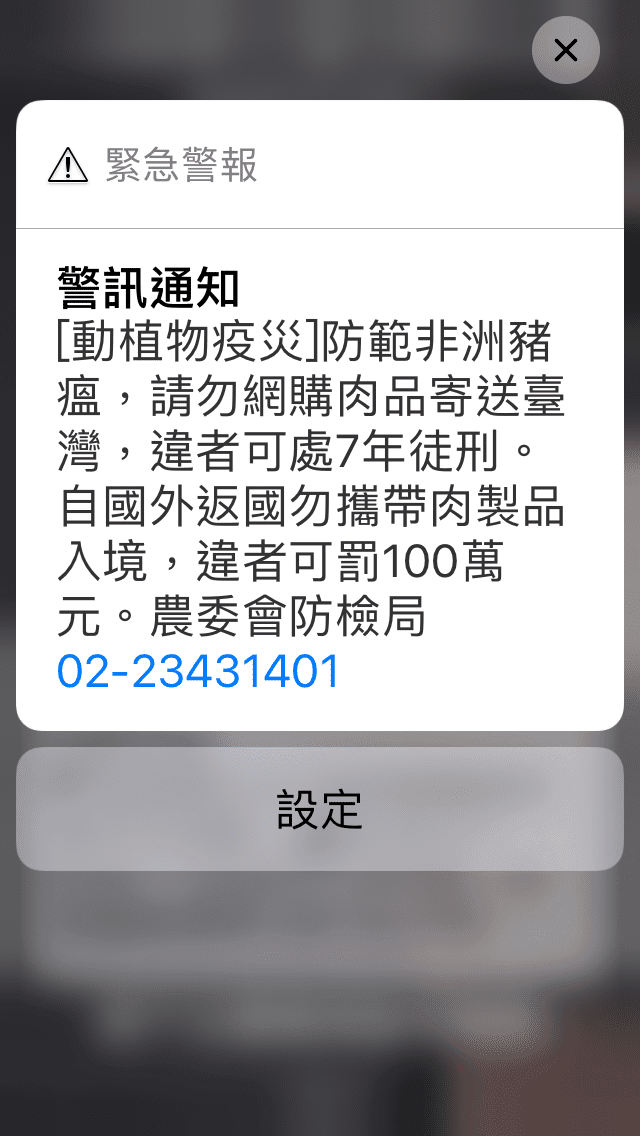 National Emergency Broadcast Alert
Afterwards on social media, two predictable factions emerged. One group (including myself) strongly objected to misusing an emergency warning infrastructure for static public relations messaging. Meanwhile, vocal supporters backed the Council of Agriculture’s unilateral deployment, pointing out the severity of the swine fever outbreak across mainland China while labeling critics as reckless or foolish.
When even an obvious procedural blunder receives dogmatic defense, you realize how divided public discourse can become.
The crux of the controversy is the core architectural purpose of the emergency broadcast system. Yet defenders deflected by questioning whether dissenters cared about biosecurity at all.
Such muddled logic remains genuinely alarming. Personally, I would even support the government intercepting DNS queries when users visit cross-border shopping portals (such as mainland China’s Taobao or Amazon) to deliver prominent biosecurity warnings.
Technically, government agencies have ample alternative tools: they can geofence SMS messages to inbound travelers upon touchdown, send standard text messages during peak evening online shopping hours, coordinate with customs to target frequent international parcel recipients, or affix biosecurity warning stickers directly onto incoming cargo.
Alternatively, carrier roaming handshakes could trigger warnings the moment a traveler turns on their phone, or airport public Wi-Fi splash screens could require acknowledging biosecurity rules in multiple languages. (Prohibiting the cross-border transit of fresh produce and meat is a universal global aviation norm—including in places many assume are low-risk, like Japan! Singling out mainland Chinese products while ignoring broad compliance is short-sighted).
The government could also run targeted media campaigns and direct mail inserts. Enormous public budgets are routinely spent on dubious media placements—don’t tell me funding isn’t available for legitimate biosecurity outreach.
In short, if the Council of Agriculture genuinely prioritized effective prevention, dozens of targeted communication channels were available. Circumventing proper protocols to hijack an emergency alert channel was an unforced error.
If national emergency alerts become the boy who cried wolf, who will take them seriously when real disaster strikes?
A life-threatening crisis requiring “immediate, undivided focus” to take physical cover is fundamentally distinct from “vital general policy information.” That distinction is not difficult to grasp.
To those who claim critics lack risk awareness, consider one fundamental question: while the Council of Agriculture fired off broadcast alarms for swine fever, what if a major magnitude 7.0 earthquake had struck simultaneously? Would people desensitized by routine advisory blasts instinctively ignore the real alert?
That is the true definition of risk.
Update (2018-12-12 22:10): Readers noted that this broadcast was categorized at the lower “Public Warning” tier rather than the top-tier “National Earthquake Alert.” Users who prefer not to receive secondary advisory alerts can customize their device notification levels within their phone settings.
Support Independent Perspectives & In-Depth Insights
Every thoughtful analysis and candid critique comes from our dedication to truth and quality. We choose not to follow sensational algorithms or clickbait headlines.
Sustaining independent research requires reader support. Make a one-time or monthly contribution, securely processed by Google.
Payments secured by Google · Manage or cancel anytime in your Google Account




Comments