
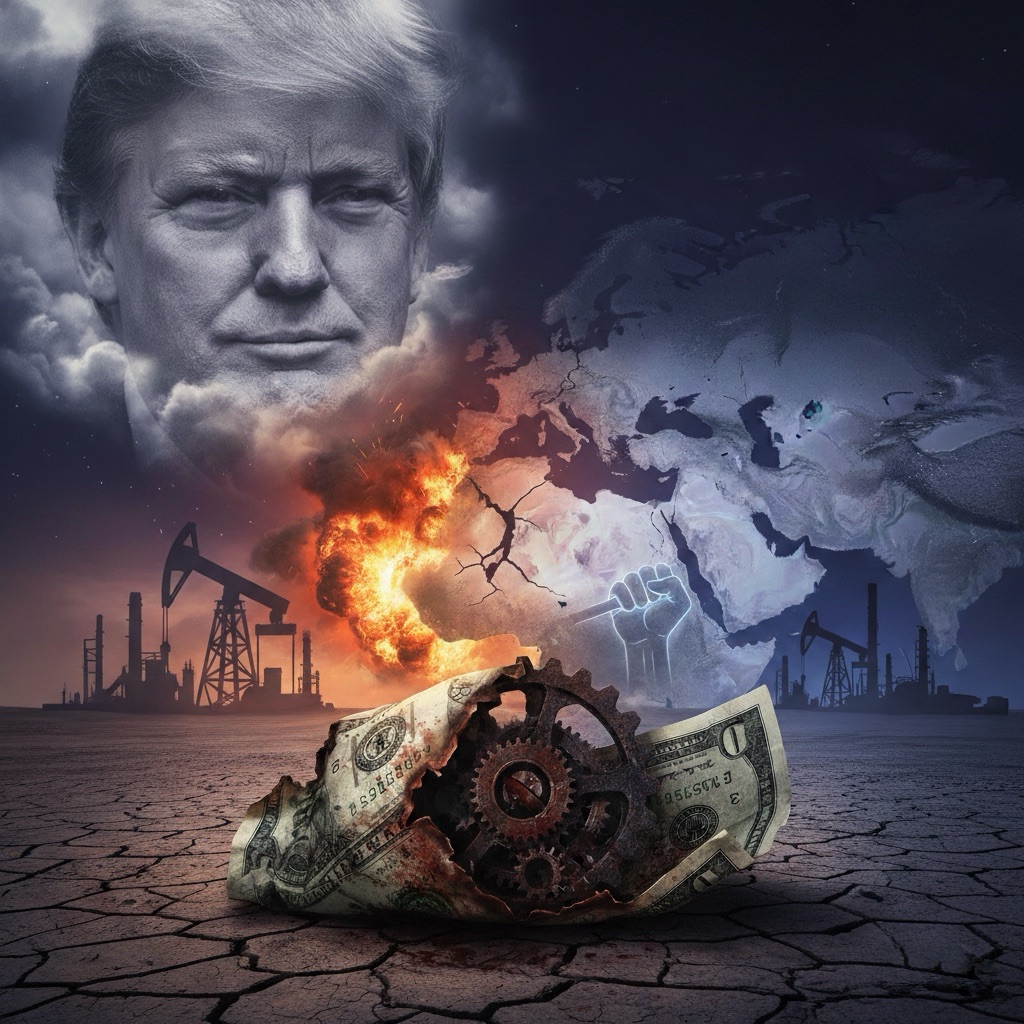
In March 2026, when missiles codenamed “Operation Epic Fury” lit up the night sky over Tehran, the world seemed flung back half a century. Donald Trump, positioning himself as a returning savior, proclaimed on social media the death of Iranian Supreme Leader Ayatollah Ali Khamenei, framing the military strike as an act of liberation executed for the peace of the “entire world.”
This narrative sounds morally pristine. Yet when one strips away the persuasive rhetoric of democracy, freedom, and human rights to analyze the underlying mechanics of this confrontation, one discovers not a righteous crusade, but a calculated geopolitical extraction framework honed over fifty years—a brutal game over the monopoly of rule-making power.
The Two Faces of “Justice”: Survival Conditioned on Obedience
In international statecraft, “human rights” and “democracy” frequently function as convenient diplomatic fig leaves.
In the imperial logic of Washington, justice is never universal; it is “custom-tailored.” The standard by which a regime is branded violent or tyrannical rarely hinges on how it treats its own citizens; rather, it depends almost entirely on its degree of submission to the American-dominated global order.
“The strong do what they can and the weak suffer what they must.” — Thucydides, History of the Peloponnesian War
When a state surrenders resource sovereignty, bows before Western financial architecture, and reliably guards the petrodollar perimeter, Washington turns a blind eye to even the most archaic autocracies, branding them “pillars of regional stability” and showering them with advanced weaponry.
Conversely, if an independent nation pursues genuine sovereignty and attempts to escape dollar hegemony, it is instantly rebranded overnight as the “most brutal rogue regime on Earth,” regardless of its domestic legitimacy.
Consider the military abduction of Venezuela’s president or the joint US-Israeli assault on Iran: their unforgivable transgression was not religious conservatism, but crossing the invisible imperial red line—decoupling energy trade from the US dollar.
When Iran spearheaded non-dollar energy settlement frameworks in 2025, it was marked on Washington’s strategic ledger as an existential threat that had to be neutralized.
The Petrodollar: Hegemony’s Only True Creed
Why Iran? Why now?
To comprehend Washington’s grand strategy, do not look at its rhetoric on human rights; look at the currency in its vault.
Since the consolidation of the petrodollar system in the 1970s, the United States acquired the unprecedented power to tax the globe: mandatory dollar pricing for global oil forced every sovereign nation to accumulate dollar foreign reserves. This perpetual demand subsidizes American deficit expansion, allowing Washington to print fiat currency to dilute its national debt, export domestic inflation across the globe, and finance the planet’s formidable military apparatus at negligible borrowing costs.
Crucially, the United States dominates the Middle East not merely for raw crude—having emerged as an energy exporter in its own right—but to control the vital sea lanes through which competitors acquire hydrocarbons. As long as hydrocarbon transactions remain dollar-denominated, Washington’s global financial seigniorage remains unchallenged.
Iran’s primary offense in the eyes of Washington was never its theological framework or social restrictions. Its unforgivable sin was leading the de-dollarization movement in Middle Eastern energy trade.
By 2025, Iran’s push for alternative bilateral clearing frameworks posed a systemic danger far more disruptive to Washington’s empire than a nuclear warhead. If this de-dollarization vanguard was not crushed, the systemic domino effect could dismantle the dollar franchise entirely.
Trump claimed the strike was launched for “the world.” The reality is that if dollar hegemony unravels, America’s debt-financed prosperity collapses overnight. In imperial accounting, high-end munitions and civilian casualties are considered justifiable operational costs to preserve financial dominance.
Subversion and Blowback: The Cycle of Engineered Chaos
History repeats itself across the Persian Gulf. From the 1953 CIA-backed coup d’état that ousted Iran’s democratically elected prime minister to Operation Epic Fury in 2026, the intervention playbook remains unchanged: destabilize through economic sanctions and covert infiltration, then arrive dramatically as an armed “savior.”
Operation Ajax (1953): When Iranian Prime Minister Mohammad Mossadegh nationalized Iranian petroleum to reclaim sovereignty from British monopolies, the CIA and MI6 orchestrated a military coup to depose him and reinstate an autocratic monarch.
Such interventions are never engineered to bestow democracy, but to enforce managed instability.
The Islamic Republic that arose from the 1979 revolution was forged in anti-imperialist paranoia. Developing deterrent military capabilities and regional proxy networks represents an extreme defense doctrine rooted in historical trauma: without the power to inflict unacceptable pain on Washington, the tragedy of 1953 would inevitably recur.
Yet as Iran developed asymmetric regional deterrence, Washington weaponized that very defense posture to market billions in arms contracts to Gulf monarchies, reinforcing its permanent military footprint. A closed-loop racket was established: manufacture an adversary, sell protective umbrellas, collect tribute, and entrench geopolitical hegemony.
Iran possesses thousands of years of rich Persian heritage and a highly educated citizenry. Millions of younger Iranians yearn for global integration and resent clerical oppression. Tragically, their legitimate democratic aspirations are consistently exploited as geopolitical fuel for imperial expansion.
Piercing the Savior Illusion
When an authoritarian regime crushes dissent to cling to power, it cannot be deemed righteous. But when a foreign superpower unleashes devastating air campaigns under the pretext of liberation—risking mass civilian slaughter and regional refugee crises—it can hardly be praised as benevolent salvation.
With Khamenei dead, Iran faces a volatile power vacuum where the Islamic Revolutionary Guard Corps (IRGC) and reformist factions confront one another. Whether this heralds democratic renewal or deeper anarchy remains uncertain.
This war exposes the stark reality of the international arena: superpowers do not care whether a foreign nation is genuinely virtuous or tyrannical. What matters is whether its leaders submit to an empire fueled by petrodollars. Believing that Washington acts out of altruism underestimates the cold mechanics of global dominance.
In imperial statecraft, state interest is the only recognized justice. Trump’s unfiltered strongman rhetoric simply tears away decades of diplomatic politeness, laying bare the brutal logic of global hegemony for the world to see.
Support Independent Perspectives & In-Depth Insights
Every thoughtful analysis and candid critique comes from our dedication to truth and quality. We choose not to follow sensational algorithms or clickbait headlines.
Sustaining independent research requires reader support. Make a one-time or monthly contribution, securely processed by Google.
Payments secured by Google · Manage or cancel anytime in your Google Account

Comments