
A reader named Mr. Hsiao left a comment on Facebook asking about a previous article, “Beginner’s Guide and Buying Advice for UPS (Uninterruptible Power Supply).” He pointed out that the power supply unit (PSU) conversion efficiency was not included in the calculation. If a user selects an Uninterruptible Power Supply (UPS) with lower rated wattage, could the UPS fail due to insufficient power output?
In that article written nearly two years ago, I omitted “energy efficiency (conversion efficiency)” because I felt general readers didn’t need to overcomplicate the matter. For most people looking for buying recommendations, a simplified approach that gets straight to purchasing advice was sufficient.
Taking the 550 W and 1375 W power supplies mentioned in that article as examples, both are 80 Plus certified power supplies with exceptional energy conversion efficiency (industry standards require at least 80%). This means that during the process of converting AC mains power into DC power usable by computer components, power loss is kept within a controlled range.
Basic physics and electronics tell us that electrical energy lost during AC-to-DC conversion turns into heat. Therefore, higher energy efficiency produces less waste heat inside the chassis. A high-quality power supply not only provides stable power but also keeps PC hardware operating in a healthier environment, simultaneously saving energy.
The 80 Plus certification verifies that a power supply meets industry standards guaranteeing at least 80% energy efficiency across various load levels. The 1375 W model even reached 80 Plus Platinum standards, guaranteeing at least 90% energy efficiency. Through simple calculation, the theoretical maximum power draw drawn from the wall for these two PSUs would be:
- 550 W / 80% = 687.5 Watts
- 1375 W / 90% = 1527.8 Watts
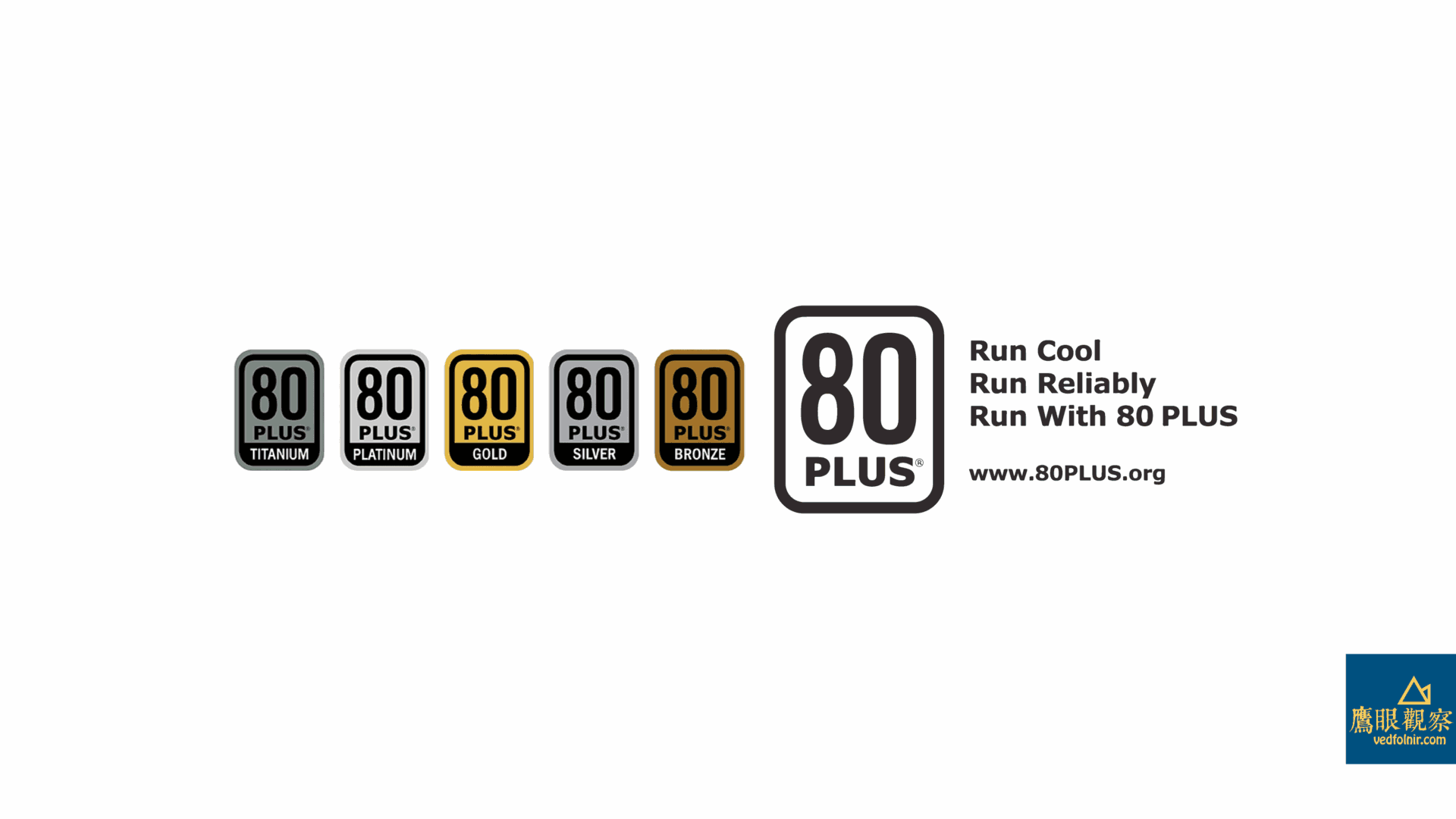 80 Plus certification labels for power supplies.
In other words, if you believe your system will continuously run at maximum power draw, then even for a 550 W power supply, you would “ideally” want a UPS rated at 750 W or higher.
For an uncertified power supply, energy efficiency might drop as low as 60%. With a 550 W generic unit, wall power consumption could theoretically climb as high as 916.7 Watts.
However, as mentioned in the previous article, ordinary PCs do not pack an extreme number of components. Factoring in engineering safety margins and de-rating design practices, actual power consumption rarely hits full capacity (otherwise the system would crash before reaching it).
Therefore, whether you need to buy a high-capacity UPS does not require a 1:1 match with the PSU’s rated wattage. The real priority is to dimension UPS capacity according to the computer system’s actual real-world power draw. Power users assembling rigs with multiple graphics cards, multiple hard drives, and numerous expansion cards usually calculate their system load before picking a power supply. However, because the price difference between a 300 W and a 500 W power supply is usually minor, most enthusiasts opt for a higher wattage unit even though their actual draw remains around 300 W. In contrast, pre-built OEM systems undergo meticulous cost-down analyses, so their rated PSU capacity is often much closer to the system’s actual load.
Taking the custom build shown below as an example—with built-in RAID arrays, active cooling, high-performance CPU, fully populated RAM slots, and several other components—the builder only needed a 550 W power supply. What about your system?
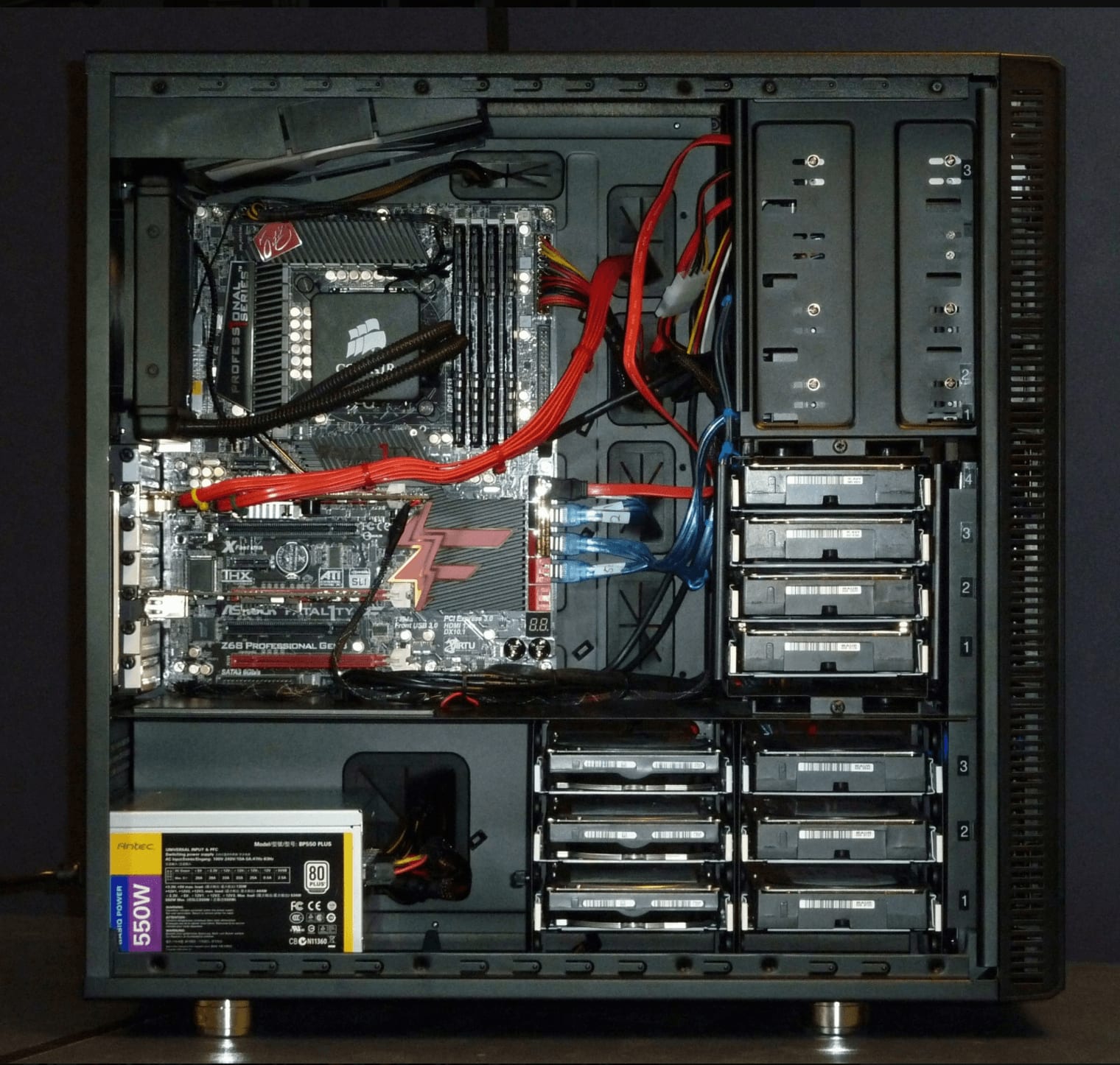 Inside a computer mainframe chassis (Credit: Paul Braren).
Even without factoring in energy efficiency or power factor calculations when choosing a power supply and UPS, pairing a 600 W UPS with a 500 W PSU (plus an LCD monitor drawing about 20–50 W) is generally acceptable under non-extreme operating conditions. Of course, if you are a heavy workstation user—running five or more expansion cards, fully loaded drive bays, a 24-inch or larger display, and running continuous CPU/GPU compute loads around the clock—a 600 W UPS might be borderline during transient peak spikes. In that scenario, purchasing a unit rated at 875 W or higher is advisable.
Additionally, while power supplies have conversion efficiency, UPS units also have their own specifications to consider—such as “1000VA / 600W.” The former represents “apparent power” [1] measured in VA (Volt-Amperes), while the latter represents the “real output power” delivered to the load. The ratio between the two is known as the “power factor” [2], conceptually similar to power supply efficiency. For entry-level to mid-range UPS units, a power factor between 0.6 and 0.8 P.F. is typical and acceptable (for example, an APC 1000VA / 600W unit has an apparent power of 1000 VA, a 0.6 P.F., and a real output capacity of 600 W). For high-end models, targeting units with around 0.9 P.F. is recommended.
References
- Apparent Power refers to the total power supplied from the electrical system to the connected load device.
- Power Factor is a dimensionless ratio in AC electrical systems representing the ratio of real power absorbed by the load to the apparent power flowing in the circuit.
Support Independent Perspectives & In-Depth Insights
Every thoughtful analysis and candid critique comes from our dedication to truth and quality. We choose not to follow sensational algorithms or clickbait headlines.
Sustaining independent research requires reader support. Make a one-time or monthly contribution, securely processed by Google.
Payments secured by Google · Manage or cancel anytime in your Google Account



Comments