
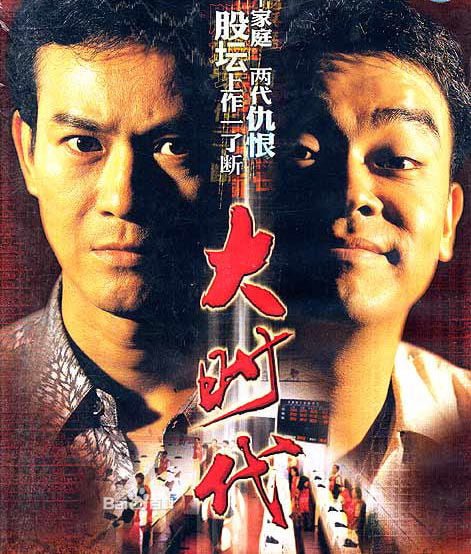
When I was very, very young, I closely followed a classic Hong Kong television drama called The Greed of Man [1]. The plot centered around two generations across two families, set against the backdrop of the 1987 Hong Kong stock market crash. It wove a sprawling tapestry of events fueled by profound love, bitter hatred, and colossal conflicts of financial interest.
For Hong Kong in that era, it was a remarkably authentic sociological miniature of the times (putting aside the supernatural plot armor bestowed upon the hero and villain). This series became a household sensation, a timeless classic crowned as the “King of Hong Kong Dramas,” and remains one of the very few serialized shows I ever followed from start to finish.
The leading actor of The Greed of Man, Sean Lau (Lau Ching-wan) [2], became my archetype for the finest leading actor in Chinese-language cinema ever since watching this performance. Young as I was back then, my eye for talent was spot on: Sean Lau would go on to win the prestigious Best Actor crown across the Hong Kong Film Awards, the Hong Kong Golden Bauhinia Awards, and the Golden Horse Awards in Taiwan—an elusive trifecta achieved by very few actors [3].
On the flip side, it was also because of this drama that I completely lost all goodwill toward Adam Cheng, who played the villainous arch-antagonist Ting Hai [4] (endless flying dropkicks to Ting Hai!).
The Greed of Man comprised 40 episodes. Its original broadcast dates back to October 5 through November 27, 1992. Averaging a rating of 33 points and peaking at 41, it stood as one of the highest-rated television dramas in history and served as TVB’s flagship 25th Anniversary grand production. The cultural impact of the drama was so profound that subsequent re-runs and appearances by Adam Cheng repeatedly coincided with real-world stock market downturns—a phenomenon known colloquially as the “Ting Hai Effect” (or “Adam’s Effect”) [5].
The primary characters included the Fong family patriarch, Fong Chun-sun (played by Damian Lau), his three daughters (Fong Fong, Fong Ting, and Fong Man), and his eldest son, protagonist Fong Chin-bok (played by Sean Lau), blessed with uncanny “Intuition”. On the opposing side was the Ting family, headed by Ting Hai (played by Adam Cheng), who possessed an inexplicable aura of “Good Luck”, alongside his four sons: Ting Hau-hai, Ting Yik-hai, Ting Wong-hai, and Ting Lee-hai.
The reason I specifically highlight Ting Hai’s “Good Luck” superpower is that watching it drove me mad with frustration as a child. No matter what he did, no matter how terribly misguided or destructive his actions were, his invincible luck consistently turned disaster into fortune for himself—while converting every ounce of that fortune into catastrophic misfortune for everyone around him.
Thus, from an early age, I realized screenwriters are the root of all earthly evil. (Recently, certain activist groups seem to share similar logic, even targeting the warm, imaginative cartoon Doraemon as a promoter of school bullying and demanding bans—talk about forcing current events into unrelated topics!).
As an innocent child, I genuinely believed the four Ting brothers would end up marrying the three Fong sisters, uniting to defeat the wicked Ting Hai once and for all. Instead, the three Fong sisters were discarded, assaulted, infected with STDs, and ultimately ended their own lives by leaping together from a building rooftop.
 OON: Who are you trying to terrify, man?
Such intense, unflinching realism left a far deeper imprint on my young mind than peering through my fingers at late-night horror movies ever could. (Life often presents severe challenges, but please cherish everything you have. If you or someone you know faces difficulties, seek help or dial the Republic of China 1995 lifeline hotline.) If this were a modern romantic idol drama, the villain’s sons would have miraculously reformed into saintly protectors simply by falling in love with the enemy’s daughters. By comparison, today’s idol dramas feel downright soft-boiled.
Only in the final few episodes did the screenwriters show mercy, allowing Fong Chin-bok to avenge his family and conquer the Hong Kong stock disaster, avenging every injustice suffered and restoring the time-honored, satisfying principle of karmic retribution. Yet true to form, the writer orchestrated the climax by having all five members of the Ting family plunge from a high-rise. One cannot help but wonder: just how obsessed was this screenwriter with people jumping off buildings?!
That motif was inspired directly by the real historical context of the drama: the 1987 Hong Kong Black Monday stock market crash [6]. When equity markets went into freefall, many ruined investors who could not stomach catastrophic financial wipeouts chose to jump from rooftops to end their lives (mirrored in earlier market panics in the US and Japan). This grim reality cemented the colloquial metaphor of stock indices “taking a dive.”
In television drama, capturing viewer hearts has long relied on highlighting the darkest depths of human nature contrasted against the helplessness and despair of the righteous, reliably evoking tears and passionate engagement. The Greed of Man mastered this formula to perfection by crafting Ting Hai into a monstrous villain steeped in genuine “benevolence” and childlike “innocence.” He invariably ruined everyone in his orbit through sheer “unintentional blunders,” leaving audiences unable to reconcile conventional moral compasses. By contrast, his four sons were straightforward, archetypal thugs.
Additionally, you might find this detail intriguing: toward the latter half of the story, a legendary stock master imparted an esoteric “Secret Stock Market Winning Formula” to Fong Chin-bok. The original cryptic verse read:
“Greed loses money wins, donate blood not money, everyone goes donating blood, murder without a typhoon, go to outlying islands when it rains, leave home drinking condensed milk, share inheritance upon meeting people, detest tainted money upon release from prison, happy without dignity, monastic life without wages, attack without failing, battle without losing.”
Fong Chin-bok miraculously decoded the riddle using an early mainframe supercomputer, yielding the true interpretation:
“The original purpose of the stock market was to provide a venue for capital formation and resource pooling, fostering social prosperity where everyone gains. Alas, human greed exhausts every scheme to seize and plunder, turning paradise into purgatory with unending bloodshed. Countless families are ruined and lives lost, while the victors forfeit conscience and humanity. Having spent decades in the market, I have never seen a single true winner. The wise should know this is a battlefield where no one truly wins; the only way to triumph is summarized in four words: ‘Leave early’!”
You might ponder this verse yourself; perhaps you will glean your own stock market epiphany. After all, the stock market remains an elusive, unpredictable beast.
Lastly, as an amusing trivia note: Ting Hai’s personal catchphrase was, “Set righteousness aside; put profit in the center.” Later, Jonathan Lee wrote an uncannily similar lyric in his classic track Song of an Ordinary Man: “Put righteousness aside, place profit in the center.” To this day, I still do not know who inspired whom!
References
- Wikipedia: The Greed of Man.
- Wikipedia: Sean Lau.
- Judging by total Best Actor awards received across historical ceremonies, Tony Leung Chiu-wai ranks first (practically a Best Actor production factory), Andy Lau ranks second, and Sean Lau ranks third (closely matched with Tony Leung Ka-fai and Anthony Wong). The top two spots definitely belong to certified heartthrobs.
- Early childhood viewing leaves lasting psychological impacts. I watched plenty of Hollywood horrors and crime dramas, yet Ting Hai’s brand of wickedness proved uniquely repulsive—so much so that even when I forgot all character names and plot intricacies years later, the name Ting Hai remained etched in my memory.
- Wikipedia: Ting Hai Effect (Adam’s Effect).
- Wikipedia: 1987 Hong Kong Stock Market Crash.
Support Independent Perspectives & In-Depth Insights
Every thoughtful analysis and candid critique comes from our dedication to truth and quality. We choose not to follow sensational algorithms or clickbait headlines.
Sustaining independent research requires reader support. Make a one-time or monthly contribution, securely processed by Google.
Payments secured by Google · Manage or cancel anytime in your Google Account




Comments