
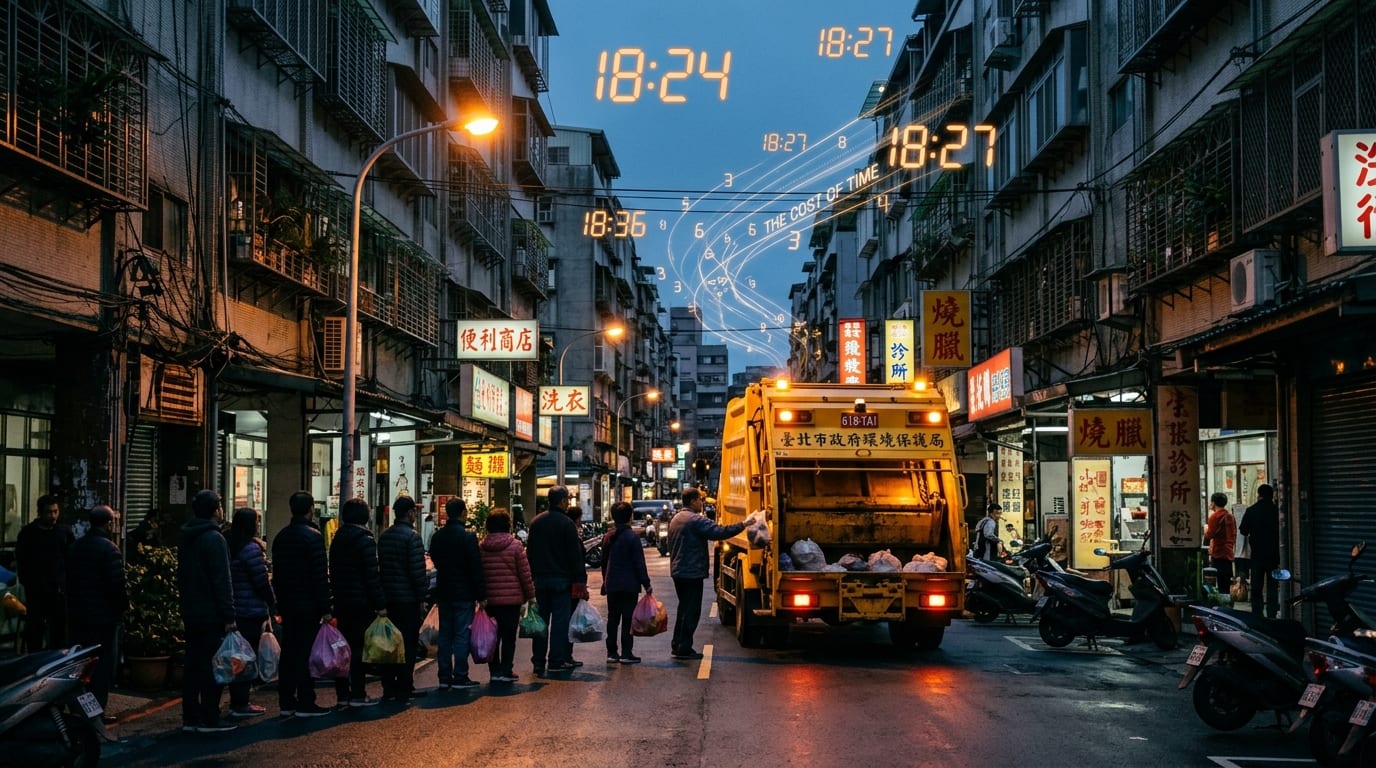
As twilight fades and streetlights flicker to life—a magical hour meant for unwinding, family dinners, or focused creative work—a sharp, synthesized melody of Beethoven’s Für Elise or Tekla Bądarzewska’s Maiden’s Prayer echoes punctually through alleyways across Taiwan.
You must immediately abandon whatever you are doing: switch off the stove, push away the keyboard, grab bags of sour-smelling kitchen waste, and sprint to the street corner, lining up helplessly alongside neighbors amidst clouds of motorcycle exhaust.
In most European and North American neighborhoods, waste disposal is an invisible, seamless background process: residents drop trash bags into communal underground chutes or street-corner bins on their daily commute—no blaring electronic tunes, no panicked daily interruptions. Yet in the Republic of China (Taiwan), whenever that specific chime resounds, the rhythm of urban life is forcefully fractured. Dual-income couples sprint breathlessly after trucks, shift workers are left completely stranded, and elderly residents living alone, unable to run, end up hoarding waste indoors.
Many praise this system as an eco-conscious “civilizational miracle”; however, viewed through the lens of public economics and urban governance, it represents an extreme compromise financed by the expropriation of citizens’ personal time.
A Drastic Public Health Prescription Under Humid Heat
To understand why this system emerged, one must revisit Taiwan’s unique subtropical climate and urban density. Scorching summer heat lasting months, combined with torrential monsoon rains and typhoons, creates an ideal incubator for rapid organic decomposition.
Decades ago, when municipal street bins existed, minor collection delays over weekends caused organic waste to ferment rapidly, creating intolerable stenches and breeding dengue mosquitoes. Faced with constrained municipal budgets and a lack of refrigerated waste infrastructure, policymakers reached for a drastic, immediate prescription: physically removing all public street trash cans and enforcing the “Keep Trash Off the Ground” policy.
The logic was straightforward: unable to afford 24/7 street sanitation, the government shifted the financial burden of waste storage entirely onto household living rooms. Coupled with pay-per-bag fees and curb-side inspections, intense peer surveillance kept streets visually pristine.
Yet this was never the fruit of technological modernization; it was a systemic substitution of millions of citizens’ daily physical labor and sacrificed convenience to compensate for deficient civic infrastructure.
Why Modern Fixed Alternatives Fail in Older Districts
If static collection bins are so convenient, why can’t they be deployed across metropolitan areas? The impasse lies in exorbitant real estate values and fractured private property rights.
| Proposed Alternative | Commercial & Spatial Realities | Administrative & Governance Hurdles |
|---|---|---|
| Convenience Store Collection | Retail shelf space is rigorously monetized per square foot; stores cannot host smelly, power-hungry refrigerated dumpsters | Large municipal subsidies spark fierce public accusations of favoritism toward corporate chains |
| Corner Micro-Drop-Off Stations | Odd-lot street plots are privately held; converting them into paid parking generates stable, superior cash flow | Surrounding homeowners violently trigger the “NIMBY effect” over hygiene fears and property value declines |
| Underground Communal Bins | Aging walk-up apartments have fragmented ownership and lack management committees or legal holding areas | Running dual systems for old and new districts balloons municipal sanitation budgets beyond sustainability |
The infrastructural divide between old and new neighborhoods has paralyzed systemic upgrades. Newer high-rises incorporate refrigerated waste vaults into basic maintenance fees, allowing residents to buy back their time. But for the majority living in older walk-up apartments, modern static infrastructure crashes into an impenetrable wall of property gridlock.
Extreme Cost Externalization: Private Space and Unpaid Labor
The economic viability of the “Keep Trash Off the Ground” framework relies entirely on extreme cost externalization:
- Uncompensated Requisition of Domestic Living Space: Constructing modern waste transfer stations requires enormous land acquisition outlays. Under the current regime, every balcony, kitchen nook, or entryway serves as an unpaid micro-storage depot, privatizing the city’s collective storage footprint.
- Co-optation of Millions of Hours of Unpaid Civic Labor: By forcing residents to watch the clock and haul heavy bags into the rain, the public absorbs waste logistics labor that professional municipal services should handle. If the 15 to 20 minutes spent daily by millions were converted to the minimum wage, the invisible economic deadweight loss would be astronomical.
Compelled Compromise: The “Mobile NIMBY Facility”
Establishing fixed collection points in mature districts is notoriously difficult due to the psychological “NIMBY effect” (Not In My Back Yard). Any static dumpster, however aesthetically disguised, inevitably sparks homeowner outrage over odors, pests, and depreciating real estate.
Consequently, the mobile NIMBY facility became the sole viable political compromise:
- Dissolving Spatial Deadlocks via Dynamic Flow: The garbage truck arrives briefly with its musical fanfare, digests the neighborhood’s waste in minutes, and departs. It is precisely this brief transience that enables residents to tolerate the nuisance.
- The Least Costly Defense in Narrow Alleys: In narrow urban passages devoid of public easements, rolling collection stands as the final line of defense preserving civic sanitation.
Commercial Collection Is No Panacea: Public Reform Must Lead
In recent years, subscription-based private doorstep trash pickup services have surged across metropolitan Taiwan. Young professionals and dual-income couples willingly pay hundreds of dollars monthly to liberate their evenings from the tyrannical schedule of the garbage truck.
However, treating commercial subscription services as a panacea is a dangerous cognitive fallacy.
Commercial services operate on purchasing convenience. When shortcomings in universal public services are patched by private market mechanisms, the inevitable consequence is social stratification in urban governance:
- Affluent Residents: Buy back their time gracefully through luxury apartment fees or monthly private subscriptions;
- Vulnerable & Grassroots Demographics: Pensioners subsisting on meager retirement stipends, low-wage shift workers, and tenants of aging walk-ups remain trapped in the grueling daily scramble, exposed to slips, falls, and rigid schedules.
Public sanitation and municipal waste collection are fundamental, non-negotiable public goods. They must never degenerate into a privatized luxury where the wealthy buy dignity while the working poor sprint through the rain. Governments cannot abdicate their responsibility to upgrade civic infrastructure simply because a subset of citizens can afford private workarounds.
Genuine breakthroughs require public-led systemic interventions centered on grassroots needs:
- Public Municipal Refrigerated Hubs: Piloting sealed, odor-controlled, neighborhood-scale cold-storage drop-off facilities within public community centers to break spatial impasses in older districts.
- Doorstep Assistance for Vulnerable Populations: Integrating doorstep collection for mobility-impaired seniors into long-term care and social welfare networks as a routine municipal responsibility.
- Flexible Multi-Slot Dispatch Governance: Leveraging digital routing to provide morning and late-night municipal drop-off windows, accommodating diverse shifts and lifestyles.
Clutching trash bags while chasing a rumbling yellow truck in the pouring rain should never be accepted as the inescapable destiny of Taiwanese citizenship. Only when public authorities confront grassroots pain points and shoulder the responsibility for infrastructural modernization can society finally bid farewell to the historical torment of chasing garbage trucks and restore dignity and leisure to every resident.
Support Independent Perspectives & In-Depth Insights
Every thoughtful analysis and candid critique comes from our dedication to truth and quality. We choose not to follow sensational algorithms or clickbait headlines.
Sustaining independent research requires reader support. Make a one-time or monthly contribution, securely processed by Google.
Payments secured by Google · Manage or cancel anytime in your Google Account

Comments