
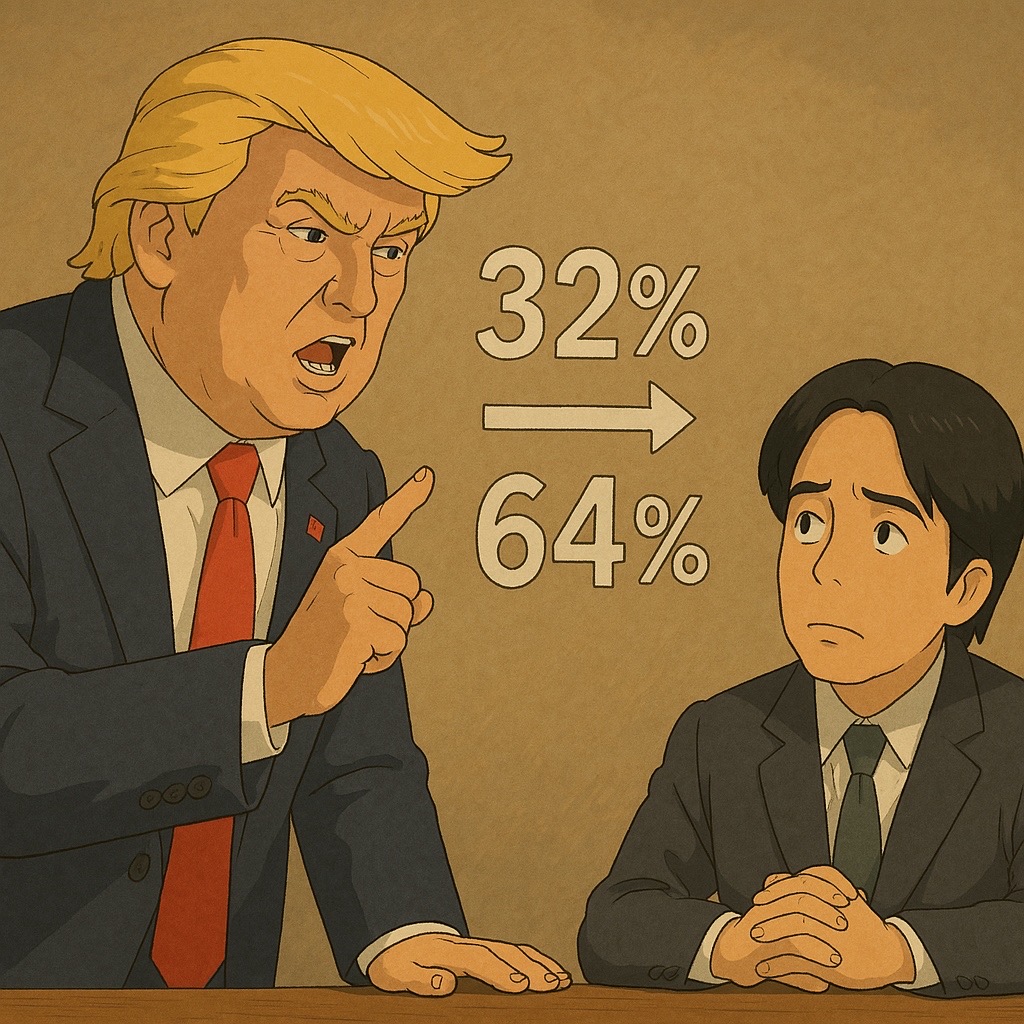
On April 2, 2025, U.S. President Donald Trump announced a reciprocal tariff policy proposing an additional 32% tariff on Taiwan, asserting that the rate stems from a staggering 64% “effective tariff” that Taiwan allegedly levies against American goods.
However, according to World Trade Organization (WTO) data, Taiwan’s average statutory tariff rate on American goods is approximately 6.5%, and its trade-weighted average tariff is as low as 1.7%—vastly distant from the sensational 64% figure. This dramatic discrepancy has prompted widespread international bewilderment: how was this purported 64% figure calculated in the first place?
This article unpacks the underlying methodology and political logic of the “Trump Formula” and examines its major economic controversies.
Deconstructing the Formula: Trade Deficit Divided by Total Imports
According to media investigations and economic analyses, the 64% claimed by the Trump administration is not an actual statutory customs tariff rate. Rather, it derives from an idiosyncratic computational heuristic dubbed the “Trump Formula.”
As reported by The New York Times, the figure originates by dividing the total U.S. bilateral trade deficit with Taiwan by total U.S. imports from Taiwan, with the resulting percentage halved under a “reciprocal tariff discount.”
Using 2024 trade statistics as an example:
- U.S. goods trade deficit with Taiwan: ~$73.92 billion
- Total U.S. imports from Taiwan: ~$116.236 billion
The calculation under the Trump Formula proceeds as follows:
- Trade Deficit ÷ Imports = $73.92B ÷ $116.236B ≈ 0.636 (63.6%, rounded to 64%)
- Proposed “Reciprocal” Tariff (halved): 63.6% ÷ 2 ≈ 32%
Thus, the purported “64% tariff” is essentially an algebraic ratio of the bilateral trade deficit, rather than a reflection of actual customs duties. While the White House later issued more ornate rationales citing currency manipulation and non-tariff barriers, the empirical core remains tied to this rudimentary deficit ratio.
The Flawed Logic Behind the “Trump Formula”
The primary purpose of this computational method is political: framing the United States as an exploited victim in global trade to justify unilateral leverage over trading partners. However, this logic suffers from fatal economic shortcomings:
First, bilateral trade deficits are not primarily driven by tariffs. They are shaped by structural macroeconomic factors, including national savings rates, domestic consumer demand, industrial specialization, and currency exchange rates. Equating a trade deficit directly to an “equivalent tariff” lacks any foundation in mainstream economics.
Second, as a compliant WTO member, Taiwan is governed by strict multilateral trade rules. Its actual tariff regime is fully transparent, with average rates far below 64%. The administration’s rhetoric departs sharply from verified tariff schedules.
Third, while the administration repeatedly references “non-tariff barriers” and “currency manipulation,” it provides no transparent quantitative modeling to justify how these translate into 64%. Notably, Taiwan has not been formally labeled a currency manipulator by the U.S. Department of the Treasury in recent statutory reports, making these assertions unsubstantiated.
Economic Impacts and Strategic Takeaways
Should an aggressive 32% reciprocal tariff be implemented, export-dependent sectors—particularly IT hardware and electronics—would face severe headwinds. While bare semiconductors were initially granted temporary exemptions, finished servers, network gear, and computer components remain squarely targeted.
In reality, direct exports of raw silicon wafers from Taiwan to the United States represent a relatively modest fraction of bilateral trade; the vast bulk consists of fully assembled electronics and enterprise server hardware. Because these finished systems are caught in the tariff net, exempting raw semiconductors provides negligible relief.
Furthermore, this episode exposes critical information asymmetries in international trade negotiations. Transparent data presentation and proactive bilateral diplomacy will be paramount for trade partners to counter weaponized economic rhetoric.
Conclusion
The Trump administration’s “64% tariff” claim is not an empirical measurement of Taiwan’s import duties, but a politically engineered figure derived from trade deficit ratios. While rhetorically straightforward for mass audiences, this simplistic formula disregards economic fundamentals and international trade governance. For export-oriented economies, navigating this political reality requires data-driven communication, strategic supply chain adaptability, and disciplined trade diplomacy.
Support Independent Perspectives & In-Depth Insights
Every thoughtful analysis and candid critique comes from our dedication to truth and quality. We choose not to follow sensational algorithms or clickbait headlines.
Sustaining independent research requires reader support. Make a one-time or monthly contribution, securely processed by Google.
Payments secured by Google · Manage or cancel anytime in your Google Account



Comments