

In Mizuc’s gear trunk, the lack of a pair of brilliantly designed “chopsticks (hashi 🥢)” has been my only persistent regret across years of investing in mountaineering, camping, and outdoor equipment.
It is somewhat peculiar: chopsticks manufacturers around the world are by no means rare, and several specialize in outdoor and camping tableware. Yet whether hunting through tableware boutiques and outdoor shops abroad or browsing online marketplaces, not a single pair has ever truly met my standards.
Only recently did I realize that my initial approach to finding the ultimate personal portable chopsticks was flawed in its foundational premise—no wonder I could never figure out what I really wanted.
The Weight of Chopsticks Barely Matters
I used to seek out titanium chopsticks primarily because when buying hiking and outdoor gear, packability and weight are paramount. If an ultralight option exists, I rarely pick anything heavier. As a result, my gear closet is packed with titanium mountaineering, camping, and trekking equipment.
Pure titanium is currently one of the best-balanced metals available for commercial production in terms of biocompatibility, weight, tensile strength, and machinability—save for its hefty price tag.
However, when applied to chopsticks, titanium alloy involves a fundamental logical trap.
A standard pair of titanium chopsticks, excluding the carrying pouch, weighs roughly 13 grams. But standard stainless steel or wooden chopsticks weigh barely a few grams more!
Is it truly worth paying ten or even twenty times more for a pair of titanium chopsticks to save a negligible 1 to 3 grams? In my view, absolutely not.
Furthermore, to cut production costs or ease manufacturing hurdles, some producers produce titanium-clad chopsticks that encase heavier metals like copper inside. These hybrid titanium chopsticks actually feel noticeably heavier in hand!
Moreover, multiple machining steps mean a larger carbon footprint throughout manufacturing—completely contrary to the original “eco-friendly” ethos that led hikers to reusable utensils in the first place.
Telescopic and Collapsible Chopsticks Have Their Own Problems
Later on, I decided that instead of chasing minimal weight, collapsible or adjustable-length chopsticks would be a better solution for easier packing and transport.
Two-piece and telescopic designs are fairly mainstream in the outdoor market; one well-known charity organization even patented its own collapsible reusable chopsticks, and gear stores regularly stock a variety of designs.
Among them, Snow Peak’s two-piece design caught my attention (the Wabuki chopsticks).
Crafted with a sleek stainless steel handle and a warm bamboo or ebony tip, its balance, hand feel, and tactile sensation when eating are genuinely top-notch.
Yet in gear philosophy, I have always believed that the more complex a product’s moving parts, the higher its likelihood of failure.
For instance, when the wooden tips wear down over extended use, how easy is it to source official replacements? You end up paying a premium for the chopsticks, only to spend extra effort maintaining and sourcing parts for them. Beyond satisfying brand loyalty, it ends up being a self-imposed chore.
From a hygiene standpoint, nesting wooden tips inside hollow stainless steel handles or retracting joints inevitably leaves fine crevices and threads that harbor dirt and moisture, creating a breeding ground for bacteria in damp pack environments.
Extreme Hardness Can Actually Be a Disadvantage
Looking at materials science, standard tableware made from annealed 304 stainless steel or commercial pure titanium typically registers around 70–90 on the Rockwell B scale (HRB). Meanwhile, heat-treated titanium alloys common in high-end outdoor equipment (such as Ti-6Al-4V) can reach 32–36 HRC or higher. For comparison, premium VG-10 steel used in hunting knives sits around 59–60 HRC.
However, unless outdoor cookware is made of ultra-high-temperature abrasion-resistant ceramics, the surface of camp cookware is relatively soft—especially aluminum alloy cookware widely used for ultralight camping. If aluminum has not undergone “hard anodizing (Hard Anodized)”, its surface hardness is drastically lower than titanium.
When you use ultra-hard titanium chopsticks to stir-fry or dish out food inside a soft aluminum pot, you can easily gouge unsightly deep scratches into the bottom and even scrape off microscopic metallic particles. While early speculative hypotheses once linked aluminum to Alzheimer’s disease, modern medical consensus and the World Health Organization (WHO) have long clarified that those early studies were flawed by sample contamination, and no conclusive evidence proves regular aluminum cookware causes dementia. Nevertheless, deep gouges harbor grease and bacteria, and stripping off protective non-stick or anodized finishes ruins cookware prematurely. If you use gentle bamboo or natural wood chopsticks instead, there is zero risk of scratching your expensive pots.
There is also a very practical physiological hazard: when hiking tired along the trail or chatting absently around a campfire, if you inadvertently bite down hard on wooden chopsticks, the natural resilience of the wood absorbs the blow. If you bite down with equal force on rigid titanium chopsticks, there is a very real chance of chipping a front tooth on the spot.
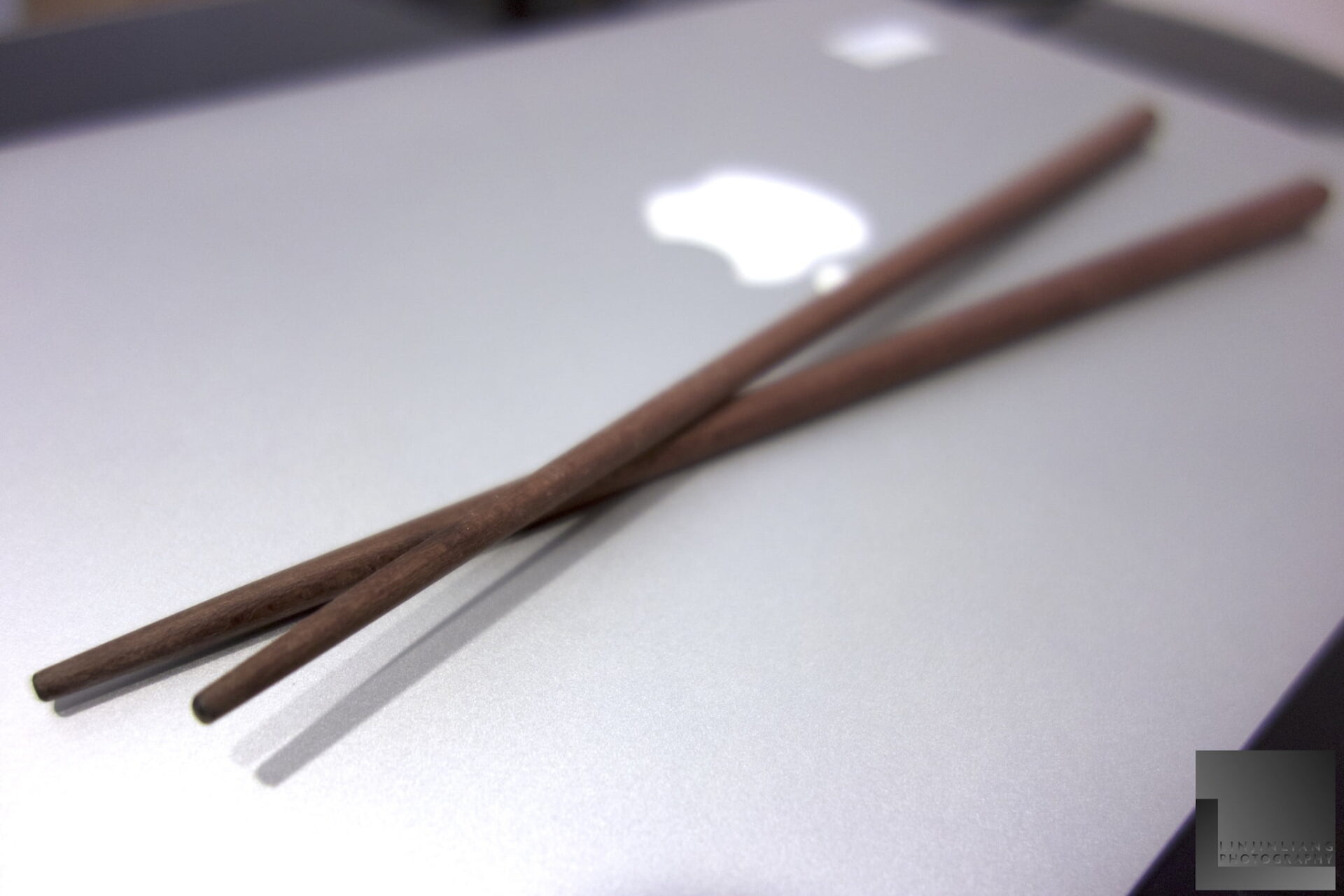 Wooden chopsticks (Image: Jinliang Lin)
Sensitive Mouths and Metal Chopsticks Don’t Mix
While titanium exhibits exceptional corrosion resistance and stability against acids and alkalis in atmospheric conditions, its naturally formed titanium dioxide (TiO₂) passivation layer undergoes anodic oxidation discoloration (“heat bluing”) when exposed to open flame. While a normal physicochemical phenomenon, this surface color shift often causes unwarranted safety concerns among everyday consumers.
The more critical consideration, however, is “thermal conductivity”. Within metallurgy, pure titanium (thermal conductivity around 21.9 W/m·K) and titanium alloys (around 6.7 ~ 7.5 W/m·K) are indeed poor thermal conductors compared to copper (~400 W/m·K) or aluminum (~237 W/m·K). Yet, once the reference point shifts to natural wood or bamboo (thermal conductivity of only 0.1 ~ 0.2 W/m·K), titanium still conducts heat dozens or even hundreds of times faster than wood or bamboo!
In outdoor environments like mountaineering and camping, we often expect gear to multitask—such as using chopsticks to stir boiling water, turn sizzling meat slices on a skillet, or double as cooking tongs. In these cases, heat quickly travels up the metal chopsticks directly to your fingertips. When picking up scalding food straight from a boiling pot into your mouth, the heat retained in the metal tip can easily burn sensitive lips (a disaster for anyone with a low tolerance for hot food).
Although some high-end outdoor brands offer hollow titanium chopsticks to reduce both weight and heat conduction, the manufacturing complexity and retail cost soar accordingly. For those who frequently cook outdoors and use chopsticks to stir-fry and taste-test, well-insulated wooden or bamboo chopsticks remain the simplest, most foolproof choice.
Rethinking Reusable Cutlery
While reusable eco-chopsticks were created to cut down on single-use waste, packing them around in a daypack and keeping them thoroughly sanitized on the go can be bothersome. In daily life, they aren’t always the most practical carry-on item.
Today, many restaurants provide reusable dining utensils, making personal chopsticks less of a necessity. Still, if you prefer personal hygiene control, a simple pair of stainless steel, bamboo, or wooden chopsticks remains my top recommendation.
They are inexpensive, lightweight, and easily replaced without hesitation—unlike pricey titanium sets that people feel guilty parting with.
Chopsticks should be treated much like toothbrushes: frequent use inevitably produces microscopic surface abrasions where microbes can settle. Regularly replacing them is far more important than obsessing over an exotic material (provided you avoid cheaply painted, chemically treated, or questionable mystery metals).
Finally, after testing and evaluating various outdoor eating utensils over years in the backcountry, I have personally reconsidered whether chopsticks are essential outdoors at all. Rather than carrying chopsticks, I find a versatile titanium spoon with multiple functions far lighter and more practical. For cutting duties, a standard pocketknife or hunting knife does the job.
Multi-functional “sporks” commonly found in outdoor outfitters may not ladle broth as neatly as a dedicated soup spoon, and their fork tines are modest, but for ultralight travel where versatility reigns supreme, sporks remain a highly efficient outdoor utensil despite their quirks.
One closing tip for international travelers: packing a spork or metal cutlery in carry-on baggage can occasionally cause issues at airport security checkpoints, as pointed tines may trigger safety inspections. While I have personally cleared security without issue, rules vary by airport and agent; be prepared for the possibility of having it confiscated if an agent deems it non-compliant.
Reader Q&A
Q1: Titanium is widely used in aerospace for extreme temperatures—how can you say it “conducts heat quickly”? Wouldn’t rockets melt immediately?
Reader Tim writes: Calling titanium a fast heat conductor makes no sense. Titanium’s hallmark is resisting high and low temperatures, which is why it’s used in aerospace. If it conducted heat quickly, wouldn’t a rocket melt before it even reached orbit?
Mizuc responds: What is the logical connection between a material’s “thermal conductivity” and its “temperature tolerance limit (melting point and high-temperature strength)”? Confusing these two distinct physical concepts is precisely where the misunderstanding arises.
First, in physics, when compared to copper (~400 W/m·K) or aluminum (~237 W/m·K), pure titanium (~21.9 W/m·K) and titanium alloys (~7 W/m·K) are indeed relatively low conductors within the metal family. However, this article compares titanium against everyday wooden and bamboo chopsticks (thermal conductivity around 0.1 ~ 0.2 W/m·K)! Titanium conducts heat dozens to hundreds of times faster than wood or bamboo. When grabbing scalding meatballs straight out of boiling broth, heat conducts rapidly into the chopstick tips and scalds your mouth—a clear, verifiable physical reality during camp cooking.
Second, invoking aerospace highlights another common misconception. Launch vehicle propellant tanks and airframes extensively use aluminum-lithium alloys—which have very high thermal conductivity (over 150 ~ 200 W/m·K)—to maximize weight savings and cryogenic toughness. Rocket thrust chambers and nozzles survive several thousand degrees not because their metals “resist heat transfer,” but because cryogenic liquid hydrogen or kerosene circulates through cooling jackets via “regenerative cooling”, alongside ablative linings and thermal barrier tiles. In fact, while pure titanium has a high melting point (1668°C), it readily reacts with oxygen and nitrogen above 500°C and suffers severe embrittlement. That is why rocket hot sections rely on nickel-based superalloys (such as Inconel) rather than titanium alloys.
Q2: Will hard titanium spoons or sporks scratch other metal camp cookware?
Reader Colman asks: Aren’t you worried that titanium spoons will scratch other tableware? I used a Snow Peak spork with a Belmont titanium mug as a bowl once, and it left lots of scratches. It hurt to look at; I’m thinking of switching to Kupilka pine composite tableware.
Mizuc responds: They certainly will! My older black anodized aluminum cookware was heavily scratched by hard metal utensils. Eventually, I upgraded my cookware to titanium to withstand scraping.
From a mechanics perspective, chopsticks and spoons behave differently: When picking up and prodding food, chopsticks frequently strike the pot or bowl at an “acute angle”, concentrating force onto tiny contact points and maximizing scratching risk. Spoons and sporks make contact at broader angles with wider surface distribution. Moreover, chopsticks are used continuously throughout a meal, while spoons or sporks are engaged selectively during outdoor treks.
If you use soft aluminum cookware with non-stick coatings, or care deeply about keeping the matte finish of expensive titanium cups pristine, switching to wood, bamboo, or composite tableware like Kupilka (natural wood-plastic composite) is an outstanding alternative that eliminates scratching while offering superior insulation and tactile comfort.
Extended Reading
- Product reference: Wabuki collapsible chopsticks
- The Rockwell hardness test is an indentation hardness testing method widely applied across manufacturing and scientific research.
Support Independent Perspectives & In-Depth Insights
Every thoughtful analysis and candid critique comes from our dedication to truth and quality. We choose not to follow sensational algorithms or clickbait headlines.
Sustaining independent research requires reader support. Make a one-time or monthly contribution, securely processed by Google.
Payments secured by Google · Manage or cancel anytime in your Google Account




Comments