
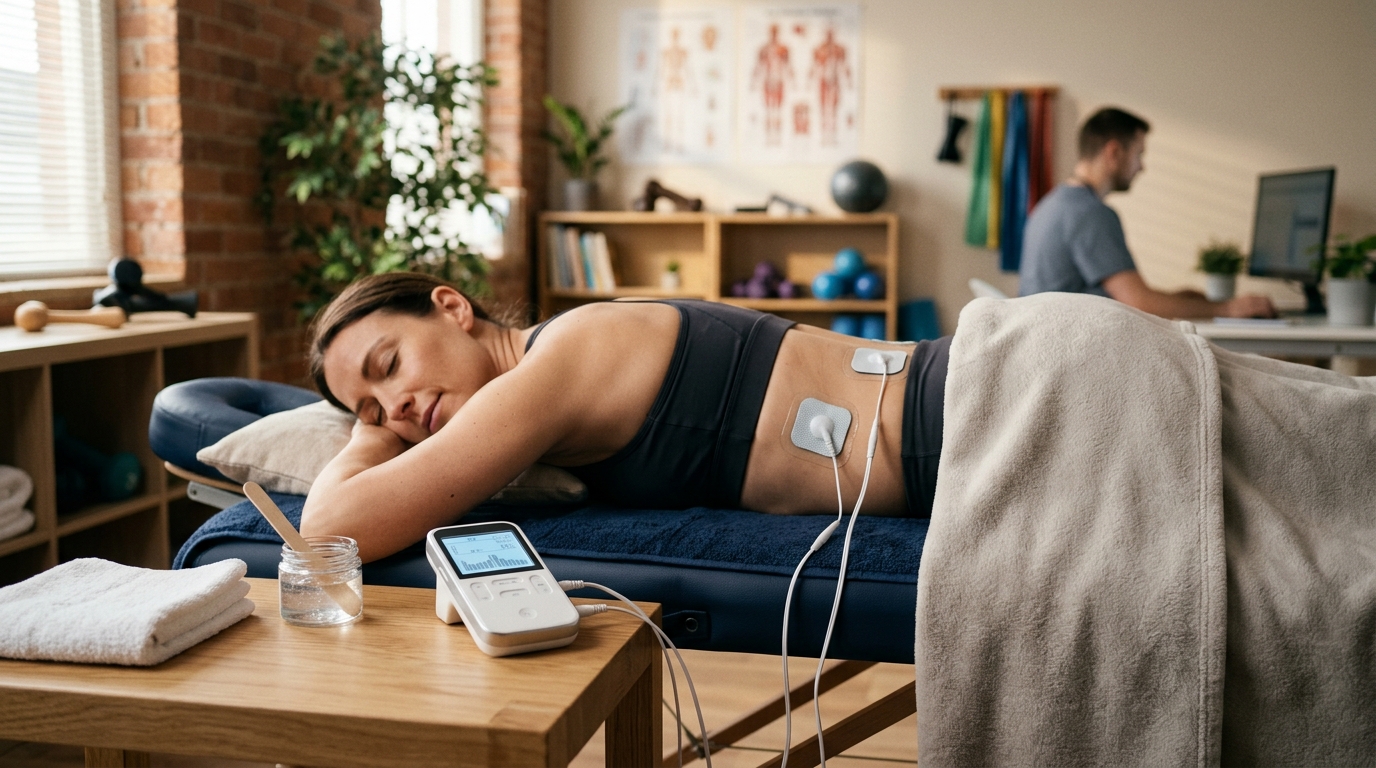
Are you also an office worker who sits in front of a computer for more than 8 hours every day, with shoulders and neck so stiff they feel like iron plates? Or a phone-huncher who spends long hours looking down at your phone or binge-watching shows? Facing the lower back pain, shoulder and neck soreness, and tight waist muscles brought on by prolonged sitting and standing, many people, when visiting a rehabilitation clinic or physical therapy center, have experienced a therapist placing two adhesive electrode pads on the affected area, accompanied by a tingling rhythmic sensation, and the once-tight, sore muscles gradually relaxing.
This device, widely used in clinical and home health care, is formally called a “TENS unit,” and is also known medically as a “Transcutaneous Electrical Nerve Stimulator (TENS).”
In the Ministry of Health and Welfare’s regulatory classification, a TENS unit belongs to “Class II moderate-risk medical devices,” with clearly defined physiological effects and current parameter setting specifications. This article will deeply analyze its neuroscience mechanism of pain relief, the standard steps for selecting a qualified medical device, and the fatal contraindications that must never be ignored when using it at home.
Neuroscience Decoded: How Does a TENS Unit Relieve Pain in the Human Body?
Many people think a TENS unit merely massages muscles through “electrical vibration,” but in fact its pain-relief mechanism is deeply rooted in the physiological regulation of the central nervous system:
1. Gate Control Theory
This is the most famous core theory in modern neurophysiology explaining electrical pain relief:
- The body’s pain signals are slowly transmitted to the dorsal horn of the spinal cord and the brain by slower-conducting thin nerve fibers (C fibers and Aδ fibers).
- The gentle pulsed microcurrent output by a TENS unit preferentially stimulates the fast-conducting, larger-diameter myelinated sensory nerve fibers (Aβ fibers) on the skin surface.
- When the “touch/tingling” signal conducted by the thick fibers reaches the spinal cord first at extremely high speed, it activates inhibitory interneurons in the dorsal horn, as if closing a “neural gate,” directly blocking at the spinal cord level the channel by which slow pain messages are transmitted to the brain, so the brain cannot receive the pain signal.
2. Stimulating the Brain to Secrete a Natural Painkiller: Endorphins
Clinical medical research has confirmed that when pulsed current of a specific frequency (especially 2–10 Hz low-frequency continuous waves) continuously stimulates the nervous system, it can induce the hypothalamus and pituitary gland to release a natural neuropeptide — “endorphins.” Endorphins have a morphine-like analgesic and sedative effect, comprehensively raising a patient’s tolerance for pain and bringing a sense of physical and mental relaxation.
Three Steps to Medical Device Safety: Recognize, Check, Use
Facing the dazzling array of products on the market touting “relieve fatigue” and “microcurrent massage,” consumers must strictly follow the safety principles recommended by the Food and Drug Administration of the Ministry of Health and Welfare when purchasing:
- Recognize (know the medical device):
Confirm that the product you intend to buy is a legal “TENS unit” with medical efficacy, not an unregulated general electronic toy or vibrating massager that has not undergone safety verification and arbitrarily claims efficacy. - Check (check the license):
The packaging box and device casing must clearly state the “medical device license number” issued by the Ministry of Health and Welfare (for example: 衛部醫器製字第 xxxxxx 號, 衛部醫器輸字第 xxxxxx 號), along with complete manufacturer name, address, product name, specifications, and manufacturing date. - Use (read the instructions carefully):
Before use, carefully read the medical device package insert (instruction manual) provided by the manufacturer, and set parameters according to the operating method instructed by a physician or physical therapist.
Accessory warning: never buy inferior off-brand electrode pads
Electrode pads are the medium that evenly conducts current into the human skin. If you buy cheap third-party pads of unknown origin to save money, the conductive hydrogel is often unevenly distributed or has excessively high impedance, causing excessive local current density — not only triggering contact dermatitis and severe redness and allergies, but possibly even causing electrical skin burns. Be sure to purchase genuine or manufacturer-certified compatible qualified electrode pads.
Three Golden Rules for Home Operation
| Core Operating Principle | Correct Practice and Key Details | Common Misconceptions and Potential Risks |
|---|---|---|
| 1. Correct placement | Electrode pads should be attached to both sides of the muscle belly of the sore muscle (for example, one above and one below, or one left and one right), so the current flows along the direction of the muscle fibers. | ❌ Never place them on the front of the chest over the heart, both sides of the carotid artery, the temples of the head, or the throat, otherwise it can easily cause a sudden drop in blood pressure or fatal arrhythmia. |
| 2. Gradually increase intensity | After turning on the power, the intensity must be gradually and slowly increased from the “lowest setting,” until you feel a slight involuntary muscle contraction accompanied by a gentle tingling sensation. | ❌ Mistakenly believing “the more painful, the more effective; cranking it to the max treats pain best.” Excessive stimulation can cause severe muscle spasms, strains, or even nerve fatigue damage. |
| 3. Control the duration | Treatment of a single area is recommended to be kept within 15 to 30 minutes each time, and no more than 2 times per day. | ❌ Attaching pads for hours while watching TV, or even sleeping with them on — prolonged electrolytic action can easily burn the epidermal tissue of the skin. |
The 12 Major Contraindicated Groups and Dangerous Situations That Must Never Be Ignored
Although a TENS unit is a gentle and effective non-invasive physical aid, under certain physiological and pathological conditions, the microcurrent introduced into the body may bring fatal consequences. Anyone meeting the following conditions is strictly forbidden from using it, or must first obtain evaluation and permission from a specialist physician:
- Those with an implanted electronic pacemaker or implantable cardioverter-defibrillator (ICD) (electromagnetic interference will cause the cardiac pacemaker to misread and trigger cardiac arrest!).
- Those currently connected to other electronic medical instruments (such as wearing a Holter monitor or vital signs monitor).
- Those with severe acute cardiovascular disease, a history of myocardial infarction, or severe hypertension.
- Patients with a history of epilepsy (electrical signals may induce abnormal brain discharges and convulsions).
- Women in early pregnancy or about to give birth (electrical stimulation of the waist, abdomen, and specific acupoints may induce reflex uterine contractions, increasing the risk of miscarriage and premature birth).
- Patients with acute fever (body temperature above 38°C) or in an acute infection phase.
- Patients who have just suffered an acute cerebrovascular event such as a stroke.
- Newborns, infants and young children, and those unable to express sensory responses on their own.
- The acute phase of acute spinal fracture, joint dislocation, acute ligament tear, or a freshly strained muscle (at this time the capillaries in the affected area are ruptured, and electrically stimulated contractions will worsen internal bleeding and swelling).
- Areas with open wounds, inflammation and pus, eczema, or contact dermatitis on the skin surface.
- Those with severe peripheral neuropathy or loss of skin temperature and pain sensation due to diabetes (unable to sense burns and excessive current, prone to invisible tissue burns).
- When the body is damp, just out of the bath, currently bathing, driving, or operating high-risk power machinery.
Clinical Case: A New Mother’s Warning About Overuse
In the FDA’s clinical safety promotion, a very representative real case was shared:
New mother Ms. Su works during the day and has to devote herself fully to caring for her young child after work. The heavy housework and the posture of holding her child left her suffering from backache and “mommy thumb.” Taking advantage of a long holiday, she bought a lightweight, portable, qualified TENS unit. When she first used it for 15 minutes, her muscle tightness indeed relaxed noticeably.
However, Ms. Su mistakenly thought, “The effect is so good, so using it more times and longer will surely heal faster,” and on her own extended the daily usage time without limit, even wearing it for one or two hours at a time. Unexpectedly, a few days later, the originally sore area not only did not improve, but deep muscle stabbing pain intensified, and when she peeled off the pads she found a large area of local skin redness, itching, and dense papules and blisters — suspected severe allergy and over-stimulation dermatitis from the current — which frightened her into quickly seeking treatment at rehabilitation and dermatology clinics.
This case gives us two important lessons:
- Single-use time must never exceed 30 minutes: TENS units of different models have different frequency and output energy designs, and prolonged continuous stimulation causes an “energy accumulation effect,” which not only over-fatigues and spasms muscle fibers but also damages peripheral nerve tissue.
- Never arbitrarily extend the time or increase the output intensity on your own: Treatment should follow the manufacturer’s package insert or a physical therapist’s prescription. When the body feels discomfort or the skin becomes abnormally red and swollen, you must immediately turn it off and stop using it and seek medical attention.
Tips for Cleaning, Maintaining, and Extending the Life of Electrode Pads
Electrode pads are the key consumable that ensures the microcurrent is safely and evenly conducted into the skin. Without proper maintenance, they often become covered with skin flakes and lint after just a few uses and lose their stickiness:
- Clean the skin before use: Before attaching, wipe the skin surface with warm water to wash away sweat, oil, or applied body lotion, preventing the hydrogel from losing adhesion too quickly.
- Light water cleaning when the pad is dirty: When the pad surface is covered with dust and skin flakes, you can dip a finger in “a tiny amount of clean water” and gently stroke the gel surface for a few seconds, shake off excess water, and let it air-dry naturally (never wipe with tissue or a towel, to avoid fibers sticking permanently), which restores most of the stickiness.
- Store properly to prevent drying: After each use, immediately stick the pad back onto the plastic protective film (backing) provided by the manufacturer, and store it in a sealed bag in a cool place to prevent the gel’s moisture from evaporating and becoming dry and hard.
- Replace when needed — don’t force continued use: If the electrode pad has lost its stickiness, its edges are curled, the hydrogel has yellowed, or there are cracks or damage, it means the conductive impedance is seriously imbalanced. Be sure to replace it with a genuine qualified new pad, and don’t be stingy and force continued use.
Conclusion: Scientific Use Is Medicine, Blind Abuse Becomes Harm
A TENS unit is an excellent soothing helper that modern physical medicine has given us, but it is by no means a miraculous device that can “cure all diseases.”
Only by clearly recognizing its auxiliary role of “relieving symptoms” rather than “curing the root cause,” strictly following the Ministry of Health and Welfare’s safety principles and physician’s prescription guidance, and avoiding the contraindicated zones, can you, on the premise of safety, truly bid farewell to the aches of modern life and welcome back a light and comfortable body!
Support Independent Perspectives & In-Depth Insights
Every thoughtful analysis and candid critique comes from our dedication to truth and quality. We choose not to follow sensational algorithms or clickbait headlines.
Sustaining independent research requires reader support. Make a one-time or monthly contribution, securely processed by Google.
Payments secured by Google · Manage or cancel anytime in your Google Account



Comments