
Apart from Christmas Eve, Christmas Day (and the enticing Boxing Day sales), the most buzzworthy topic online over the past few days has likely been the Council of Agriculture’s new mandate banning the use of reusable plastic crates for carrying eggs. Some media outlets even reported that convenience stores and traditional grocery stores would be prohibited from selling loose, bulk eggs, facing a NT$150,000 fine for every violation.
Let’s cut straight to the conclusion: whether downstream retailers sell loose eggs to consumers is not the primary target of this regulatory amendment. Rather, major wholesalers are no longer permitted to deliver eggs to retailers in reusable plastic crates (and please don’t ask me whether the delivery truck itself counts as single-use—that’s a terrifying thought)!
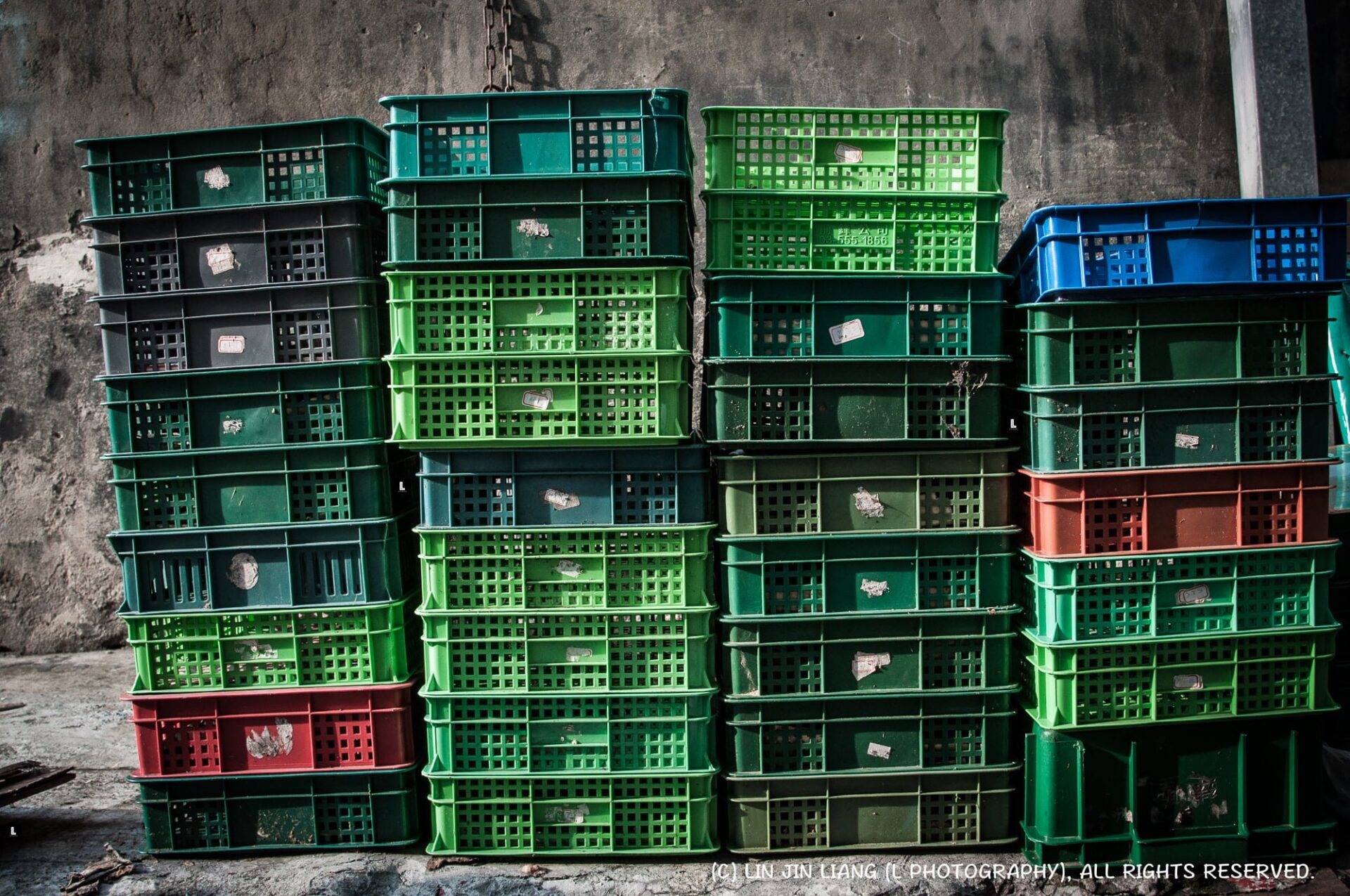
Colorful plastic crates used for carrying eggs (Photo by Jinliang Lin).
In short, egg-carrying containers must now be single-use! Therefore, the classic red-and-white plastic bags used by traditional grocery stores to bag eggs are already single-use packaging, so there is no legal risk of being fined (an edge case would be a remote mountain grocery store using its own reusable plastic basket to periodically deliver eggs to local residents).
Regarding egg containers—whether the traditional plastic crates of the past or the disposable plastic and paper pulp trays mandated for the future—both supporting and opposing arguments have merit. In fact, most points raised on both sides are valid, making it difficult to pick a single side.
However, some pointed out: “The government never said retailers can’t sell loose eggs; the media simply distorted the facts to chase traffic.” This statement is entirely accurate. Whether grocery stores or convenience stores will actually choose to sell loose eggs going forward is another matter altogether. They are legally permitted to, but whether they want to depends on their business considerations.
Consider the economics: suppose a single-use paper egg tray costs X, while a standard 10-pack plastic carton costs Y, where X is significantly greater than Y. Would a downstream merchant prefer paying higher packaging costs to sell you pricier loose eggs, or simply stock pre-packaged 10-egg cartons and compel you to buy in bulk?

Examples of smaller quantities carrying premium pricing are common in modern markets.
For instance, when traveling abroad, one quickly notices that buying in smaller portions is noticeably more expensive per unit, with price discrepancies far steeper than those seen in Taiwan.
Taiwan’s long-standing habit of buying loose eggs avoided this problem. Purchasing just one or two eggs not only accommodated single individuals or small households, but also kept living expenses lower. In Japanese convenience stores, for instance, you can find 2-egg single-use packs, but their unit price is considerably steeper.
As an aside, some clever downstream merchants might think about buying 10-pack cartons and splitting them open for individual sale. However, washed eggs have a shorter shelf life once unpacked, and disrupting established consumer habits poses distinct retail challenges, so we won’t dwell on that here.

Many observers evaluate this policy solely through their personal shopping routines and the eggs they encounter daily, overlooking the sheer scale of the egg supply chain in Taiwan and the vast number of businesses that rely on it.
According to egg industry experts, up to 100,000 egg crates circulate across Taiwan every single day! Switching to disposable trays introduces a serious logistical problem. Traditional plastic crates held large volumes of eggs securely, allowing bulk sales or direct delivery to local eateries while maximizing cargo space. Once switched to softer, disposable packaging, the volume of eggs each transport vehicle can safely haul decreases significantly. Maintaining the existing supply volume would require at least twice as many delivery trips.
Furthermore, breakfast diners, small eateries, and street food stalls with heavy daily egg usage will need significantly more secure storage space to store these disposable containers.
Inevitably, looking across the broader market, retail egg prices will climb. Even if durable, heavy-duty disposable containers are adopted to preserve per-trip cargo capacity, such packaging comes at a substantially higher cost.
Proponents of the policy argue that disposable packaging effectively cuts off avian influenza transmission routes, asserting that food safety and hygiene take priority over environmental waste concerns.
Honestly, both viewpoints carry strong rationales. However, shouldn’t infection control primarily be handled at the source—through rigorous disease control on poultry farms, proper sanitization during egg washing, and standardized sterilization protocols for reusable plastic crates?
Or is the government implicitly telling us that these baseline sanitation procedures were never properly managed, and that there are no plans to enforce them?
Support Independent Perspectives & In-Depth Insights
Every thoughtful analysis and candid critique comes from our dedication to truth and quality. We choose not to follow sensational algorithms or clickbait headlines.
Sustaining independent research requires reader support. Make a one-time or monthly contribution, securely processed by Google.
Payments secured by Google · Manage or cancel anytime in your Google Account



Comments