
Taking advantage of the last free time before school started at the end of August, I took my mom and my brother’s two children on a three-day, two-night road trip around Hualien and Taitung.
Driving along, stopping and going, heading south along the mountain route of Provincial Highway 9 and then connecting to the coastal route of Provincial Highway 11 to return north, we leisurely circled the whole of eastern Taiwan. This is my personally much-loved “cruising” rhythm — speeding along the eastern coastline and rift valley plains without the pressure of traffic lights, listening to the low hum of the engine and the waves hitting the shore, is itself an ultimate enjoyment that soothes the soul.
However, for my elementary-school nephew and niece, who are at an active age, a long car ride may not count as a very interesting task. But I have always believed that learning to be alone with the flowing scenery outside the window and cultivating patience while in motion is also an extremely important part of travel education. Fortunately, the two children were highly cooperative, perfectly carrying out the highway philosophy of “sleep when on the car, pee when off the car,” allowing the whole journey to proceed smoothly in harmony.

Entering Hegang: An Encounter with the Origin of the King of Mid-Autumn Fruits
Friends familiar with the geography of Hualien and Taitung surely know that heading south along the mountain rift valley of Provincial Highway 9, after passing near the Ruisui Hongye Hot Spring area, you enter the simple foothill settlement of “Hegang.”
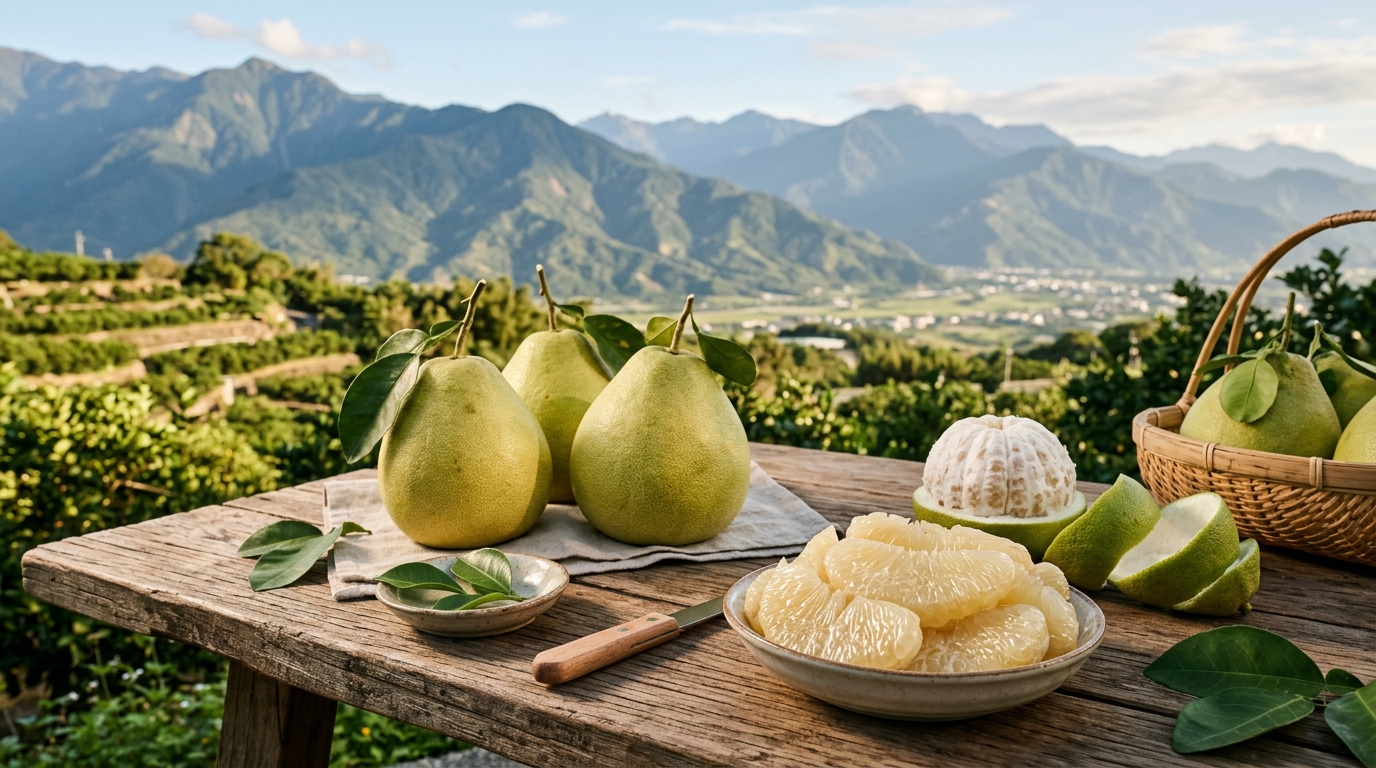
If you happen to be a gourmet who values seasonal flavors, hearing the two words “Hegang” will probably trigger the same reflex association in your brain as hearing “Ruisui” immediately brings to mind fresh milk — that’s right, the mountains of verdant orchards that greet your eyes are precisely the indispensable king of fruits every Mid-Autumn Festival: pomelo!
As the car passed through the Hegang production area, we stopped by a tourist orchard shop. I usually practice minimalism when traveling and rarely casually buy local souvenirs, but today there was an extra person in the car: my mom. Everyone knows that the main pleasure of the creature known as “mother” when out and about is often to buy this and that, eat and drink, with the duty of pleasing the grandchildren’s stomachs.
So, as my mom activated her “social radar” and enthusiastically chatted up the local vendors and fruit farmers, the topic unknowingly turned to the controversial photo that had been hotly debated on social media at the time — “Why are there large trucks with Tainan Madou license plates grandly driving into the Hualien Hegang collection yard to haul pomelos?”
Madou Trucks Coming to Hegang to Haul Cargo? Unveiling the True Face of the Pomelo Industry Chain
At the time, images of large trucks carrying cargo across counties circulated online, and many netizens instinctively cursed, “This is simply selling dog meat under a sheep’s head,” and “Madou pomelos are all Hegang pomelos with relabeled origins.”
In the Hegang orchard, an enthusiastic local small farmer smiled and revealed to me: “Actually, every year during the late-August harvest season, this kind of large truck from central and southern Taiwan coming to the production area to haul cargo has long been the norm for years.” To unravel this “who is who” myth, we must first clarify two basic concepts in agronomy that are most often confused: “variety name” and “origin name.”
1. “Madou Pomelo” Is a Botanical Variety Name, Not a Tainan Patent!
Many people mistakenly believe that only pomelos grown in Tainan Madou can be called “Madou pomelo,” which is a huge misunderstanding.
In Taiwan’s agricultural variety classification, the legal official variety name of the commercially cultivated pomelo throughout Taiwan is “Madou Pomelo (Citrus grandis Osbeck cv. Matou Wentan)”! Whether it is Tainan Madou, Hualien Ruisui Hegang, New Taipei Bali, Miaoli Xihu, or Yilan Dongshan, the vast majority of the tree seedlings planted by farmers across Taiwan are all of the “Madou Pomelo” variety.
Therefore, the Hegang production and marketing group printing “Hegang Madou Pomelo” on the boxes refers precisely to “the Madou Pomelo variety grown in Hualien Hegang,” which is fully defensible in law and agricultural product labeling.
2. Why Do Madou Dealers Cross Mountains and Seas to Buy Cargo in Hegang?
- A Huge Gap Between Supply and Demand: Although Tainan Madou has the longest history and the most resounding fame, Madou’s cultivated land area and output are extremely limited. Every Mid-Autumn gift-giving peak season, corporate bulk purchase orders are enormous, and Madou’s local output simply cannot meet the demand of channels across Taiwan.
- Natural Disaster Risk Allocation (Such as Typhoon Emergency Harvesting): Once the south is hit by strong winds and torrential rain such as Typhoon Soudelor, Madou suffers severe fruit drop, and dealers, in order to fulfill contracted supply volumes, will inevitably turn to the Hegang production area in the Hualien-Taitung Rift Valley, which has abundant output and stable quality, to transfer goods for emergency response.
- Legal Circulation vs. Unscrupulous Origin Laundering: Legal commercial allocation is the daily routine of agricultural trading houses across Taiwan; the real illegal controversy lies in a small number of unscrupulous middlemen who, after hauling Hegang pomelos back to the west, maliciously repackage them into outer boxes printed with “Tainan City Madou District Farmers’ Association / Madou Origin Traceability” in an attempt to deceive consumers with the price difference of origin. This is a fraudulent act of false origin labeling, but it absolutely does not mean that the quality of Hegang pomelos themselves is inferior to Madou’s.
Showdown of the Two Champions: Tainan Madou vs. Hualien Hegang — A Grand Comparison of Terroir and Taste
Since the varieties come from the same lineage, what flavor difference is there between the pomelos grown in Taiwan’s two great pomelo holy lands, one in the west and one in the east? This depends entirely on the “terroir” bestowed by nature:
| Comparison Dimension | Tainan Madou Pomelo | Hualien Hegang Pomelo |
|---|---|---|
| Geographic Environment and Soil | Downstream plain of the Zengwen River basin, with deep deposits of clayey alluvial soil and strong fertilizer retention | Sunny slopes on the west side of the Coastal Range in the Hualien-Taitung Rift Valley, with gravelly sandy loam of excellent drainage |
| Irrigation Water Source and Climate | Abundant sunshine and high temperatures in southern Taiwan, with rapid fruit development | Pure snowmelt mountain streams of the Xiuguluan River, with large day-night temperature differences in the Hualien-Taitung Rift Valley |
| Tree Age Advantage | Old-tree age unsurpassed in all of Taiwan (generally over 30 to 50 years) | Introduced in the 1960s, now mostly vigorous trees in their peak production period of 25 to 40 years |
| Fruit Shape and Appearance Features | Relatively small fruit, wide base like a roly-poly toy, thin skin with fine, dense, and smooth oil cells | Relatively plump and large fruit, with three-dimensional and clear oil cells on the skin, resistant to storage and not easily shriveled |
| Flesh Texture and Flavor | Soft and tender flesh that melts in the mouth, extremely high sweetness (11–13 degrees), with a sweet aftertaste | Springy, firm, and juicy flesh, with a balanced golden ratio of sweet and sour, carrying a bright, fresh fragrance |
Simply put:
- If you pursue the ultimate soft, tender, and sweet delicacy that melts in the mouth, the Tainan Madou old-tree pomelo that has weathered half a century is absolutely an impeccable top choice.
- If you prefer a rich layering that quenches thirst, is juicy and springy, and carries a slightly sour sweetness, then the Hualien Hegang pomelo, which absorbs the pure mountains and waters of Hualien-Taitung and shows a more lively sugar-acid ratio, is actually less likely to make people feel cloyingly sweet.
The Soul Key to Delicious Pomelos: Not Eating Them Freshly Picked, but “Shui-Shui” (Water Release)!
For a long time in the past, I held an indifferent “just so-so” attitude toward pomelos, always feeling that they were merely a festive fruit bought for the occasion, often with dry, hard, sour, and astringent flesh full of fibrous residue, and I had never even had the urge to actively buy them for the sake of “deliciousness.”
It was not until this trip to Hualien and Taitung, chatting at length with fruit farmers, that I suddenly realized: it turns out we had all been eating them at the wrong time!
The biggest key to a delicious pomelo lies in this soulful process after harvest — “shui-shui” (commonly known in Taiwanese as water release).
What Is Shui-Shui? Pomelos are usually harvested around “White Dew” in the 24 solar terms. A pomelo just picked from the tree has a plump, fresh green skin with taut oil cells; at this time, the flesh contains too much free water and tannic acid, so it will definitely taste dry, astringent, and coarse.
After harvest, the pomelo must be left to rest in a cool, ventilated place for about 7 to 14 days. During this period, the moisture inside the skin naturally evaporates and metabolizes, and the originally emerald, taut skin gradually turns withered yellow, grayish, and develops fine wrinkles on the surface.
Once shui-shui is complete, although the skin looks uglier and older, a miracle happens at this moment: after the excess moisture in the skin recedes, the sugar is fully concentrated and condensed into the center of the flesh, and the originally tough flesh fibers transform into soft, crystal-clear water droplets; biting into it bursts with juice and sweetness, with an aroma that assails the nostrils!
Therefore, do not rush to open and eat the pomelos bought home for Mid-Autumn Festival on the same day. Choosing ones whose skin has already turned yellowish and slightly wrinkled, or leaving them in a ventilated place at home to wait for a week of water release, is the true connoisseur’s secret to tasting the divine texture of pomelos.
The Four Golden Rules for Selecting High-Quality Pomelos
Finally, whether you plan to buy Tainan Madou or Hualien Hegang this year, as long as you master the following four selection techniques, you are guaranteed never to step on a landmine:
- A Heavy Feel Is More Important Than Size: Weigh them with both hands; for pomelos of the same size, the heavier one means the juice inside is fuller and more abundant (the ideal golden weight for a single fruit is about 400–600 grams; those that are too large often have coarser flesh).
- The Shape Should Be Like a Triangular Roly-Poly Toy: Choose the pear-shaped, teardrop form with a “wide, flat base and a short, narrow neck,” with the center of gravity standing steadily on the table without tilting; such fruit develops most evenly.
- The Finer the Skin Pores (Oil Cells), the Better: Run your fingers over the skin; those with fine, smooth oil cell dots usually come from older trees, and the flesh is sure to be more tender and melting.
- Wrinkled, Yellowish Skin Is Exactly the Peak Flavor Period: For gifts, you may choose slightly green, fresh ones that are easy to store; if the family is going to enjoy them right away, boldly choose pomelos with “yellowish, slightly wrinkled skin” that have completed shui-shui — that is the golden peak of sweet, juicy flavor!
Support Independent Perspectives & In-Depth Insights
Every thoughtful analysis and candid critique comes from our dedication to truth and quality. We choose not to follow sensational algorithms or clickbait headlines.
Sustaining independent research requires reader support. Make a one-time or monthly contribution, securely processed by Google.
Payments secured by Google · Manage or cancel anytime in your Google Account


Comments